
Intergalactic Torture Chambers
Why factory farms may spread to the stars

(Reminder, I’m having a midtown manhattan meetup/phone-bank for Bores at 5 today. Come by, it will be a blast and also impactful. RSVP here to see where it is).
Every day, hundreds of millions of animals are slaughtered after undergoing a lifetime of intense suffering. Even just counting land animals, that’s about 1.4 billion animals slaughtered every week. In just one year, we kill more animals than people have lived throughout the entirety of human history.
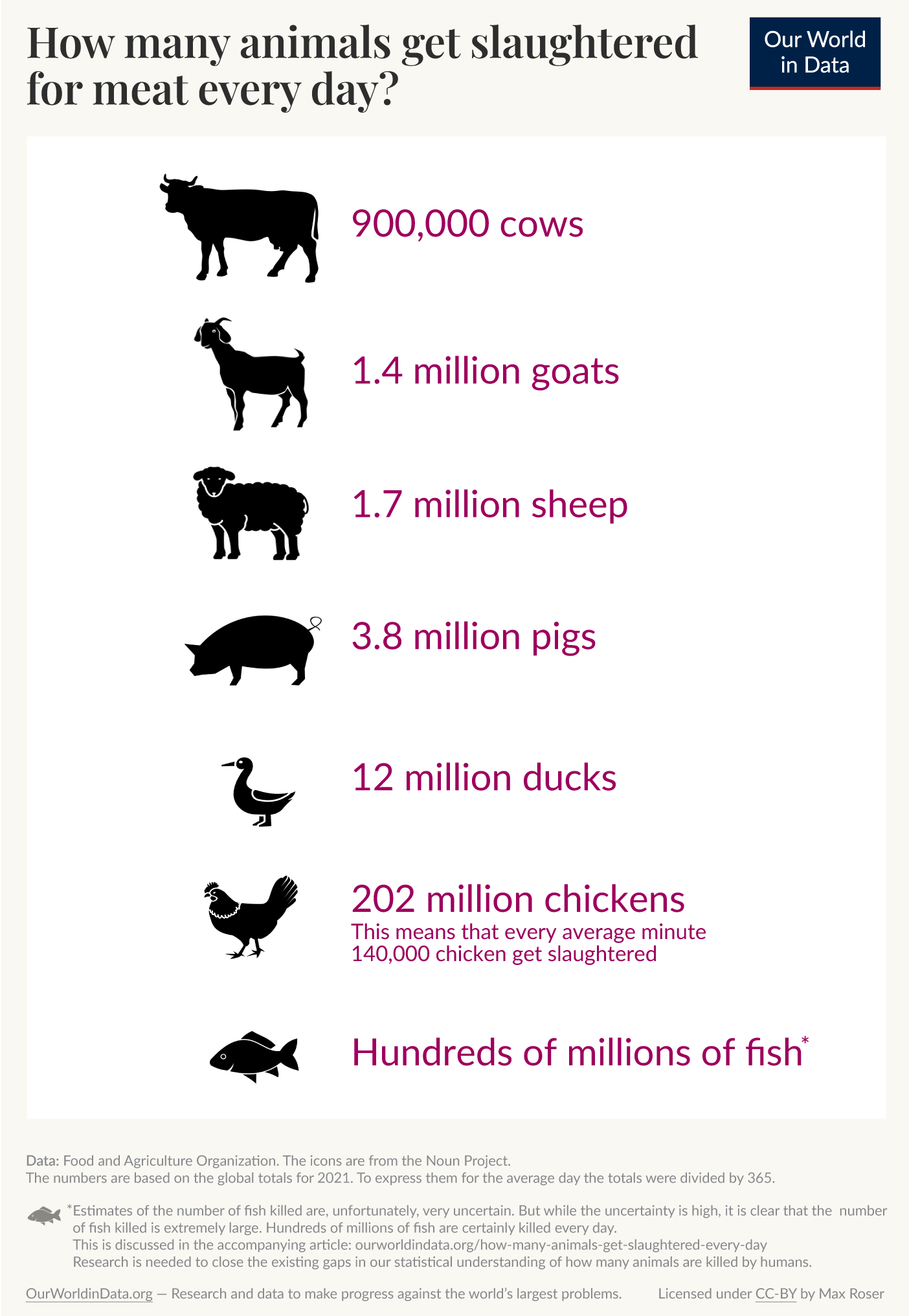
The animals are treated horribly. They’re genetically engineered so they can barely move. Their bones are broken repeatedly. They live in filth and feces, choking on ammonia all day and getting burned by the acidic feces of those around them. Billions of baby male chicks are ground up alive. The lives of the animals are worse than those of any group of humans on Earth, unless those humans live in torture chambers. You’d be arrested if you treated a dog this way.
Words cannot do justice to the horror. More suffering is caused in a few years by factory farms than all the suffering in human history. This is much worse than anything we do to other humans—billions of innocent, defenseless creatures tortured for their whole lives just because we enjoy the taste of their flesh.
But it’s still not the worst thing.
No, the worst thing would be if factory farms stuck around and spread. If their hellish, cancerous rot spread throughout the galaxy—so that their cries would ring out on a quadrillion worlds, for a trillion years. The worst thing would be if we did this entirely unnecessarily, for no benefit. At that point, even an all merciful God could not resist obliterating creation.
At that point, we wouldn’t just have built hell, but filled the universe with it—bringing screams to a thousand silent worlds. We would have brought those dark satanic mills through the void of space, so that no reachable world was free from vulnerable creatures crying out in pain. At that point, there would be some deep sense in which the fight for good was lost, where evil ultimately triumphed, on a cosmic scale.
If factory farming occurred at the scale it does on Earth across 1,000 worlds, then around 80 trillion land animals would be tortured annually. It would take half a day to slaughter a population equal to the number of people who have ever lived. And if meat consumption rises with abundance, the real numbers might be far more.
But 1,000 worlds is a dramatic underestimate of the expected number of future worlds where we’ll factory farm animals. There is some probability that we’ll spread humans to and terraform a non-trivial portion of the reachable universe. Toby Ord estimates that we could reach about 10^21-23 stars. If these stick around for a trillion years and we assume that there are 1,000 planets per star (given the possibility of constructed planets), we end up with 8x10^46 factory farmed animals.
We may be entering that world.
If factory farming isn’t replaced, then by default, it will spread to the stars. We won’t automatically stop farming cows, pigs, and chickens just because we venture away from Earth. So the question is whether we’ll replace factory farming.
Now, the good news: there’s a perfectly good alternative. It’s called lab grown meat. It involves growing meat without needing to torture and slaughter an animal. It has the taste and consistency of meat—it will be identical at the cellular level to standard meat. The only difference is that it did not come off the flesh of a tortured and murdered animal who thrashed in agony and terror as it was bolt-gunned in the skull, who didn’t want to die.
You’d think support for it would be a no-brainer. Humans enjoy the taste and consistency of meat. With lab-grown meat, we’ll be able to produce it without the torture. This has all the upside of ordinary meat and none of the downside. So what has the world done about it? Have we invested billions of dollar trying to produce it? Has there been a great research project taken by popular governments?
No. In fact, it’s been banned in a number of U.S. states. The Save Our Bacon Act, currently being battled over in Congress, prohibits state bans on meat products, but leaves out any prohibition on lab meat bans. Lab grown meat became a culture war issue. Some people find it icky. They don’t want to eat it, even if it’s cheaper. They only eat flesh that came off a living sentient being.
So already, we’re doing nowhere near enough to accelerate lab grown meat. But still, it seems reasonably likely that we’ll develop it at some point. Maybe 80% odds, I’d guess, that we find some way to produce meat without needing to torture billions of animals.
But after that, we have to actually eat lab meat instead of the flesh of mistreated animals, in order for it to replace ordinary meat. And that’s where the deeper problem lies. AI might solve the technical problems of lab meat, but there’s no guarantee people would eat it. While most people in the U.S. and UK say that they would try cultivated meat, only about 13% said they’d prefer to eat it over regular meat.
Now, who knows how this would really go? People’s trust in a technology tends to increase after the technology is created. Before computers, people generally didn’t see much use for them—now, almost everyone has one. Surveys provide only imperfect evidence. But still, if people have such profound contempt and fear for lab meat that in a number of states it’s illegal to make a cultivated hamburger, it’s hard to be extremely confident that factory farming will end. If there’s a 70% chance that cultivated meat would displace factory farming if it was developed, and an 80% chance that it’s developed, then the odds that it will replace factory farming are only 56%.
It could, of course, end in other ways. But I find it hard to be very confident that factory farming will end through any other mechanism. My guess is that it’s about a coinflip whether factory farming spreads to the stars—whether hell goes intergalactic. Maybe 60% odds that factory farms are eventually abolished. Lewis Bollard, one of the most experienced and careful animal activists, thinks that the end of factory farming is neither impossible nor inevitable.
In What We Owe The Future, Will MacAskill argues that the end of slavery wasn’t historically inevitable as we often now think. The end of slavery depended, in large part, on persuasive moral appeals from activists. The end of slavery didn’t depend primarily on economic factors—when it was abolished, the slave industry was highly profitable and was growing rather than contracting. In fact, the British government spent about 40% of their annual treasury expenditure paying off slave owners. And after abolishing slavery internally, Britain worked hard to get it abolished in other European countries, which makes no sense if they had primarily economic motivations.
Moral shifts don’t just happen. Sometimes they happen by default, but we shouldn’t be so confident that they will happen by default that this gives us license to stop fighting. Even if the odds that factory farms would spread intergalactically were only 10%, this would still be a moral emergency of cosmic proportions.
And those fighting for farmed animals have been amazingly successful. Each dollar spent on corporate campaigns has spared animals from many years in a cage. About 50 full-time activists have managed to shift the practices of a multi-billion dollar industry, affecting hundreds of millions of animals every year. This comes out to millions of animals affected per full-time activist pushing for these reforms.
How does knowing that factory farms might persist change the priorities we should have?
Some Longtermists think that fighting against factory farming isn’t a big deal from a Longtermist perspective. But this becomes hard to maintain once you realize that the factory farms might stick around for trillions of years and spread through space—that the next few decades might be the most important time in history for farmed animals, that will determine their eternal fate.
It becomes especially hard to maintain when one thinks about how a world where most biological organisms rot in hellish torture chambers is likely to treat other sentient beings. If we can’t even treat biological beings with any modicum of compassion, what hope is there for digital ones?
It is terrifying that the end of factory farms may not come until humanity is extinguished entirely. It makes the fight all the more urgent. The hell that exists on Earth today may soon spread to the stars.
Insightful piece! I'd add that there are already lots of research projects working on bringing factory farming to space.
The Lunar Hatch project is working on bringing fish factory farming to space and this article says Chinese researchers are too: https://www.theguardian.com/environment/2025/apr/28/sea-bass-in-space-lunar-hatch-fish-farms-moon-aquaculture
The European Space Agency is working on bringing insect factory farming to space: https://www.esa.int/Science_Exploration/Human_and_Robotic_Exploration/Insects_on_the_space_menu
One huge benefit of cultivated meat will eventually be the ability to custom design meat. Evolution has optimized muscle tissue for the animal's survival, not for the taste preferences of people who kill the animal and eat it. (That might actually be selected against.) All sorts of factors figure into taste -- muscle fiber orientation, length, marbling of fat, etc. That's why people have preferences for different cuts of meat. But I presume that all of that could be custom designed and probably augmented. Why not use some alternative fat instead of cow fat in beef? Marble it differently, depending on how you cook it. Or no fat at all? Have largely parallel muscle fiber orientation, with 12% crossing fibers. Maybe 23%. Maybe 75%, just to have a crazy steak. Go for it -- the possibilities are endless. Once all these design options become feasible, I could imagine master chefs custom designing meat. Sure, many people now think they would try it (because it is novel) but not regularly eat it (because it is weird and maybe a little icky), but if it cheaper, customizable, tastes better, and endorsed by celebrities, it will presumably catch on. Although it is an unfortunate metaphor here, if you build a better mousetrap . . . .
BTW, "cultivated meat" or "cultured meat" something similar is probably a better term than "lab-grown meat" since it eventually will be grown in some sort of production facility, not a lab.