
There Aren't Any Good Arguments Against Lab Meat
If we can replace the factory farms that torture animals by the billions, we should!

1 Introduction
Lab-grown meat is meat produced directly from animal cells, so that an animal doesn’t need to be bred and slaughtered. It allows people to eat meat without needing to farm animals. And yet it is widely hated. Many states (in response to lobbying from big agribusinesses) have even gone so far as to ban it. Here’s what John Fetterman said about why he supported the ban:
Fetterman: Yeah, I just think as I’m a member of the agriculture committee, and I really stand with our farmers now. And of course we don’t want like the factory farm situation, absolutely opposed to animal cruelty, but for me if I lived on Mars, you know, those kinds of, the kind of, what’s the lab meat would be a great opportunity, but for me right now, like.
Maher: But you want to ban it? I mean, shouldn’t people have the right to eat it?
Fetterman: It’s like actively, I mean if people have a chance to present that, but overall, for me, I think, you know, someone that’s really, I thought, the really highly highly processed food, I mean, that’s exactly the instance of that.
Apparently “big ag paid me money,” wouldn’t fly as an explanation on TV, so we got…whatever that was.
Here’s what I want to convince you of in this article: there is no intellectually serious objection to lab-grown meat. When lab-grown meat is available at your local supermarket for a comparable price, you should buy it instead of regular meat. Lab meat is a very good thing, and it should replace conventional meat.
Many issues in the world are complicated. There are even complicated questions about lab meat. It’s not obvious when it will be cheap enough to compete against normal meat. In general, on empirical topics, people should refrain from being confident. But here, the case for lab meat being a good thing is totally decisive.
2 Why lab meat?
There are a number of major reasons to support lab-grown meat.
The biggest one is that it could end factory farming. Right now, billions of animals languish in hellish conditions. They dwell in feces. They are mutilated: dehorned, castrated, branded, and debeaked. They’re systematically starved. They’re genetically engineered so they can barely walk. Huge portions of them languish in cages. They don’t have enough space to turn around.
The most intense pain humans undergo in their lives is disabling pain. This might accompany childbirth or a painful surgery. The best report on animal pain guessed that factory farmed chickens undergo about an hour a day of this. 99% of animals are factory farmed, so the main effect of lab meat is displacing factory farming.
So in short, every year we torture a population of animals greater than the number of people who have ever lived. Experiencing intense pain is really bad, no matter your species or your level of intelligence. The reason it’s bad to be in intense agony doesn’t have anything to do with how smart you are—infants feeling pain is bad even though they aren’t very smart. Intuitively, what’s bad about hurting is how it feels, so if animals hurt like the rest of us, their pain is comparably bad.
Factory farming is probably the cause of more intense pain in a few years than all the suffering in human history. If that pain is bad for the same reason human pain is, then factory farming is much worse than all human suffering ever in world history. Lab meat could replace factory farming, and prevent a number of animals equal to the human population of the United States from being killed every day.
Imagine if every single person on Earth at any given time was torturing three dogs in their basement. Every few months, they’d painfully kill one of the dogs and replace them. That’s roughly the scale of land-based factory farming. Ending this might reduce more suffering than any other event ever in world history.
There are some other upsides too. Factory farms are a major pandemic risk. Most new diseases come from animals. With sick and injured animals penned up in close quarters, it’s almost the ideal environment for starting new pandemics. Swine flu, which killed hundreds of thousands of people, came from pig farms. Multiple influenza strains have emerged from poultry farms—both H5N1 and H5N2.
Along these lines, lab meat could minimize use of antibiotics. About 75% of antibiotics are used in meat production. It’s cheaper to flood animals with antibiotics than to maintain conditions that prevent them from needing them. This leads pathogens to develop resistance to antibiotics. Antibiotic resistance contributes to about 4 million deaths a year, potentially nearer to 10 million by 2050 (it directly causes over a million deaths annually). Lab meat wouldn’t require such vast antibiotic expenditure, and could thus prevent millions of annual deaths.
There’s also a health benefit. With lab meat, one has the ability to custom design specific meat products. This can allow them to make meat with a more desirable nutrient profile—higher in protein, lower in fat, higher in essential vitamins.
3 Is lab meat gross?
One reason that John Fetterman supports making it illegal for people to eat lab-grown meat is that he finds it gross. Should we similarly outlaw other foods that Fetterman finds gross?


Reply: btw, this is the thing that makes conventional meat.
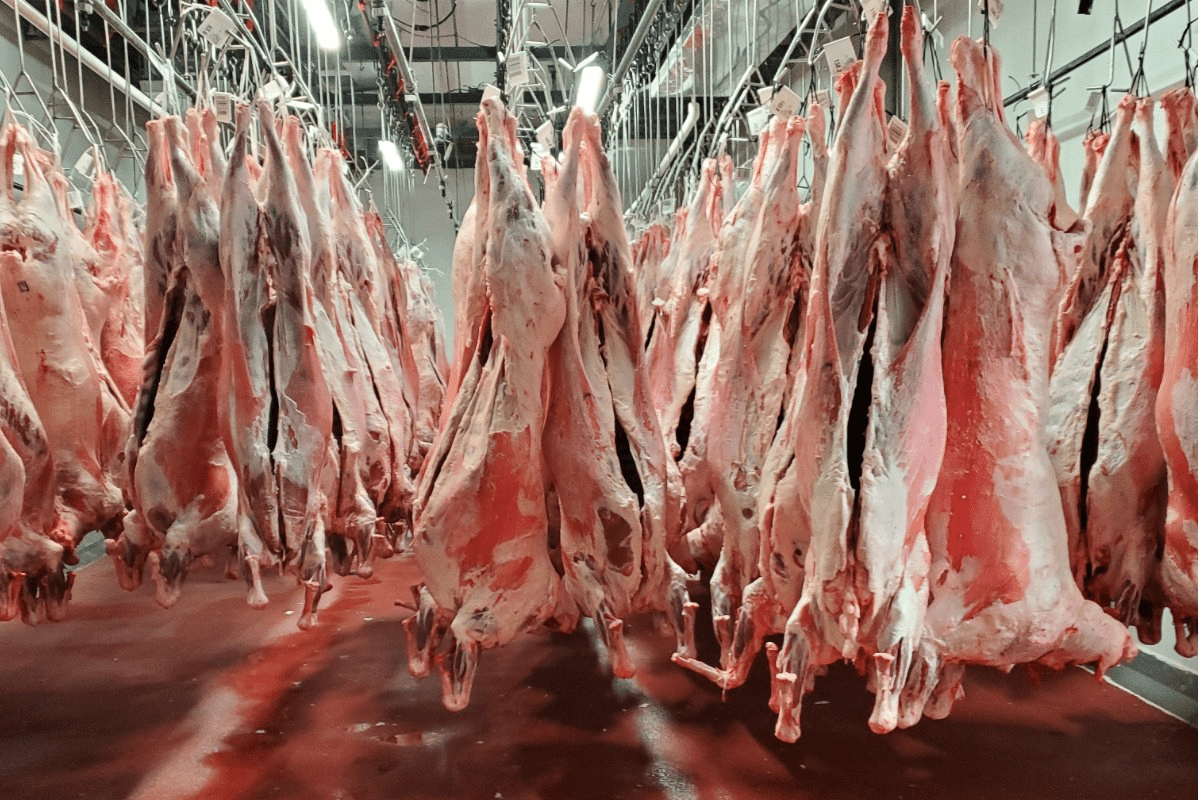


I really don’t think that people eating conventional meat want to play the “is it gross?” game.
Put aside the initial apparent grossness of eating someone else’s body, soaked in their blood. And not just someone else’s body: the body of someone who lived in a noxious admixture of piss and feces for her whole life, who got horrible lung conditions, who had festering open wounds for much of its life, for whom the mere sight of its grisly death would ruin your appetite. And we’re supposed to be nauseated by machines?
29% of slaughterhouses aren’t adequately compliant with hygiene standards. One analysis stated “The breaches include a significant level of faecal contamination of carcasses, failure to wash knives, and failure to stain animal byproducts so they are identifiable as unfit for human consumption.”
Fecal contamination is an especially big problem. When animals live in shit for their lives and you cut through their innards, fecal contamination is a common result. Nearly all beef contains bacteria that comes from feces. One consumer report suggested:
All 458 pounds of beef we examined contained bacteria that signified fecal contamination (enterococcus and/or non-toxin-producing E. coli), which can cause blood or urinary tract infections.
They add a product colloquially known as pink slime to standard beef. Raw meat is so gross that if you eat it, it will give you horrible diseases.

Put in one sentence: I don’t think meat from a machine is more gross than the flesh of a tortured animal who lived in poo for its whole life, that usually contains bacterial contamination from the aforementioned poo.
4 Cost?
Currently, lab meat is more expensive than regular meat. Might cost be a long-term prohibitive barrier?
It will also probably be cheaper eventually. Lab meat costs have declined dramatically over time. While it’s hard to forecast exactly when it will become cost competitive, some estimates say this could come as early as 2030. Given that lab meat cuts costs on feeding the animals, we should expect, in the limit, it to be cheaper. While some estimates forecast it being more expensive, these generally assume something like a continuation of the current paradigm—without new technological innovation.
But in any case, my aim in this article is to defend the claim that once lab meat is cost-competitive, there won’t be any serious objections to it. Exactly when that will be is hard to forecast. Whenever that is, however, you should never eat conventional meat again.
5 Environmental impact
About a year ago, there was a flurry of news coverage directed at a study which found that lab meat is much worse for the environment than standard beef.
The big problem: the study wasn’t very good. The study assumed that cultivated meat would be made with pharmaceutical-grade ingredients, even though the industry isn’t planning on using those and doesn’t currently use them mostly. Its estimate of the emissions from lab meat was based on a 2010 paper that vastly underestimated how clean the grid was (because, you know, it was written when I was six years old). As Elliot Swartz of the Good Food Institute writes:
It is simply not possible to bring cultivated meat to market using pharmaceutical-grade inputs. This is known by everyone in the industry, so attempting to portray this as a realistic scenario is neither accurate nor beneficial to the analysis.
Lab meat won’t be economically viable if their product requires enormous energy expenditures. So the kind modeled isn’t actually the kind that would be used.
In general, other studies tend to paint a rosier picture. The most detailed study relying on detailed insider industry information estimated that lab meat would have lower emissions than conventional meat. Other studies said that it wasn’t really clear how it would compare. In general, you should be wary about predicting high energy expenditures from a technology before it exists. Once it exists, there are likely to be sophisticated innovations that cut energy expenditures.
Overall, my guess is in expectation that lab meat is somewhat better for the environment than conventional meat. Though it will depend a lot on how the industry develops. But even if lab meat has higher emissions, it will still be much better than conventional meat.
A kg of beef requires about 100 kg of CO2 equivalent. A kg of chicken requires about 27 days of animal torture. Let’s assume outrageously conservatively that a kg of lab chicken is so much worse for the environment than normal chicken that its emissions are equivalent 100 kg—equivalent to that of standard beef. This would mean that lab chicken causes about 4 kg of carbon per day of animal torture it prevents.
A campfire produces about 10 kg of CO2 equivalent. So as long as you think torturing a chicken for two and a half days is worse than lighting a campfire, then even by outrageously negative assumptions, lab meat is still a good thing.
6 Food safety
There are a number of food safety concerns people have about lab meat. These don’t stand up to scrutiny. This is why the notoriously risk-averse and sclerotic FDA has approved lab meat for public consumption.
In the less reputable corners of Facebook, people have claimed that lab meat is literally cancer cells—that you are eating cancer. This is total misinformation. Both lab meat and cancer involve cells growing and multiplying, but the resemblance ends there. Cancer cells have unique characteristics that differ from normal cells, including those in lab meat. The people raising this objection also exhibit cell growth, but this doesn’t mean that they are cancer.
Sometimes people worry that lab meat is contaminated. But contaminated lab meat is easier to spot than contaminated regular meat, and so can be thrown out before it reaches market. For this reason, contamination risks might impose costs on producers, but for consumers, lab meat has strictly lower contamination risk than normal meat (because, you know, it doesn’t come from the body of an animal who lived in shit for its whole life).
7 Conclusion
There are real technical challenges we’ll need to solve before we can develop lab-grown meat. But once we have developed it, there won’t be any serious objections to eating it instead of conventional meat. The standard objections all backfire. Food safety concerns are higher for conventional meat than lab meat. So is likely environmental impact, grossness, and likely, in the limit, cost.
The reason people oppose lab meat is generally that they find it weird and it has become a culture war issue. It’s much less gross, however, than standard meat. And it would be a real shame if we kept torturing billions of sentient beings because we collectively got the ick in response to something that came from a machine, and not from a chicken’s breast.
I think there's two problems with your article:
1. Most people consider animals to be food, so there's not really a moral need to develop lab meat.
2. Most people don't consider lab meat to be food (you discuss this in the article). If that's the case, then it simply can't replace meat as there's no equivalence in the eyes of the consumer, and it might be unethical to even try.
The fact that so many conservatives want to make lab meat illegal just shows that these people are literally evil. If a Disney film had a villain like that, then people would probably say that the villain is too unrealistic because no normal human being would be that morally depraved.