I absolutely love the blog ColdButtonIssues—the guy who writes it is insanely interesting. Sadly, he suffers from an all-too-common affliction: wrongness about anthropic reasoning. I had him on to discuss. Hope you enjoy.
Below I’ll also describe one version of the Dutch book that I had in mind in the video. The basic intuition you should have about this kind of thing is that because the view leaves your credences sensitive to things that don’t affect the payout structure—having to do with, say, the number of geese in the far future—by changing these things around we can deliberately influence your betting behavior so that you predictably lose. Cold Button Issues’ view is that you should treat the present moment as randomly drawn from all moments of conscious experience (SSSA with a universal reference class).
There are two views of how to bet in these anthropic scenarios: one is that you bet at twice the odds that actually reflect your credence, because doing so correlates with how you’ll bet on the other day. The idea here is that you know that if you bet some way on one day, you’ll bet the same way the other day, so you think of yourself as voting on how you bet for both days.
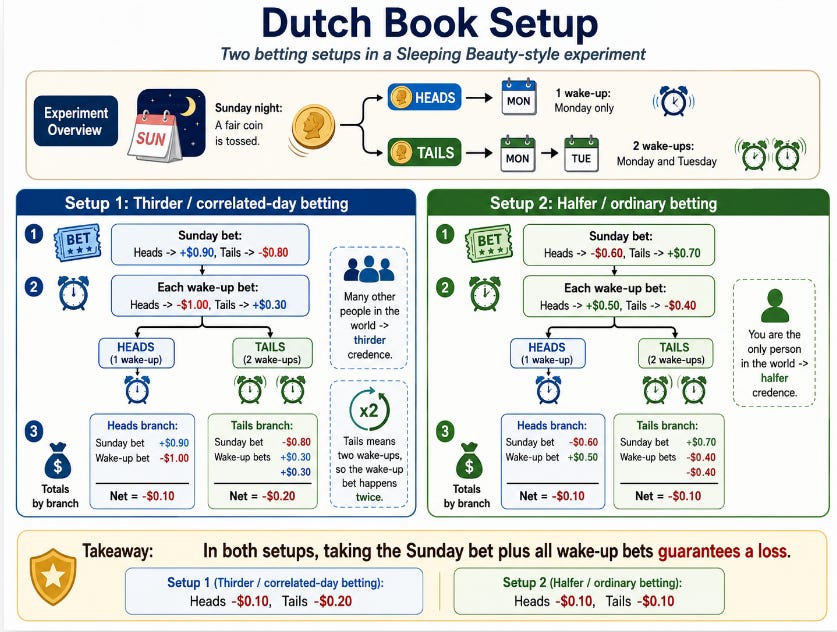
Here, the Dutch book is straightforward. On Sunday, you’re given a bet where you get 90 cents if heads and you lose 80 cents if tails.
Then, each day after you wake up, you’re given a bet. If the coin came up heads, you lose $1. If it came up tails, you get 30 cents. Here imagine there are a ton of other people in the world, so you have thirder credences (on Cold Button Issues’ view). Because you’re a thirder, you bet at twice the odds you actually believe, and you believe the probability is 2/3. So you bet as if tails was 4x likelier than heads. You think “2/3 probability the coin came up tails. If the coin came up tails, then if I bet on tails today, I’ll also bet on tails the other day. I’ll get 30 cents each day—60 cents in total. 1/3 odds I lose $1, so in expectation I win from the bet.”
If the coin comes up heads, you win your Sunday bet and gain 90 cents. But then you lose your wake-up bet, so you’re down a dollar. In total, you lose ten cents. If the coin comes up tails, you lose 80 cents on Sunday, get back 30 cents both days, and are down 20 cents. So overall, you’re guaranteed to lose—either 20 cents or 10.
What’s the Dutch book if you don’t think you should bet at twice your credence on grounds that your actions across days are correlated?
Imagine that you’re the only person in the world. Thus, the view recommends halfer credences.
On Sunday (let’s imagine the Sunday bet is arbitrarily short for simplicity, though it can work even if it’s longer), you are offered a bet: if heads, you lose 60 cents, if tails, you gain 70 cents.
In the experiment, each wakeup you get the option to get 50 cents if heads and lose 40 cents if tails. You think heads and tails are equally likely, you bet at the odds you believe, so you take this bet.
Taking both bets, whether the coin comes up heads or tails, you lose ten cents. If heads, you lose 60 cents in the initial bet and only get back 50 in the experimental bet. If tails, you gain 70 cents in the initial bet, but lose 40 cents both days—so in total, you lose 80 and are down 10 cents.
I had Chat-GPT make a helpful chart to illustrate: