
Bryan Caplan Replied To Me On Bugs: He's Still Wrong
Caplan's philosophical populism

1 What if the walls screamed?
“When the facts change, I change my mind - what do you do, sir?”
― John Maynard Keynes
Imagine if scientists discovered that the walls screamed.
Well, not screamed, so much. But every second, they were in extreme pain. In fact, imagine if every single square inch of wall all around the world was a separate conscious being in unbearable agony. Every moment, every square inch of wall experienced pain about as intense as that experienced by the victims of the Icebox killers. The Great Wall of China alone would contain vastly more suffering in a week than all the suffering that has ever existed in all of human history.
Such a finding would have wildly counterintuitive implications. It would mean that how much a person improves the world depends mainly on how they affect the number of walls. It would mean that we have a moral obligation not to live in houses, but instead in tents, so that the number of screaming walls might be reduced. It might even mean that various historical crimes turned out for the best if they reduced the number of walls in the universe. Communism might even turn out to be a good thing, as poor communist countries might have fewer walls.
Now imagine in such a world, someone came along and declared that the screaming walls had no important ethical implications. We should just ignore them. Ethics is, after all, based on common sense. And what could be more common sense than that it’s not wrong to build walls and live in houses?
This would be a bad argument. Of course that’s currently an item of common sense in our world. But when the facts change, so too should we change our minds. If we learn that living in houses is really, mindbogglingly terrible—that the typical house causes as much suffering as was brought about by various genocides, then we should update our judgment. We shouldn’t dogmatically cling to the common sense judgments that were formed in the absence of awareness of relevant facts, after learning important facts that overturn it.
Now, in the real world, someone has made a very similar argument. That person is Bryan Caplan.
2 Bryan Caplan
Bryan Caplan is an economist, George Mason professor, and author of many interesting books. I’ve written many essays criticizing him, others agreeing with him, and we’ve even had a debate in person about whether God exists. I find Caplan to be consistently interesting, clever, and thoughtful—though confused on the topic of animals. In his recent, two-part reply to me, Caplan wrote:
In case it’s not obvious, I hold the intelligence of both of these philosophers in highest regard. As I’ve often said, Huemer is the best philosopher. And young Adelstein has immense potential, though I fear he’s too dogmatic to reach his potential.
I feel the same way about Caplan! He’s one of my favorite economists to read, though I find that he sometimes makes major philosophical blunders, especially on this topic. As for age, well, in line with Reagan, I will refrain from commenting on Caplan’s senescence :).
Our core disagreement is about insects. Caplan thinks that taking seriously the welfare of insects is simply insane and wildly counterintuitive. If insects matter, then because they’re so numerous, probably nearly all the moral significance in the world is had by the bugs! If the insects matter, the main determinant of our actions’ impacts is how they affect the bugs. But Caplan thinks that’s just crazy! It’s not wrong to exterminate insects in your house, nor is it wrong to build a house because it takes over insect environments.
Caplan seems to think I’m a non-intuitionist run amok! I start with a plausible utilitarian principle, and then go with it even when it implies things that are insane. I’m a bit like the Objectivists. In fact, Caplan goes so far as to say:
I don’t think that Huemer’s arguments for ethical vegetarianism are as implausible and poorly defended as Rand’s arguments in “The Objectivist Ethics.” (Adelstein’s, though, are).
But despite Caplan claiming that my arguments are “as implausible and poorly defended as Rand’s arguments,” he never mentions what my arguments are, nor even shows any awareness that I have arguments that do not assume the other person is a utilitarian! In fact, my argument for veganism is exactly the same as Huemer’s! Even though I’m a utilitarian, I don’t assume utilitarianism to argue for ethical veganism, because ethical veganism is way more plausible than utilitarianism. When I argue that insects matter, I start with very modest premises: that pain and suffering are bad, that one should try to prevent lots of bad things, and that one should refrain from causing lots of bad things.
I am an intuitionist! I agree with Caplan and Huemer that the way to figure out ethics is by relying on intuition. I’m a utilitarian because I think the deepest and most fundamental intuitions support utilitarianism. And I would think insects mattered even if I weren’t a utilitarian! Caplan doesn’t need to trot out his usual speech about the importance of intuitions—I’m already on board.
Why does an intuitionist like me end up concluding weird things like that the primary determinant of whether our actions turn out for the best is how they affect insects? Because intuitionism doesn’t just dogmatically commit to everything that most people believe. It starts from the things that are really obvious. When we start from very basic and modest premises, like that extreme agony is bad, we get very quickly to the conclusion that insects matter a whole lot. Hillary Clinton once claimed that women were the primary victims of war. But she was wrong—insects are!
When the world is weird, ones ethical judgments should be weird too! If the walls screamed, then that would invert lots of moral common sense judgments. But that’s not because taking seriously icebox-torture-level suffering is counterintuitive—it’s because such a world would turn out to be surprising, and so surprising things would be true of it!
If the walls screamed in the way I described in the intro, then probably wanton home destruction would be a good thing. But it would be silly for an intuitionist to argue that the walls screaming can’t matter because obviously wanton home demolition is wrong.
To give another example, and one that I’ve given before, Bryan is a pro-natalist. He thinks that having children is great! I agree! Some people, however, have suggested that if many worlds is true, wearing sunglasses to the beach vastly increases the number of newly generated universes, creating around 2^10^18 new universes every second.
Using Bryan’s methodology, it would be trivially easy to argue against pro-natalism. Pro-natalism absurdly implies that if such people are right, going to the beach is morally obligatory! It implies that if Hitler increased the aggregate amount of universe splitting, then his actions would probably be for the best. Clearly, then, pro-natalists are out of accordance with common sense! Probably they’re just dogmatic like the followers of Ayn Rand!
But again, this would be a bad argument. If the world is insanely weird, then it’s not a problem if your ethical judgments are weird. You don’t have direct, pre-theoretic access to which actions are permissible. You have to first learn what the world is like before coming to overall judgments about which actions are okay and which things in the world matter. You must know an action’s effects before figuring out if it’s okay! You shouldn’t use a judgment about the permissibility of an act to judge which states of affairs are important, if you came to your judgment about the permissibility of the act without thinking about those states of affairs.
One way to figure out if an ethical conclusion is really counterintuitive, or if it’s an intuitive judgment in a weird world, is to slowly lay out the steps of the argument and see which one is surprising. In the case of the argument for insect suffering, the argument is:
Pain and suffering are bad.
If something is responsible for the overwhelming majority of the world’s pain and suffering in expectation, that thing is very bad.
Insect suffering is, in expectation, responsible for the overwhelming majority of the world’s pain and suffering.
1 and 2 don’t seem counterintuitive. It’s 3 that’s really surprising! It’s, therefore, the factual premise that’s shocking, not the moral premise. Most people would be vastly more surprised to learn that in expectation nearly all the world’s misery is had by insects than that the source of nearly all the world’s misery matters.
Caplan thinks that immigration restrictions are worse than Jim Crow. But that’s counterintuitive! Most people would find such a suggestion outrageous! I don’t think that’s a good reason to reject it though, because one doesn’t have very reliable direct intuitions about how bad aggregate harms are, and judgments about the badness of immigration restrictions are formed both without empathy towards immigrants and in the absence of knowledge about the effects of immigration. Despite being strongly held, such intuitions aren’t trustworthy.
The same thing is true of insects! Our intuitions about actions that we formed without considering how they affect insects or empathizing with insects can’t be a reliable guide to how we treat insects. Bryan isn’t just being a phenomenal conservative—he’s being a dogmatist of common sense, dogmatically clinging to a proposition just because it’s widely accepted, without seriously considering its shaky foundations.
3 How much do the bugs matter?
For the reasons I just explained, I don’t think that Caplan’s argument from “caring about insects has revisionary implications about the morality of normal actions,” is remotely persuasive. But what about his direct intuition that insects don’t matter—that, for instance, saving one person from extreme agony is vastly better than saving a trillion bugs from extreme agony.
Unsurprisingly, I don’t trust this one much either.
I’ve already explained why in more detail here. In short:
Our direct intuitions about insects are riddled with bias. We feel no natural empathy towards insects because of how they look. Besides, they’re really small. If ants were 100,000 times bigger, and we watched them thrashing and twitching, we’d take them a lot more seriously. But obviously size is morally unimportant. Besides, humans don’t have very reliable intuitions about big numbers—we display a bias called scope neglect where our assessment of a problem isn’t proportional to its scale. Humans support the government paying roughly the same amount to save 2,000 birds as 20,000 or 200,000. No wonder we don’t take seriously the billions of painful insect deaths occurring every second. Thus, we shouldn’t trust our direct intuitions about how much insects matter, because those intuitions are horribly distorted by scope neglect, socialization not to care about insects, and the natural factors that bias us to not have empathy for insects.

(You’d at least think twice about torturing a million of these guys for trivial reasons, but they’re just big bugs!)
If we were impartial, then we’d take insects very seriously. Behind the veil of ignorance, you’d be millions of times likelier to be an insect than a person. If you lived the life of every conscious creature who ever existed, you’d care vastly more about insects than people, on account of spending about three years as an insect for every second you spent as a person. If insects screamed in intensity proportional to their agony, then all other sounds would be drowned out by the shrieks of the bugs. In light of this, it seems like it’s mere apathy and lack of empathy that makes us ignore the plight of the bugs. Behind the veil of ignorance you would care vastly more about insect suffering in the last week alone than all the suffering in human history! And that’s true even if you think that pleasure and pain are only a pretty small part of what matters in life.
If we change superficial features of insect suffering to correct for bias, then Bryan’s position is the unintuitive one. There are about 100 million insects for every person. If we imagine the insects had human bodies (to correct against superficial bias), then it would seem obvious that if you were in a country surrounded by 100 million people with human bodies and insect minds—starving, twitching in pain, succumbing to disease—your welfare would not be the only thing that mattered. The hundred million mentally simple creatures around you starving, being eaten alive, and bleeding out against the pavement would matter too!
The argument for caring about insect suffering is quite straightforward and appeals to an obvious premise: suffering is bad. The source of nearly all the world’s suffering, including very plausibly nearly all the world’s intense suffering, is therefore quite bad too. Insects aren’t smart, but the badness of being in extreme pain doesn’t depend on how smart you are—if a very mentally disabled person was tortured, that would still be very bad, even if they had the mental capacities of an insect. The badness of a headache comes from the fact that it hurts, not how smart the person having it is—your ability to do calculus has nothing to do with how bad it is for you to suffer intensely.
Regarding this last point, Caplan says:
The most I can say is that, for all his brilliance, Adelstein begs the question when he says things like “[S]uffering is bad. This isn't because we can do calculus or are smart, the badness of your headaches have nothing to do with how smart you are.” While this is a trivial deduction from utilitarianism, many people think that a random human’s headache is obviously morally worse than the painful death of a random mouse. If such people are right, utilitarianism is wrong.
But again, I did not assume utilitarianism to argue for insect welfare. I think the moral importance of insects is considerably more obvious than the correctness of utilitarianism! That’s why Michael Huemer, Caplan’s favorite philosopher, is also of the opinion that insects matter a lot!
It’s true that humans think things that imply that how smart you are affects how bad your suffering is. But that’s consistent with the notion being intuitive (compare: people mostly think that taxation is morally fine, but Caplan thinks there are powerful intuitive arguments against taxation being fine). When one thinks in the abstract about what it’s like to feel intense pain, it seems utterly bizarre that its badness would depend almost entirely on how smart you are.
Imagine a really horrible and painful experience like being set on fire. If you were set on fire, you wouldn’t be reflecting or engaging in higher cognition. Your entire world would be pain. So then why in the world would how smart you are, how robust your mental capacities are, have anything to do with the badness of that? When I have a painful headache, it just seems totally bizarre that its intrinsic badness would be in any way connected to my ability to reason. It’s bad because it hurts!
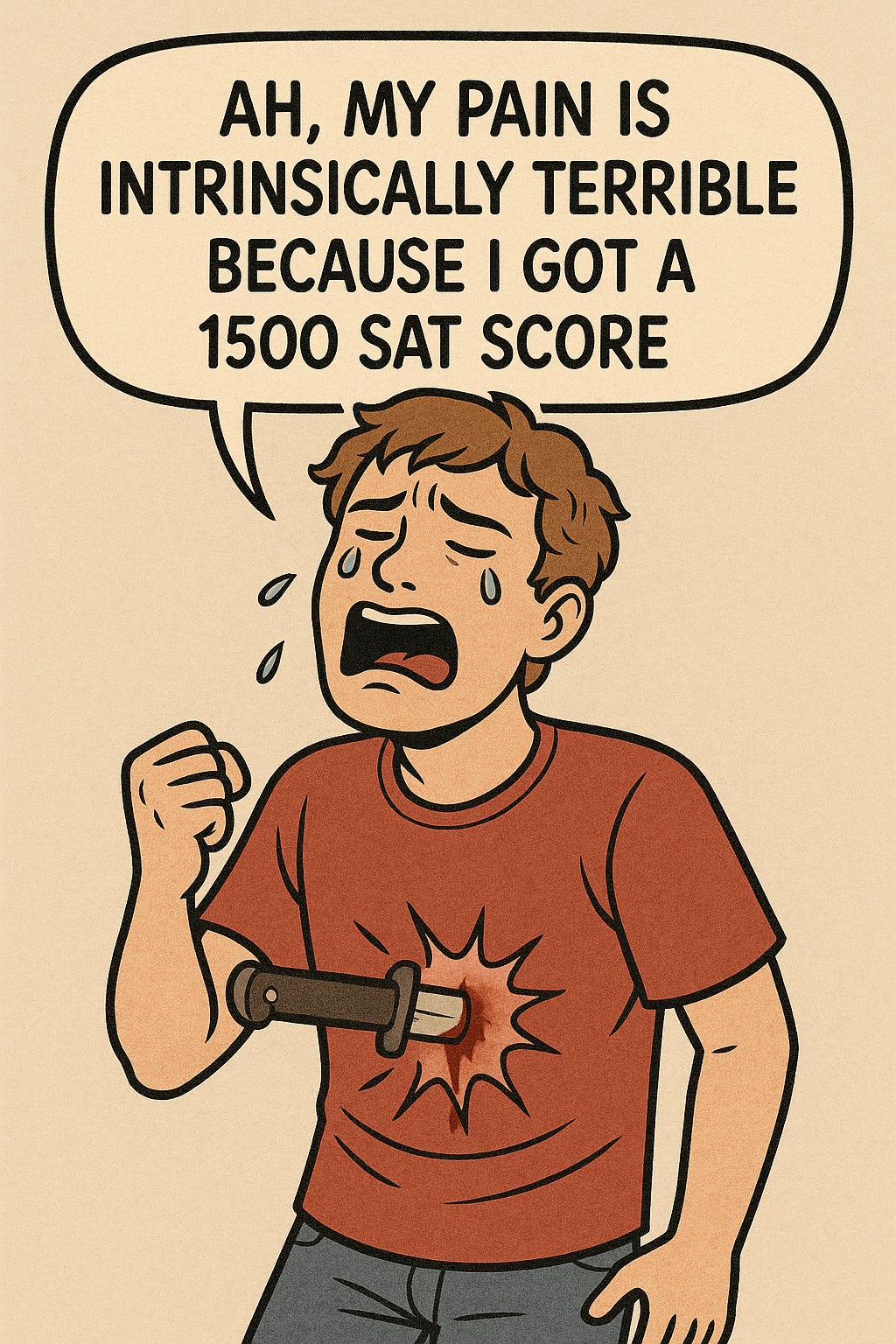
In fact, while Caplan claims his view is intuitive, it’s really not. Caplan’s view implies that humans who are as mentally disabled as animals like pigs and chickens can be tortured to death for trivial reasons. Pigs, remember, are about as smart as young children. Caplan thinks their suffering isn’t bad because they’re not smart enough, which would seem to imply that many humans have cognitive capacities below the point at which their pain matters. Nuts!
4 Loose ends
I think Caplan has never grappled with my core argument against his position—an argument which strikes me as completely decisive. Even if we grant that he’s right that very mentally simple creatures don’t matter morally, we should think that the animals we eat—cows, pigs, and chickens—are above the threshold where their suffering matters. In other words, even if Caplan is right that it doesn’t matter much when very stupid creatures suffer intensely, probably cows and pigs and chickens are above the threshold at which their intense suffering matters.
Why think this? Because it’s intuitive! The idea that it would be fine to burn live cats for biofuel is a crazy idea! The idea that babies and mentally disabled humans who are below the cognitive abilities of cows and chickens can be tortured for trivial reasons is nuts! Caplan’s position isn’t common sense! It’s not common sense that we can torture animals for trivial reasons. Most people support animal welfare to some degree! They just tend to ignore the implications it has for their diet.
So even if Caplan is right about bugs, he’s wrong about pigs and chickens.
Caplan also makes some other points I disagree with. Huemer defends ethical vegetarianism by appealing to the premise that you shouldn’t cause others very large amounts of pain and suffering for very tiny benefits. Caplan replies:
The moral badness (and goodness) of suffering varies widely depending on the characteristics of the being who suffers. The suffering of low-intelligence creatures like bugs is vastly less bad than the suffering of high-intelligence creatures like humans.
This is plainly irrelevant. Maybe sometimes suffering is a good thing if it’s deserved, but animals on factory farms aren’t paying the price for their sins. Their suffering is plainly not deserved!
Next, Caplan challenges my argument for the position that most insects live bad lives, arguing:
Adelstein also has a creative biological story for why bugs are better-off dead but humans aren’t: Bugs use a “high offspring, low survival probability” reproductive strategy (r-selection), while humans are a “few offspring, high survival probability” reproductive strategy (K-selection). The typical bug is a hedonic loser; the typical human, a hedonic winner.
That said, Adelstein rushes to advocate mass extermination of bugs, instead of calling for a massive research project on bug consciousness. Question: Given bugs’ fragility, isn’t it fairly likely that bugs and humans are miserable for similar percentages of their lives? Humans spend more more total time lingering in agony than insects. How often does a bug survive severe trauma for even a few days? If you respond, “Well, bugs might suffer from long-lasting starvation,” consider the fact that many bugs have evolved to eat less frequently than humans.
First of all, insects probably spend a pretty large portion of their time hungry, thirsty, or afflicted by disease. They spend a larger portion of their time in discomfort than people.
Second, while humans often take years to die, that entire period isn’t extremely unpleasant, the way that the time a person is being eaten alive is. So insects spend a much larger portion of their time in very intense suffering.
Third, while insects sometimes have quick deaths, they’re often quite painful. If you live a week and then get burned to death, while only a small portion of the week is spent burning to death, the week likely contained more misery than welfare. Same thing is true of being eaten alive and dying in the other ways insects tend to.
Fourth, the fact that insects go longer without starving doesn’t mean that starvation deaths aren’t generally painful. We don’t have great data on this, but probably most insects starve to death.
Fifth, I do support vastly more research into bug consciousness. Unfortunately there’s already a decent amount of research and it’s not clear what other research would be super likely to get to the right answer. Most people also aren’t equipped to do research into insect suffering, so for most people, this advice isn’t that useful.
Caplan seems to think I’m a naive utilitarian who rejects ethical intuitions as a source of evidence. For instance, he writes:
Impatient readers will think that Adelstein and Huemer derive ethical vegetarianism from the same moral foundation, but they totally don’t. Adelstein is a bullet-biting utilitarian. As a result, he is immune to all moral counterexamples. The sole way to change his mind on moral questions is to show that he’s made a mistake about the best way to maximize total happiness.
Adelstein’s right, there is a difference. I’m doing normal moral philosophy, where you can challenge grand moral theories with pointed counterexamples. Adelstein is doing dogmatic utilitarianism, where you instantly reject all the counterexamples because they contradict your grand moral theory.
Once again, this is not what I’m doing! In fact, one of the big reasons I stopped being a hedonic utilitarian, and started being an objective list utilitarian (thinking that there is more that is good for a person than just pleasure and pain) is that I found hedonism unintuitive! Caplan seems to take me to be the caricature of a naive utilitarian, while not actually listening to any of the things I say about why caring about insect suffering is intuitive!
Overall, I think I am the one applying the consistent intuitionist approach. When an intuition is unreliable, formed without full knowledge of the facts, subject to lots of biases, and goes away when one corrects for the bias, I give it up. Caplan is being the philosophical equivalent of a populist: dogmatically clinging to beliefs that sound good and are widespread, even if they ultimately crumble upon more careful reflection.
He neglects the core way that philosophy should lead to people changing their mind: showing that modest commitments lead to extreme conclusions. I’m following the Huemerian method; Caplan is not! If you initially thought that an action was fine, and then learned it caused others extreme suffering for trivial personal gain, then you should revise your judgment. Common sense is not immune to revision, especially when it turns out to be built on ignorance and conflict with utterly obvious judgments.
At the start of this essay, I mentioned the ethical implications of every square inch of wall being in extreme agony all the time. On Caplan’s view, if the walls that were in extreme pain all the time weren’t very smart, their agony wouldn’t much matter. If lobsters when boiled in pots experienced 10,000 times the suffering that humans would from a comparable experience—agony so intense it would drive a human insane in a moment—on Caplan’s view, we’d still have virtually no reason not to boil lobsters.
That view—that torture level suffering isn’t important in the slightest so long as the victim isn’t smart—is vastly more counterintuitive than anything I think. Caplan should follow the Huemerian method: abandon things that sounded plausible at first when they conflict with deeper and more robust ethical verdicts.
This is one of the most rigorous ethical dismantlings I’ve read in a long time. The screaming wall thought experiment is not about absurdity—it’s about recalibrating moral scale when confronted with a reality we’re conditioned to overlook.
Caplan’s appeal to “common sense” feels less like philosophy and more like comfort. But ethics isn’t supposed to feel comfortable when it’s doing its job. When empirical scope explodes—whether it’s insect suffering, systemic cruelty, or mass extinction—moral frameworks either stretch or snap. Dismissing that as “insane” reveals less about moral truth and more about emotional convenience.
This piece doesn’t demand sentimentality toward insects. It demands consistency. And that alone is a rare and radical thing.
Great post, Matthew!