
The Twitter Foreign Aid Madness
People are making colossal errors when analyzing the destruction of foreign aid

Foreign aid has become the topic of the day on Twitter. Like most conversations on Twitter, this one has become a giant dumpster fire. Perhaps this comparison is unfair to dumpster fires, which have the virtue of destroying garbage, rather than elevating it as Einstein-esque genius. Nuanced and sensible answers have been enveloped in a blaze of callousness, nonsense, and basic errors in reasoning. In large numbers, people are either not grasping basic points or pretending not to grasp them.
It’s been annoying seeing supposedly serious public intellectuals make such basic and obvious errors. It’s really a stark reminder that success as a public intellectual can exist alongside severely impoverished intellect. Worst of all, these basic mistakes have been weaponized in defense of a very bad cause—the child-killing decimation of foreign aid. The recent debacle has been illustrative of how profoundly politics can warp people’s brains and cause them to behave in a way that is both immoral and idiotic.
1 Did anyone die?
It began with Elon doing what he often does—saying something false:


Now, it is obvious that if you “feed into the woodchipper” a bunch of programs that provide medicine to sick children in large numbers, this will cause a non-zero number of deaths. This holds even if you think it was good policy overall. Every major policy change causes a non-zero number of deaths. If Elon is not aware of this fact, he is sufficiently ignorant about how the political world works that he shouldn’t be trying to influence it. Fortunately, Nicholas Kristof came with the receipts. He listed the names of many of the children who died as a result of the cuts.


You’d think that this would be an open-and-shut case. Elon says no one can name names. Kristof, who did the reporting, names some names. Case closed. Sadly, it has not been. The response from Elon’s countless defenders has been simply to change the subject. Here is one of the top replies:


Remember the topic of dispute: Elon said no one died from the cuts. Kristof shows that’s wrong. There’s a separate debate to be had about how blameworthy Elon is—whether what he did is akin to killing vs merely failing to save. But that is separate from Kristof’s simple point that some people died. All talk about Elon’s degree of culpability is an obvious distraction. Konstantin Kisin weighed in to say:
This is why no one in any Western country can cut any welfare spending ever and why we keep going further and further into debt.
Because any time anyone reduces spending on anything, an example can be wheeled out of a person who suffered or even died as a result.
Obviously one should sometimes enact policies that lead to some people dying. But if you have better memory than a goldfish, you will remember that Kristof’s point was in response to Elon disputing that cutting USAID led to any deaths. How culpable that makes Elon is a separate topic. Kisin followed his initial commentary up with, “I am making the point that saying a policy led to the deaths of innocent people is not a sensible way to analyse complex policy debates.”
This is confused. It is obviously relevant whether a policy led to deaths. That doesn’t settle whether it’s good policy, of course. Every policy will lead to some deaths. But it’s one of the things worth considering. If a policy leads to a million deaths, that makes it worse than an otherwise similar policy that does not. Kisin seems unable to distinguish between “we should weigh lives lost when evaluating policy” and “any policy that leads to any deaths is bad.”
2 Morally culpable?
Here is how the moral debate has been playing out on Twitter:
Liberal: Elon Musk killed millions of people.
Conservative: LOL, as if. Not saving people isn’t the same as killing them. By this logic, you have killed lots of people by failing to give to effective charities.
I think both of these positions are a bit too quick. Undeniably, Elon Musk did something that led to a lot of people dying. But whether his actions count as killing is a matter of philosophical debate. Still, I think there’s a strong case to be made that his actions were more like killing than failing to save. Even if they’re more like failing to save, they were still very bad.
First, why might his action count as killing? Well, traditionally Congress has power over spending and shutting down agencies. So there’s a reasonable case to be made that Elon behaved unlawfully. Even if he did not, he behaved in some ambiguous gray zone of legal activity.
Notably, Elon wasn’t just choosing not to give his own money to save lives overseas. He was blocking existing lifesaving government programs in a way that was both haphazard and illegal. If someone is driving an ambulance to a hospital and you direct them to stop working. This leads to the death of the person in the ambulance. Presumably, you are on the hook for killing someone.
Alternatively, imagine that there’s a hospital that is saving a bunch of lives. You seize control of the hospital by taking a series of legally dubious actions. You order the hospital to stop treating patients. Arguably, you are on the hook for killing. What you did isn’t the same as simply failing to save people.
One reasonably accurate test for whether a person is responsible for killing: this: would their alleged victims have been alive had they not acted instead of doing as they did? Ted Bundy killed people, because had he not taken the actions that he did, his victims wouldn’t have died when they did. Failing to donate is different because it doesn’t leave you counterfactually responsible for any deaths. There aren’t extra people dead because of how the person who failed to donate acted.1
By this standard, Elon killed people—had he never existed, there are lots of extra people who’d be alive today. If you want to see a more detailed case for this being the correct analysis, see my article here. Remember, there were people left with medical devices inside of them because of Musk’s actions. Surely, taking active steps so that medical devices are left inside people midway through treatment isn’t exactly the same as not giving your money to charity.
But let’s suppose Elon’s actions weren’t equivalent to killing but were more like letting die. Does this mean he’s off the hook? No. It’s bad when people die. The only reason millions of people aren’t going to die (probably) is that Elon wasn’t successful in destroying foreign aid. And still, his actions very likely led to large numbers of predictable deaths.
If the U.S. can prevent very bad things from happening at small cost, it should. It would have been good to stop the Rwandan genocide, for example, if we could have done so easily. Similarly, one of the big upsides of intervening in World War II was stopping the Nazi holocaust. It is good to prevent bad things from happening, even if you don’t stop every bad thing in the world. If a hundred thousand children were drowning in pools, and you eliminated the program that would have pulled them all out, that would be very bad, even if it isn’t the same as killing.
Common-sense morality isn’t consequentialist. It holds that consequences are among the things that matter, but they’re not the only thing. In terms of bad consequences, the USAID termination is just about the worst policy that happened in my lifetime. So if consequences matter at all, this was very bad. And remember: the impact on the federal budget of DOGE’s activities was negligible, and the impact on the deficit was negative. So this was a very large number of deaths caused without any upside.
Now, for what it’s worth, I do think that ordinary people are culpable for failing to donate effectively. Your donations can save lives. When you don’t donate, it’s like you’re walking past a drowning child. You are letting someone die when you could have saved their life.
This doesn’t mean we are obligated to spend every single penny on donations. If there were enormous numbers of drowning children—too many to save them all—you wouldn’t have to forego all pleasure and dedicate your whole life to saving them. But you would be obligated to make saving them a major life project. If giving to life-saving charity is similar, then we’re obligated to do a lot more than we mostly do. I hope you’ll join me in giving away at least 10% of your income to effective charities (though I give a good amount more) and taking the Giving What We Can pledge.
3 How many deaths?
Did Elon’s actions lead to millions of deaths? Some early studies predicted that they would.
But these generally had serious methodological problems and assumed a total dismantling of foreign aid rather than the mere sizeable cuts we’ve actually seen. We’ve also gotten some new evidence against the early extreme projections of USAID deaths. Data from South Africa doesn’t show an uptick in deaths.


I grant that this is some evidence against the higher-end estimates. But in light of earlier estimates predicting many deaths, the amazing effectiveness of foreign aid in general, problems with the data, and specific reporting on deaths caused, we’re still probably looking at high estimates of deaths. Also, South Africa has more functional institutions than other African countries, so they’re better able to respond to cuts.
Ultimately, this leads me to be more skeptical of the highest estimates. But we’re still likely in for a lot of deaths. We’ll have to wait and see when data comes in from other countries. Even if it only leads, on the low end, to 100,000 annual deaths—a lot lower than many of the estimates—this would still be almost an Iraq war’s worth of deaths over the course of four years. That’s a lot of pointless death.
Someone well-versed in statistics should try to come to a comprehensive estimate of lives lost from USAID cuts. Though it is great news that it looks like some of the highest estimates were too high.
4 Other errors
Many other influential people have jumped in to say wrong things. For example, here is a statement from Gad Saad—perhaps the single man in America whose confidence is least accurately apportioned to his competence.

Reply: obviously Kristof does not have the power to prevent all deaths anywhere in the world. That claim is ridiculous. Also, when there are many different actions that save lives, you aren’t culpable for all the ones you don’t pick—you can, after all, only pick one. This isn’t like axing DOGE, because the money didn’t go into saving comparable numbers of lives. In addition, as described before, there is a distinction between not saving lives and actively sabotaging existing life-saving programs.
Gad is evidently trying to make a parody argument—that the same moral calculus that says Musk is blameworthy also says everyone in the world is blameworthy for every death. But this parody is unsuccessful because the factual claim he’s making is obviously false, he ignores the distinction between doing and allowing, and he ignores the obvious fact that there’s a big difference between not spending on some life-saving programs in order to spend on others, and not spending on any life-saving programs.

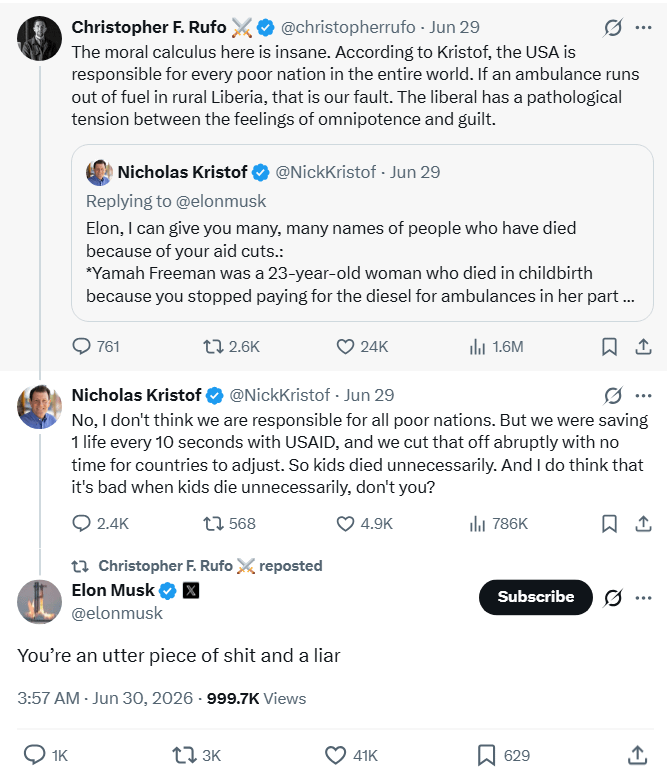
Reply: that was not Kristof’s claim. Kristof noted that when Elon abruptly shut off the services providing fuel for ambulances, leading to someone dying, that meant his actions caused a death. Apparently noting the effects of actions is “the most grotesque moral blackmail” Rufo has ever seen. Speaking of Rufo:
Yes, it is a “hidden premise” that African countries often have bad governments that aren’t able to fund life-saving services. This is a dark truth that they don’t teach you in lib school—you have to go to UATX to learn it. Chris Rufo is the first to uncover this worldview-destroying bombshell.
Liberals have indeed asked why nations are dysfunctional. In fact, there are a number of books on the subject. Most are by liberals. Surely Rufo knows this. But whatever the cause of nations’ dysfunctionality, it is still good to save lots of people’s lives. Analogy: if a child is drowning because their nation is too dysfunctional to put fences around pools, it is still good to pull them out of a pond so that they don’t drown.
This is one thing that irritates me about many right-wingers. They act like there is some collection of dark truths that they know which liberals won’t admit to. Usually, these “truths” are either banal and widely-known or false. They then act like correctly analyzing every single policy depends on knowing these truths—usually without any explanation of why this would be. Their attempts to explain the connection between these hidden “truths” and policy tend to be full of edginess and innuendo but wholly bereft of substance.
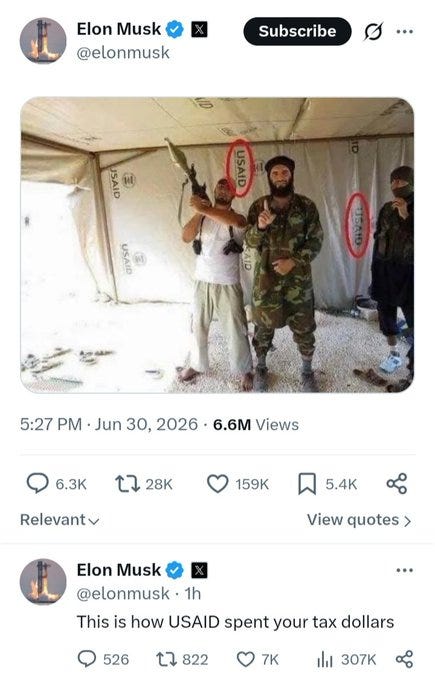
If you actually investigate this claim, what happened was that the Taliban stole a tent provided by USAID. USAID did not buy a tent for the Taliban. I think it is a bit alarming that the richest man on Earth provides a non-stop firehose of easily-debunked lies.
5 Conclusion
The current discourse has been very dumb. Here’s the right view to have:
Whether Elon’s actions are like killing is morally ambiguous. It’s neither exactly the same as shooting someone nor as simply failing to give to life-saving charity. Probably, though, it’s more like killing.
Even if it wasn’t killing, it was still very bad.
Exactly how bad remains to be seen. Probably the highest-end estimates are inflated.
Elon’s actions definitely caused some deaths. Punting to discussion of 1 in response to this claim is a distraction.
It doesn’t follow from the fact that Elon behaved badly that we’re obligated to give all our money to effective charities. Still, we are, in fact, obligated to give more than we mostly do.
I also feel like there’s a pretty profound missing mood from right-wing reactions. There are children currently dead because of Elon’s cuts. We can debate, as a policy matter, whether providing foreign aid was worth it. But you’ve lost a bit of your soul if the dead kids don’t weigh at all on your conscience—if your first thought, when reading about the kids who died, is how it can be spun into a snippy lib-owning remark. The attitude towards the dead children hasn’t even been feigned sadness; not a scintilla of somberness has been even attempted by those defending the cuts. Such behavior is pathological and inhuman.
Even this test is imperfect, though it’s a reasonable heuristic. For more details about this sort of thing, I recommend Shelly Kagan’s book The Limits of Morality.
Let’s consult the mythology of america’s pantheon:
“Look, when you can do the things that I can, but you don't, and then the bad things happen - they happen because of you."
- Peter Parker
https://youtu.be/AVlww2uJHAc?t=154
This might be too much psychoanalysis on a guy I don’t know, but I feel like Elon is crashing out so hard over this because he is racked with guilt somewhere deep inside.