
The Inverted Bacteria That Experts Think Might Kill Everyone
Leading scientists produced a 299-page report. They came away terrified.

In the sequels to Ender’s Game, humans encounter, on the planet of Lusitania, a terrifying new pathogenic threat called the Descolada. Being a new alien pathogen that arose orthogonally to the standard tree of life, it was extremely lethal. The human immune system was defenseless. Fortunately, this story was fiction.
However, on Earth today, we may be encountering something similar. Sometime soon, technology might introduce a new and terrifying kind of bacterial threat called mirror bacteria. It may be the single most terrifying thing in the world. And despite leading experts thinking mirror bacteria might destroy human civilization, including multiple Nobel Laureates and many of the people who pioneered the field, there are only about ten people working to address the threat.
Life on Earth has a property called chirality, meaning that it can’t be rotated onto its mirror image. For a point of comparison, think about your right and left hands. No amount of rotating your right hand will make it line up perfectly with your left hand. The two are mirrored versions of each other, but rotating one will never make it into the other.
The building blocks of life are homochiral. This means they all share the same chirality, all rotated in the same direction. All life on Earth has DNA and RNA made from righthanded nucleotides and proteins made from lefthanded amino acids.
This opens up a worrying possible inversion: lefthanded nucleotides for DNA and RNA and righthanded amino acids for proteins. Like a left hand is a mirror of a right hand, this would be a mirror of ordinary life, where you couldn’t turn one into the other just by rotating it. We already have the ability to mirror some small proteins. Mirror life would simply be a scaled-up version of that basic mirroring procedure.
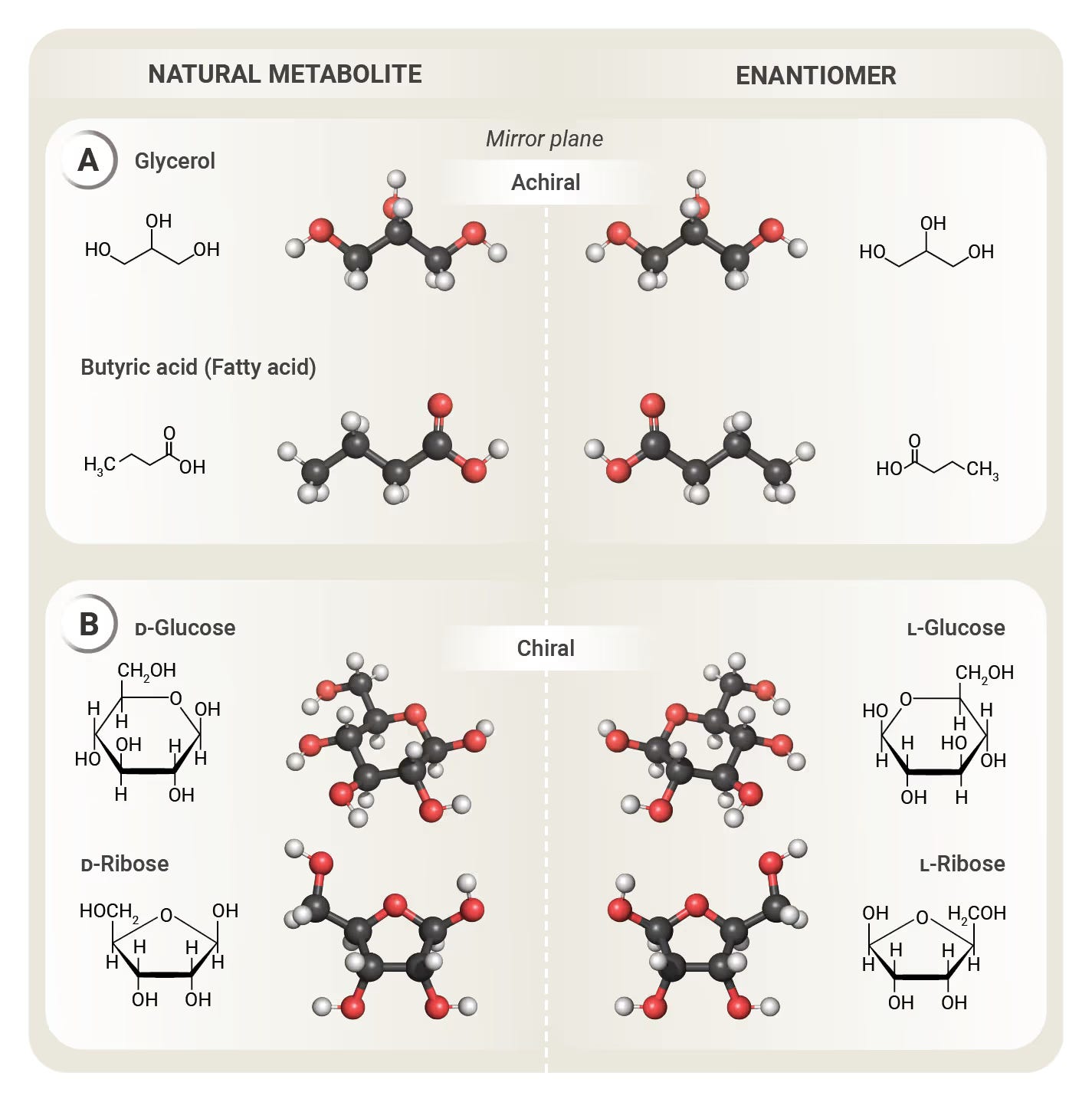
The core worry is that normal defenses against bacteria depend on its chirality. Since the most recent common ancestor of all life on Earth, all life has had a shared chirality. Mirror bacteria would be unlike anything we evolved to deal with. It would likely bypass most biological defenses.
Biological defenses depend crucially on shape. The immune system’s defenses largely depend on specific binding between molecules, but these only work if the molecules have a certain shape. With the inverted mirror shape, our immune system would be defenseless.
Think about our immune system as being like a right-handed glove, and bacteria as being like a right hand. You can think of the defenses as being triggered by the right-handed glove covering the right hand. But if instead it was a left hand, it would completely bypass most of our defenses. It would be as if we did not have an immune system.
How bad would this be?
Those with majorly disrupted immune systems usually die within a few years. Without an immune system, imminent death is almost guaranteed. This would be much worse than normal pathogens, because the biological defenses that sprung up across hundreds of millions of years of animal evolution would be entirely moot. Many of the world’s leading experts on mirror bacteria-related fields, after commissioning an amazingly detailed 299-page report, concluded “Mirror bacteria would likely be resistant to most innate immune responses.” The authors elsewhere write:
We cannot rule out a scenario in which a mirror bacterium acts as an invasive species across many ecosystems, causing pervasive lethal infections in a substantial fraction of plant and animal species, including humans. Even a mirror bacterium with a narrower host range and the ability to invade only a limited set of ecosystems could still cause unprecedented and irreversible harm.
At this point, probably you have some questions.
A first question: how worried should we really be? Sure, this sounds a bit scary, but the world is filled with scaremongering. If you’ve ever done high school debate, you’ll know that it’s always possible to cobble together dozens of scenarios for how the world might end and how declining harvests in Micronesia might lead to imminent nuclear war. By default we should be skeptical when people tell us about existential threats.
This is a reasonable instinct. But I think the evidence here is strong enough to overcome initial skepticism. James Smith, Adjunct Associate Professor at J. Craig Venter Institute, started out skeptical too, but after looking into the evidence was so terrified that he stopped everything else he was working on and started working full-time to address mirror bacteria risks. There were two things that overcame his initial skepticism:
The people sounding the alarm are many of the most preeminent experts in the world. The detailed research report sounding the alarm about mirror life was authored by 38 leading scientists, two Nobel Prize winners, and many of the world’s leading experts on mirror bacteria.
The scenario itself seems alarmingly plausible. Scientists have been successful in building mirrored versions of some parts of a bacteria. It seems reasonably likely that they’d be able to build fully mirrored bacteria. And if anyone builds it, everyone dies (with at least reasonable probability).
I searched hard to find skeptical takes on mirror bacteria. It was genuinely hard. The most detailed skeptical piece I found was written by David Manheim, who was mostly flagging general reasons for skepticism about new existential threats, rather than providing specific arguments for why mirror bacteria aren’t scary. And even Manheim came away terrified, writing:
I started skeptical, but upon close review, my estimate of the substantive risk was majorly update[d] to a high-single-digit or a very-low-double-digit-probability2 - far higher than my previous estimate of effectively zero risk.
Many of the leading experts went into the process desperately hoping to debunk it. They couldn’t. Kevin Esvelt, who first proposed the idea of using CRISPR in gene drives, wrote:
I have never in my life more desperately wanted to be wrong, for my colleagues to utterly destroy this fragile piñata of a hypothesis. Our subsequent working group could not do more than scuff it. Nor has the scientific community.
The position among the experts seems to range from “plausible but fairly low risk,” to “probably would cause an imminent global catastrophe if built.”
Contrast this with something like AI risk, which I consider a serious existential risk. Of the leading AI pioneers, many think AI poses serious existential danger, but others think the risks are overblown. With mirror bacteria, it’s hard to find people who have seriously looked into the threat and came away thinking it’s a nothingburger.
If mirror bacteria was created, how would it get released?
There are two major ways. First: lab leaks. Based on self-reported data, about a third of labs studying pathogens accidentally lead to at least one infection with the pathogen they’re studying. Oopsies! Second, rogue omnicidal terrorists could create mirror bacteria once doing so becomes technically feasible. Seems bad.
How far away from building mirror bacteria are we?
That’s disputed. Experts tend to think that we’re between ten and thirty years away from being able to build a mirror bacterium. Some think sooner. George Church, a professor at Harvard who founded around 50 biotech companies, thinks that this might be creatable in just a few years.
There are basically two kinds of research progress needed for the creation of mirror bacteria. First is progress in mirror biochemistry. To make mirror bacteria, we’d need to build a mirror ribosome, for example, and we don’t know how to do that yet. Mirror bacteria creation would also require advancements in synthetic biology—in order to combine the mirror parts into one bacterium. To put things simply, we’d need to make progress in building the parts of a mirror bacteria, and in putting the parts together to make a full mirror bacteria. Compare: to build a house, you need the raw materials, and you need to combine them properly.
Considerable progress has been made in both areas.
In the area of synthetic biology, scientists have been able to create from scratch a complete bacterial genome and transplant it into a related species. So while they can’t make a bacteria from scratch, they can make a genome from scratch and inject it into a living bacteria.
Progress has also been significant and accelerating in mirror biochemistry. Scientists have been able to successfully make mirror nucleic acids and proteins of increasing length, leading the authors of the aforementioned report to summarize “Advances in chemistry permit the synthesis of mirror biomolecules with diverse applications.”
So in short, scientists are making major progress towards building mirror bacteria. And there’s no sign of it stopping.
Here’s another question you might have at this point: if our immune systems can’t interact with mirror bacteria, won’t it be unable to interact with us? Won’t we be like two ships passing in the night? This is partially correct. Many normal bacterial interactions won’t work with mirror bacteria.
But there are many nutrients that are achiral, meaning they’re identical to their mirror image. Think about a cube: an inverted cube is just a cube. Mirror bacteria would still be able to eat achiral material. Even existing bacteria like E. coli can be grown solely on achiral food. A malicious actor would be able to create pathogens that were especially efficient at digesting achiral food—that could grow unstoppably and be immune from biological defenses. In addition, some bacteria don’t need food to grow—and so even if they couldn’t get enough achiral food, they could still grow, posing a serious risk.
So if the human immune system can’t stop mirror bacteria, what could? You might think viruses could. Bacteriophages, the most numerous biological entities on Earth, are viruses that attach to bacteria and replicate inside them. But phages depend on chiral interactions—so mirror bacteria would be wholly immune to phages. The main predator of bacteria, responsible for a sizeable fraction of aggregate bacterial deaths, would be entirely impotent.
This is also why mirror viruses aren’t a threat. Viruses depend on chiral interactions to bind to cells. A mirror virus wouldn’t be able to do this and would thus die quickly.
Mirror bacteria wouldn’t only affect humans. They could spread throughout the animal kingdom, causing mass death throughout the biosphere. Plants would also be at risk, though it’s a bit less clear precisely how at risk they’d be because plant immune systems are less well understood.
Are there viable countermeasures? A few kinds of vaccines might work. Maybe we could make mirror phages. But the most likely scenario would be the destruction of human civilization, leading to just a few small surviving populations.
If mirror bacteria is so infectious, why hasn’t it evolved naturally? The answer is that evolution proceeds gradually. To get a mirror bacteria, you have to change a bunch of things all at once. Any change made individually diminishes functionality.
So what should be done to stop mirror life? James Smith, who leads the Mirror Biology Dialogues Fund, and is one of the people working most directly to minimize mirror bacteria risk, describes what would need to happen for him to feel the threat was solved:
The first is that I think there needs to be a strong norm against the work to make mirror life in the scientific community.
The second is that I think there needs to be regulation of enabling technologies or precursor technologies, the things that we develop on the way to making mirror life.
And the third is that governments need to be taking this seriously, such that they would deploy the kinds of capabilities that they use to stop terrorists from accessing nuclear weapons to the question of mirror life.
While there’s been reasonable progress on the first, there has been much less on the later two. Smith gives the example of the mirror ribosome: that’s a key part of making mirror bacteria. Ideally scientists shouldn’t try to make a mirror ribosome. Restricting mirror biology development would only have a minuscule impact on overall scientific advancement, but would minimize one of the major threats to life on Earth.
You can help stop this threat. Currently, on Earth, there are about ten people working full-time to minimize risks from mirror bacteria. Smith summarizes “you could probably become the expert in policy around mirror life in your country within a few weeks or months of working on this.” Work on this is especially valuable if you are a biologist or biochemist. Smith’s group, the Mirror Biology Dialogues Fund, has an expression of interest form on their website that I highly recommend applying for. You can be one of just a few people working to stop one of the biggest global risks.
Mirror life is terrifying, but there’s a lot that can be done to stop it. That’s why I was willing to risk writing about this—it might tip more people off to the existence of mirror life, but people already know about mirror life. A bigger effect it might have is alerting people to what can be done to stop it.
We may be building an alien pathogen, one that bypasses biological defenses and threatens life on Earth. Leading experts are terrified. You can help make sure that doesn’t happen.
I'm not a mirror life expert (though I have research experience in chemical biology), so I may be wrong here, but I am highly skeptical that mirror life would be a legitimate threat.
For starters, I think you're wrong about the natural evolution being too hard. Bacteria already use D-amino acids in cell walls and regulation (to avoid detection), but have not gone any further. If mirror life were really so easy and viable, every bacterium would be "cloaking" itself in a cloud of D-amino acids. And from there, they'd be using more and more D-amino acids and getting better and better at using them, etc etc. That's a pretty clean path.
Furthermore, it is often said that, at some point, both hands of life lived alongside each other, but our hand happened to win arbitrarily (lacking any natural advantage). If this were true and mirror life was, in fact, so dangerous, one would expect to see a "see-saw" of handed dominance (which has not happened). There are theories that our handedness has some inherent metabolic advantages and thus didn't just arise arbitrarily (Wei et al 2023, Ozturk & Sasselov, 2022). I tend to gravitate towards those. I suppose this is a bit of a post hoc assumption though.
Even then, if our dominance were arbitrary, I find it impossible to believe that a mirror bacterium could survive for a second in our "normal-handed" ecosystem. Such a bacterium wouldn’t be able to efficiently use most of the existing biosphere as food or infrastructure. You're right about achiral nutrients, but biomass has way too many ordinary-chirality proteins, sugars, nucleic acids, cell-wall fragments, lipids, etc. How would mirror life have any competitive advantage if they were living in a world of nutrients they couldn't use? A mirror bacterium’s enzymes would have incredible difficulty "eating" normal AAs, importing and metabolizing normal sugars, exploiting the normal metabolites leaked by other microbes, etc. I'm also not sure what you mean by "some bacteria don’t need food to grow." I don't think that statement is accurate at all.
Food is 100% needed, and a lot of it. If you wanted any chance at mirror life takeover, you'd have to start with an entire mirror-engineered self-sustaining ecosystem, which is next to impossible (very hard). Even if you DID do that, both ecosystems would much prefer to just be with each other (kind of like competitive exclusion), since they'd otherwise be surrounded by junk they couldn't use.
Recent research has pushed back against the feasibility of mirror life also. 14 days ago, the preprint Pla-Mauri et al. 2026 concluded that "the widespread establishment of mirror organisms in the extant biosphere is highly unlikely, highlighting the importance of ecological constraints in evaluating the risks and feasibility of synthetic life" (this has not been peer reviewed).
All that to say, I think the concern over mirror life is a bit of a hype wave. This article is, in my opinion, a little sensationalist and doesn't get into the weeds enough. Upon getting in the weeds, you notice the infeasibility. I don't think there's much real risk, and I don't think we need mirror life safety funding.
Take everything I just said with a grain of salt.
After we create mirror life, mirror Jeff Goldblum will be there to tell us, ".dluohs yeht fi kniht ot pots t'ndid yeht ,dluoc yeht ton ro rehtehw htiw deipuccoerp os erew stsitneics ruoY"