
The Bizarre Twitter Empathy Meltdown
Having empathy for others doesn't require weird metaphysics!

On Twitter recently, there has been a good deal of discussion about whether the idea of empathy is confused. A bunch of left-wingers claimed that we are lucky to have been born in the West, where we don’t have to live in a small hut exposed to the elements and have our brains stunted by malnutrition. Seems reasonable! In response, a number of right-wingers have been claiming that we are not lucky for the following reasons:
Your being born in the West is downstream of decisions that your ancestors made.
You couldn’t have been born outside the West. It makes no sense to imagine what would happen if you were born in Sudan, because the person born in Sudan to Sudanese parents wouldn’t be you. It’s like imagining if you were a square circle.
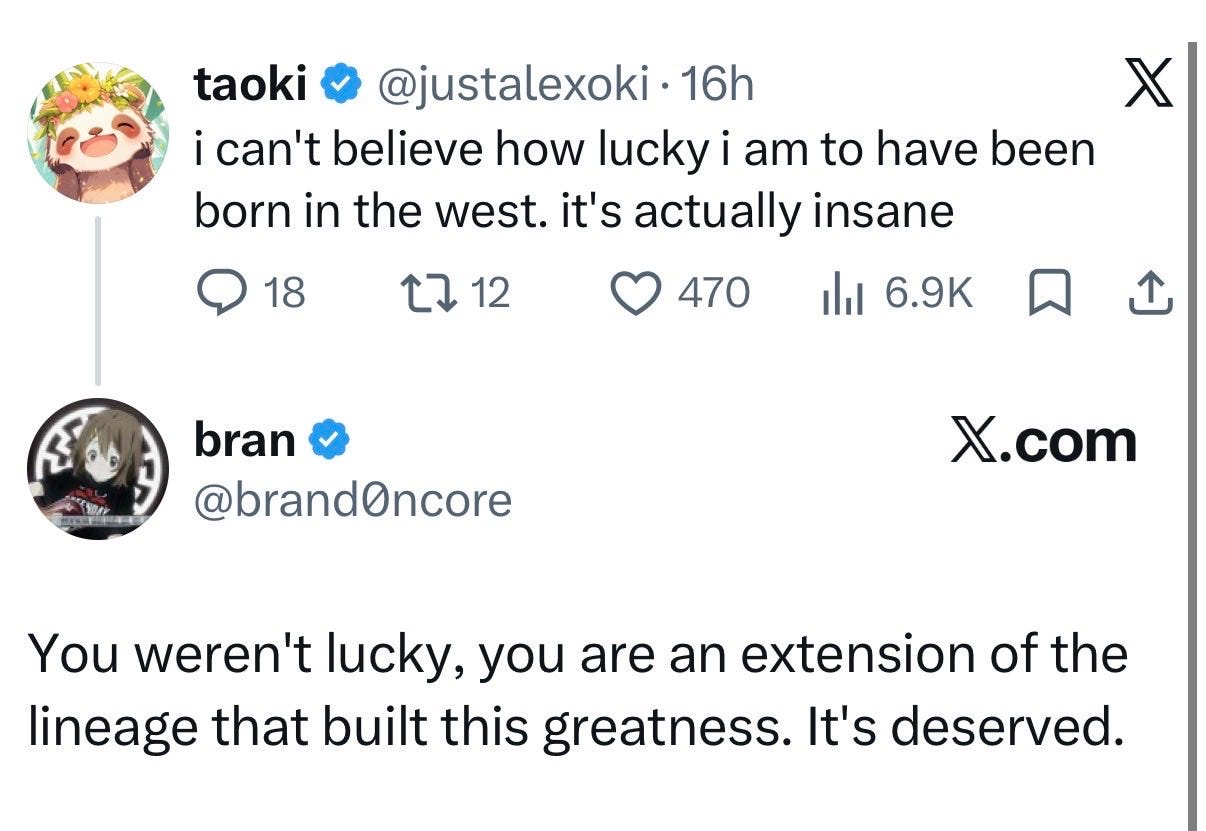
In addition, somehow this fact is supposed to discredit John Rawls’ veil of ignorance and the idea that we should have empathy for foreigners. I find all these claims baffling and confused.
The reason to have empathy for others isn’t that there’s some deep sense in which you could have been them. Instead, it’s that they exist and matter morally. You should try to inhabit the perspectives of others, even if you couldn’t really be them. People suffering and dying matter regardless of which theory of identity is true.
The arguments that we’re not lucky to have been born in the West aren’t any good either.


This is a terrible argument. Every instance of a person getting lucky is downstream of some choice made by someone. If a billionaire randomly decided to give me a billion dollars, that would be pretty lucky. Yet by Kauffman clown logic, one could similarly say:
It's not "luck" that you were given a billion dollars.
It's the specific choices of that billionaire.
When do we call someone lucky? It’s a bit hard to specify the exact conditions, but the answer is something like: when a person gets a big benefit that isn’t proportional to what the person did to get it. I’d be lucky if the billionaire gave me a bunch of money, because it would benefit me significantly, and I wouldn’t have had to work comparably hard to get it.
But the same clearly applies to your place of birth. The reason you were born in the West is because of contingent factors of history, not anything you did. By definition, then, it is lucky; it’s an unmerited reward. That the people responsible for the reward shared some of your genes is not relevant—in the above billionaire case, if the billionaire happened to be my estranged father, I still would have gotten lucky. Similarly, it seems obvious that a child who is seriously abused by her parents is unlucky, even though this is downstream of what her parents did.


A second argument that’s better but still wrong: it doesn’t make sense to say that we are lucky to be born in the West because we couldn’t have been born otherwise. I think this argument proves too much. Kim Jong Un is lucky to be born into the ruling family, even though he couldn’t have been born otherwise.
Similarly, suppose that some person decides to murder me unless the millionth digit of pi is 1. The millionth digit of pi couldn’t be anything else. But still, I got pretty lucky here. Lastly, it seems reasonable to say that people with horrible genetic conditions are unlucky in some sense, even if they couldn’t have been born otherwise.
This is why we should go with the earlier account of luck. You getting lucky from some event X doesn’t imply the possibility of X not occurring. It just requires that your getting some benefit from X wasn’t downstream of your merit.1
I should also mention: the Kauffman view depends on a thesis called origin essentialism. According to origin essentialism, you couldn’t have been created in any situations other than the one in which you were created. So on this view, it is metaphysically impossible that I be born to different parents or conceived at a different time.
But it would be pretty bizarre if whether it made sense to have compassion for Sudanese people depended on the truth of origin essentialism. You can imagine what the momentary existences of someone else are like, and try to imagine yourself undergoing similar experiences, even if you couldn’t be them in a deep metaphysical sense. When I read about North Korean dissidents being tortured in prison camps, then even if I couldn’t really be them, it is perfectly sensible to try to imagine things from their perspective.

Eigenrobot suggests that the fact that we are not souls randomly placed in bodies somehow discredits John Rawls’ suggestion that when making decisions, you should imagine making them from behind a veil of ignorance, so that you don’t know who in society you’d be. This is confused. John Rawls did not actually believe that prior to birth, we were randomly placed in a body. Instead, he said that we should make decisions as if we were. As an analogy, imagine someone says: “referees should make decisions as if they didn’t know which team they like best.” Obviously referees do know which team they like best, but that is no threat to the claim.

Now, does the fact that you couldn’t be someone else mean that Rawls’ veil is a tissue of absurdity? No! Rawls’ scenario doesn’t require that you could be anyone in society. It merely requires that you don’t know who in society you are. That, surely, is conceivable—we might even be able to implement it in the real world with sufficiently powerful drugs. For comparison, suppose there are two people, Bob and John. You have your memory wiped, so you don’t know which one you are. Even though you could only be whichever one you are, you might not know which one you are.
Rawls’ scenario asks us to imagine that we don’t know who we are. That way, we don’t bias things towards ourselves. Such a scenario is obviously conceivable! It requires no exotic metaphysics.
So the TLDR is that no matter what you think about abstruse metaphysical questions like whether origin essentialism is true, you don’t have an excuse for writing off the interests of those in other countries, or thinking that you deserve the fortunate situation of your birth.
It may be that analyzing whether you benefit from something requires one to receive counterpossibles.
The same people we say “it’s deserved” because their lineage created it recoil at the idea that they are responsible for things like slavery. Not taking a stance here, just pointing out the contradiction.
As a right libertarian the rise of these weird old-style "power is all" neo-Hegelian statists and right-wing woke anti capitalists is very concerning.
Their heroes are basically Nietzsche for hierarchy, Hegel/Gentile for the state, Schmitt for sovereignty, Spengler for decadence, Sorel for myth/violence, Evola for tradition, and de Benoist for anti-capitalist New Right synthesis