
Strong Longtermism Is Simply Correct
The objections are wrong

1 Strong Longtermism explained
Strong Longtermism is the idea that the most important features of our actions concern how they affect the long-run future. The case for it is very simple. The future could contain ridiculously large numbers of people—10^58 by some estimates, far more by others. While humanity might die off soon, we might survive for billions of years. What we do today has some chance of affecting things over cosmic timescales—vaster than empires and more slow.
Thus, nearly all the expected impact of our actions is on future people. For every present person our actions affect, there are many times more future people they affect. Insofar as future people matter, and make up nearly 100% of those affected by our actions, then most of what matters in what we do is how our actions affect the far future.
It’s very intuitive that future people matter morally. To give the canonical example, imagine that you put down a shard of glass that a child would step on. Does it matter if the child is alive currently or won’t be born for a hundred years? Certainly it wouldn’t make a huge difference.
Likewise, if pressing a button would make future people’s lives 10% less good, even if it would hugely benefit present people, we shouldn’t press it. The takeaway from this: individual future people matter significantly. Because future people are so much more numerous than present people, they matter more in the aggregate, just as the total population of Asia matters more than the population of a random small town.
A rough analogy to make the case for strong Longtermism clear: imagine that we discovered that there were giant civilizations that lived in caves. In fact, while exact numbers were hard to predict, in expectation 99.999999999999999999999999999999% of total people lived in caves. Suppose additionally that our actions affected the cave people in huge numbers. Policies routinely affected trillions of expected cave people for every non-cave person they affected. Some actions even threatened to extinguish the cave people entirely. Wouldn’t it seem that the most important effects of our actions were on people in caves?
Future people are like the people in caves. Nearly every expected person will reside in the future. We can affect them. This means nearly all the morally-significant effects of our actions concern their impact on future people.
For a rough sense of just how much efforts to benefit the far future swamp other things, suppose outrageously conservatively that an existential catastrophe would reduce the number of future people by 10^40. Let’s say 10 billion dollars would reduce existential risks by .0001%. This means each dollar reduces existential threats by 1/10^16—thus adding, in expectation, 10^24 future people.
Now, maybe you don’t think that reducing existential risks is a good use of money—perhaps because you think the future will be bad in expectation (see here for why I disagree). But this example is illustrative of the amazing expected value of Longtermist projects. The future is big enough that influencing it is very likely our best route to impact. One can quibble over which actions are best for far future people, but this illustrates that the most important actions are those that benefit future people.
And note: what matters, concerning expected value, is the mean size of the future, not the median size. So all you need is a credence of 1/10^16 that there will be 10^56 people to have 10^40 expected future people. Haggling over the size of the future is thus not a promising strategy for rejecting strong Longtermism. Even if you think the odds that a particular existential catastrophe would have prevented 10^56 future people from existing are only one in a billion, this is not enough to undermine the argument for Longtermism.
If strong Longtermism is correct, then this matters a great deal. It means that when planning what to do in your life on moral grounds, you should primarily look at how your actions affect the long-term future. And crucially, strong Longtermism is not on its face a crazy or bizarre idea. The case for it appeals to standard premises that sound plausible when you hear them. There is no standard reason people reject it in the philosophical literature—no objection that is widely agreed to succeed.
I find that strong Longtermism seems really plausible when I think about the sheer scale of the future. Imagine people in the year 2 billion AD looking back. Wouldn’t it seem like what happened in the millions of years after 2026 was a much bigger deal than what happened in 2026? Think about the earliest humans who lived in tiny roving hunter-gatherer bands. Isn’t it intuitive that the most significant effects of their actions were how they affected those who came after, rather than their immediate effects? If there are things we can do to make the far future go better in expectation—that will affect the world over millions of millennia—then that seems like a much bigger deal than what happens in the next few years.
In this piece, I’ll go through the main objections to this view and explain why I reject them. At a high level my assessment is that strong Longtermism is really a modest thesis. Its counterintuitiveness doesn’t come from surprising ethical judgments, but from the fact that we live in a surprising world, where for every person affected by our actions today, there are quadrillions of expected people affected by our actions in the future. In such a future, it isn’t surprising that the most important thing is how our actions affect the future.
Here’s the gameplan for the piece: in section 2, I’ll discuss prospects for benefitting the far future. In section 3, I’ll address the worry that Longtermism neglects the present. In section 4, I’ll explain why Longtermism doesn’t require you believe in consequentialism or that morality is objective. In section 5, I’ll address the worry that Longtermism wrongly assumes that it’s good to create happy people. In section 6, I’ll explain why you should be a Longtermist even if you discount low probabilities. In section 7, I’ll explain why you should be a Longtermist even if you adopt a bounded utility view. In section 8, I’ll conclude.
Strong Longtermism isn’t just some abstract philosophical idea—if it’s correct, it should change how you live. If strong Longtermism is right, there are actions that do more good than directly doubling the welfare of everyone on Earth today. Concerns about morality being too demanding don’t apply when this kind of value is on the table, just like it wouldn’t be too demanding for morality to demand a person take a career if doing so would prevent a nuclear war from wiping out a whole continent.
When whole worlds full of value are accessible through the actions of individuals, we have a duty not to squander them. If you’re interested in acting in ways that would benefit the long-term future, I recommend checking out 80,000 hours’ career guide, as well as thinking seriously about starting a high-impact project that could help make the future go better.
2 Can we benefit the far future?
Here’s one reason you might not be a strong Longtermist: you might not think that we can reliably make the far future better. So you’d still be an axiological strong Longtermist, thinking that most of the value in the world resides in the far future. But you’d reject deontic strong Longtermism, which is the idea that the best actions for us to take, given what we know, are the ones that are best for the far future.
The main reason to be suspicious that we can reliably benefit the long term future is that our ability to predict the effects of our actions decays over long time scales. Tracing the long-run effect of any historical event is almost impossible. As our actions’ effects progress farther into the future, our uncertainty grows. The graph of their expected impact slopes downward, meaning their total expected effect isn’t very high.
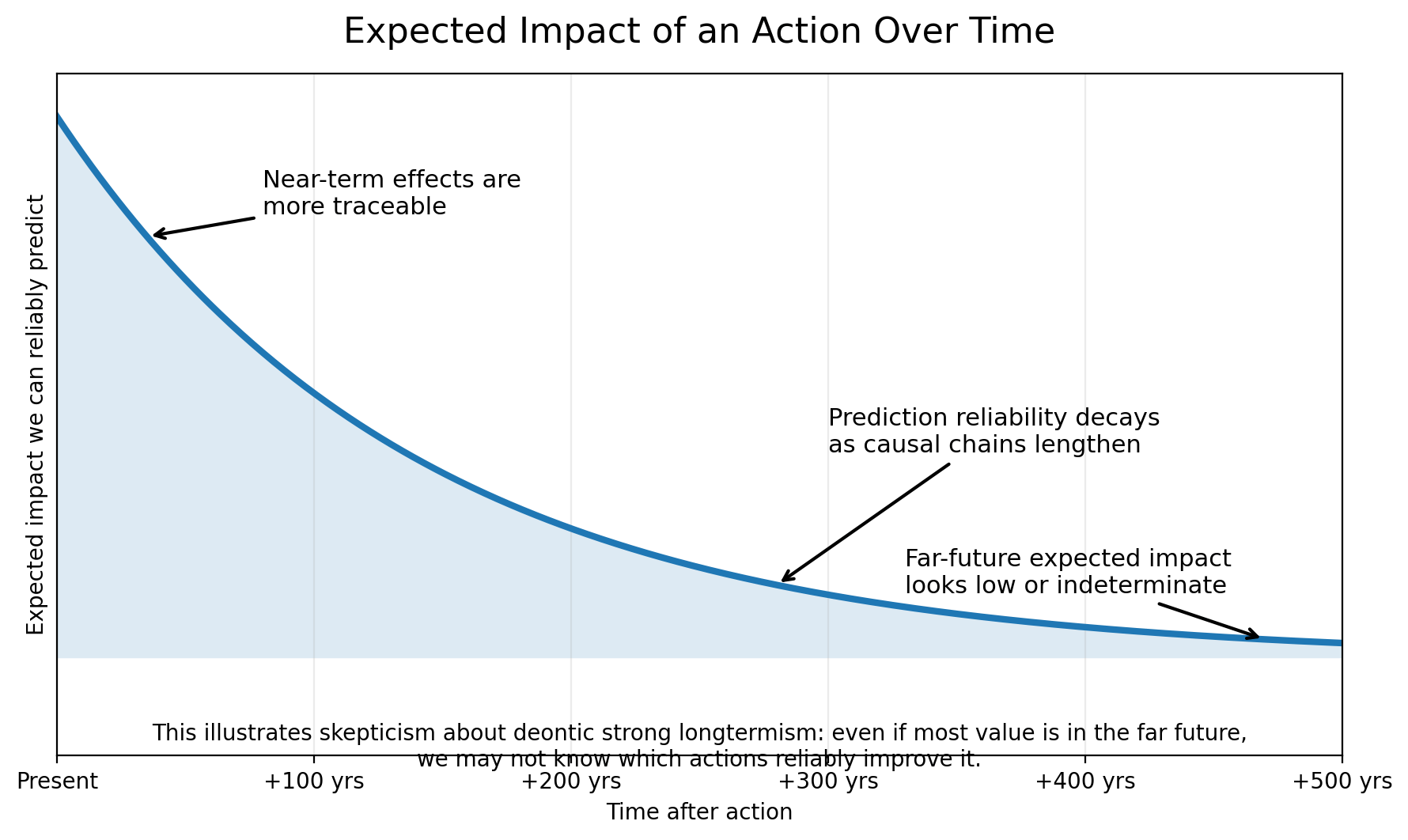
Now, for an action to have positive expected effect, it doesn’t need to be that you have any high degree of confidence that it will turn out well. Any particular move in a chess game will have a wildly unpredictable effect on the future state of the game, yet its expected effect may still be very positive. So whether this objection succeeds comes down to whether there are actions that can have positive expected benefits on the long-term future, not whether there are actions with very high probabilities of benefitting the future. As it happens, no actions have an extremely high probability of benefit (see 6.2 for more on this).
Fortunately, there are actions that benefit the long-term future in expectation. Define a persistent state as one which, if entered, will predictably stick around for a long time. An example of a persistent state is extinction: if humanity goes extinct, so that everyone dies, this is unlikely to be a merely temporary condition.
You can reliably benefit the long-term future by influencing these persistent states. Suppose there’s some persistent state that lowers the value of the future. By lowering the odds that we enter that persistent state, you can raise the expected value of the future. For a nice example, imagine that some people are considering pressing a button which, if pressed, would cut future happiness in half permanently and irreversibly. Lowering the odds of the button being pressed would benefit the future in expectation. It would lower the odds of entering the persistent state associated with the button being pressed.
The real world has a number of harmful persistent states we might enter—lowering the odds of any of these would be very good in expectation:
Extinction: if AI or a virus kills everyone, then this would be irreversible and would in expectation lower the value of the future.
Lock in: there are a number of methods by which humans might lock in our current values, so that they’re preserved for all time. The AIs we’re building today could enable this. Lowering the probability of lock in could benefit the future, because a scenario with lock in is a bad persistent state.
Extreme power concentration: AI could put unprecedented power in a small number of hands. It could enable rogue actors, either corporations or governments, to successfully carry out a coup.
There are other actions which improve the value of the future even without routing through any highly specific state we might enter. Some examples:
Moral progress: Imagine if we’d never abolished slavery. While it’s hard to know how things would turn out, this would have made the future less good in expectation. Bringing the world forward morally, so that future errors are less likely, is similarly important. Along these lines, improving the consideration afforded to non-human sentient beings seems robustly desirable.
AI character: We’re currently building AIs that could be very powerful in shaping the future. Ensuring they have good character could be very good across a range of scenarios. Along these lines, using AI to help make important decisions better could positively influence choices on topics that majorly affect the future.
Space development: Early norms often stick around—the Constitution was drafted hundreds of years ago but remains relevant today. We might be in for near-term space development if AI triggers rapid technological progress. Thus, efforts to ensure that space development goes well could be hugely impactful.
While the future is very hard to predict, it would be very surprising if there was no possible action which benefitted the long-term future in expectation. And if there are actions like that, then they swamp the expected value of other actions. It is an error to infer from the fact that the future is very unpredictable that we’re totally in the dark about which actions can make it better.
The same dynamics that apply to the future also apply to the present. We have lots of uncertainty about how our actions affect the present, especially when one accounts for second-order effects. Nonetheless, this doesn’t mean that no actions benefit the present in expectation. Serious uncertainty doesn’t equal complete cluelessness.
3 Ignoring the present?
Probably the most common complaint people have about Longtermism is that if we prioritize the interests of future people, we will neglect the interests of present people. Popular press articles about EA usually say something like, “the EA movement, founded by Sam Bankman-Fried and Elon Musk to promote cryptocurrency and tax cuts for billionaires, has promoted a philosophy called Longtermism, which critics worry justifies neglecting poor orphans to fund space settlements.”
This objection is weak. Noting that prioritizing the long term future would deprioritize other things is not by itself an objection. Any argument for prioritizing anything will be an argument for deprioritizing things other than it. This objection begs the question: if the arguments for Longtermism hold up, then Longtermism is really important, so it should be prioritized over other things.
The actions Longtermists advocate for are also good for present people. The main things Longtermists work on are preventing existential risks from AI and engineered pathogens. Leading experts often think odds are non-trivial that these things will kill everyone on Earth.
A better version of this objection claims that strong Longtermism is morally counterintuitive. If a moral theory has counterintuitive implications, that’s a reason to reject it—if some moral theory implies that it’s okay to torture babies, then we can be pretty sure that it’s wrong. Perhaps on similar grounds, we can reject Longtermism, because it implies counterintuitively that the future is much more important than the present.
But it’s important to identify why a judgment is counterintuitive. Sometimes moral judgments are counterintuitive because the world is counterintuitive. Suppose you learned that each time humans ate broccoli, a million babies were tortured in a faraway galaxy. In such a world, it would be irrational to reject as counterintuitive any moral theory that holds it’s wrong to eat broccoli. Yes, the judgment that it’s wrong to eat broccoli is a bit counterintuitive, but it’s counterintuitive because the world is surprising, not because the moral claim is surprising. If we decompose the argument against broccoli into two steps, we get:
You shouldn’t do things that cause millions of babies to be tortured for trivial benefit.
Eating broccoli causes millions of babies to be tortured for trivial benefit.
So you shouldn’t eat broccoli.
The moral premise—premise 1—isn’t counterintuitive. It’s premise 2 that’s counterintuitive. It’s no problem to make surprising moral claims when they arise from the world being surprising, rather than from strange ethical judgments. Our moral views should track the weirdness of the world—where the world is strange, moral judgments about the world will be weird too.
Along these lines, the counterintuitiveness of strong Longtermism comes from the fact that our world is surprising, not from counterintuitive ethical views. If we break down the argument into steps, we get:
For every present person our actions affect, there are in expectation trillions of future people that our actions affect.
If an action affects trillions of times more expected future people than present people, then the main thing that determines whether the action should be performed is how it affects future people.
Therefore, the main thing that determines whether most actions should be performed is how they affect future people.
Crucially, the surprising premise is not premise 2 but premise 1. It’s surprising that almost all those we affect are future people. It’s very intuitive that if an action mostly affects future people, then what’s most significant is how it affects future people. If some action had a small effect on a current person and affected the lives of trillions of future people, its effects on future people would matter most. What’s surprising: most actions in the real world are that way. Strong Longtermism is only surprising because we live in a surprising world.
4 Does this assume consequentialism? What about objective morality?
Sometimes people think that the case for strong Longtermism assumes the truth of consequentialism because the central case frequently invokes our actions’ big impacts on future people. This is false. Compare: imagine that a $1 donation could prevent a billion people from being tortured. Would you need to be a consequentialist to think this was a good use of money?
No! Every plausible view holds that there are strong reasons to bring about good consequences. Consequentialism is distinct in claiming that these are the only things that matter. But every plausible view says that they are among the things that matters. The case for strong Longtermism just depends on the idea that promoting good consequences is one thing that matters, not the only thing. Perhaps non-consequentialists should think that you shouldn’t violate side-constraints for the sake of benefitting the long-term future, but non-consequentialism is no threat to the overwhelming importance of making the far future go better.
People sometimes think that EA and Longtermism require moral realism. I do not know why they think this. To make moral claims, you don’t have to believe that morality is objective. Even if you deny objective morality, you should still be willing to say things like “raping babies is wrong,” perhaps given some suitable anti-realist gloss.
But if you believe a kind of anti-realism that permits you to ever make normative claims or even quasi-normative claims, then Longtermism is in no danger. It’s a normative claim like any other. So if your account of anti-realism allows you to express anything remotely resembling moral outrage ever at anything—Ted Bundy, the transatlantic slave trade, the opposing political party—it doesn’t undermine Longtermism. And I am satisfied with the moral case for strong Longtermism being only as plausible as the moral case against Ted Bundy.
5 Does it matter if future people get to live?
When going over the case for Longtermism, I discussed actions which might increase the number of future people by a lot in expectation. But you might be suspicious that it’s worth bringing more happy people into existence. Some philosophers think that while we should try to make existing people better off, we have no reason to create people just because they would be well off. In slogan form: make people happy, not happy people.
But this isn’t really an objection to Longtermism. It’s an objection to the idea that increasing the number of future people matters. But it’s no objection to the idea that making the far future go better is the most important thing. It may still be very important to improve the quality of future lives, even if not their quantity. So this view is no threat to strong Longtermism.
In addition, I don’t think this view is right. I’ve already written a giant post about it, so I won’t repeat most of the arguments. I’ll just mention one very briefly. Consider the following three states of affairs, where the number next to a person’s name represents their welfare level:
Bob 3, John 3.
Bob 3, John 4, Fred 1.
Bob 3, John 3, Fred 3.
2 is better than 1, because it leaves everyone better off and adds an extra well-off person. 3 is better than 2, because it has higher average utility, total utility, and more equal distribution of utility than 2. So by transitivity, 3 is better than 1. But 3 simply has an extra happy person relative to 1. Thus, adding a happy person is good.
For way more detail, see below.
6 Risk discounting
In their excellent paper defending strong Longtermism, MacAskill and Greaves call the risk discounting objection “one of the most plausible ways in which the argument for strong longtermism might fail.” I used to think that, but I don’t any more. I now think there are knockdown responses to this objection.
Here’s how the objection goes: plausibly, we should discount low risks. If someone came to you and offered you a one in googolplex chance of entry into heaven at the cost of $100, you should turn them down. Below some threshold, we should ignore risks. But normally the best ways to influence the far future are by lowering existential risks a small amount or doing other things with a low chance of success. Any individual can only have minimal chance of positively shaping the future. So if we discount low probabilities, then arguably we should discount the probability of your action making a difference.
Or to put in a single sentence: we should discount low probabilities, including the probability that efforts to improve the long-run future succeed.
Now, I have philosophical objections to the idea that we should discount low risks. The longest piece I ever wrote was arguing against this. But we don’t even need to get into that thorny territory. Even if you think low risks should be discounted, the case for Longtermism remains untouched.
6.1 Tail discounting
Those who discount low risks don’t actually discount all low risks.
Suppose Fred breaks into your house and is planning to torture you. However, he picks randomly from 10 trillion different torture methods. Thus, the probability of him using any particular torture method is very low. If you discounted every low risk, then you wouldn’t fear that scenario at all. The probability of him using any particular torture method is low enough to discount. Clearly, this is mistaken.
The problem is that “discounting low risks” isn’t super well defined. How are we divvying up scenarios when deciding what to discount? When seeing if the probability is below the threshold, do we look at any single torture method or at the set of all torture methods? Any proposal will seem arbitrary.
For this reason, philosophers don’t endorse this very crude kind of discounting. Instead, they tend to endorse something called “tail discounting.” Tail discounting involves discounting the best and worst scenarios. So when deciding which action to take, you should ignore the best and worst .00001% of scenarios.
But tail discounting doesn’t help undermine the central case for Longtermism. It isn’t like Longtermist interventions just increase the quality of the best .00001% of scenarios, or prevent a lowering in the quality of the worst .000001% of scenarios. The exact effect of a Longtermist intervention will vary depending on what the intervention does, but generally won’t be undermined by tail discounting.
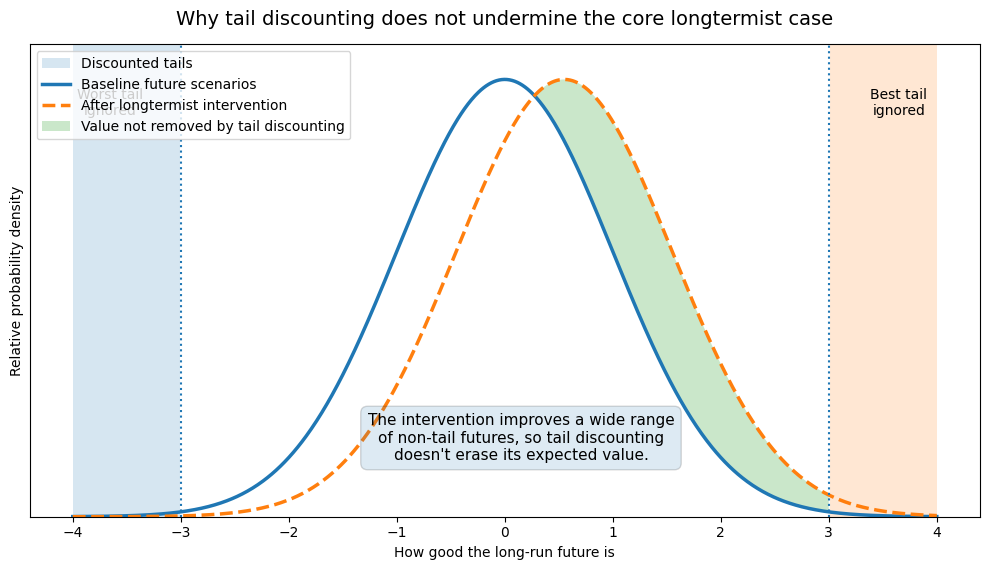
Or to put in a single sentence: tail discounting just discounts the tails, which is not all that Longtermist interventions affect. So it does nothing to undermine the case for Longtermism.
6.2 Chaos
Your actions affect the world in huge ways that dwarf their direct effects. Suppose you drive to the store. You’ll delay the people behind you by a few seconds. If this changes when they have sex by even one second, that will change the identity of their future child. This new child will take many more acts which change the identity of more children, and so on. For this reason, it’s plausible that every single person in the world will be completely different because of your decision to drive to the store. A random peasant farmer in the 10th century is counterfactually responsible for Hitler, Stalin, Norman Borlaug, and Karl Marx.
This means that the odds that any action turns out for the best are almost exactly 50%. This is already enough to undermine the case for risk discounting as an objection to Longtermism: whether you discount low risks or not, the odds you make the world better are almost exactly 50%. Longtermist actions don’t have a significantly lower risk of making the world better than other actions.
They might even have better odds. If you save someone’s life, the odds this makes things better are very near 50%. However, if you succeed in having a huge direct positive impact on the world, this might be enough to swamp the second-order effects.
Here’s a helpful analogy. Imagine that you want to maximize the odds that you’ll have money left in some pot at the end of your life. However, money is constantly randomly entering and leaving the pot by the millions. All the money you make in your life gets deposited in the pot. If you want to maximize the odds your pot has some money left over, you won’t just want to take a random medium-paying job. The fiscal impact of that job is swamped by the random monetary perturbations. Instead, your best bet is to try to become super rich. If you’re successful, then that might really save you from fiscal ruin.
Thus, if you’re risk averse, after accounting for second-order effects, your best bet is trying to make a giant splash. This applies in the money pot case and it applies in the real world.
You might be tempted to object “because these identity-changing effects are neutral in expectation, can’t we ignore them for practical decision-making?” It’s true that they have absolutely zero effect on the expected value of your acts. But they do affect the probability of your act turning out for the best. So if you care about the probability of your act turning out for the best, then these things matter.
You might object, “what I care about is that my actions’ direct impacts are very likely positive.” On this account, because Longtermist actions probably won’t make any difference directly, they get beaten out by other charities that have a more direct effect. But this view has two big problems:
It’s very difficult to have any precise account of what a direct difference is that doesn’t seem ridiculously arbitrary.
Why should this matter? If Longtermist actions have higher expected impact and higher or roughly equivalent probabilities of actually making things better, then shouldn’t you just pick them? Surely if one action is better in expectation and has a higher chance of being better then it’s simply better. Who cares about directness of impact?
6.3 Individual risk aversion
There are different kinds of risk aversion. Most of these don’t undermine strong Longtermism at all. For example, suppose that you just want to minimize the risk of the very worst outcomes. Well then Longtermist actions look more attractive—many are directed at lowering the odds of the worst case outcomes.
The only kind of risk aversion that might be thought to help with avoiding Longtermism is a kind of individual risk aversion. On this view, what you care about is making sure you positively impact the world. You’re not trying to minimize risks of the worst case outcomes, so much as risks you make the world worse. You want to take actions with a high chance of making things better.
The big problem: individual risk aversion of this kind is very implausible. To see this, imagine that a three-sided die is rolled. You are offered two gambles:
Risky:
If the die comes up 1, you save 1,000 people. Otherwise, you save none.
Safe:
You save 300 people no matter what the die comes up.
Now, separately, some other guy named Bob has decided that he will save 300 people if the die comes up 2 and 600 people if it comes up 3.
If your aim is simply to maximize the odds that you make things better, then you’ll take the safe gamble. That guarantees you save hundreds of lives, rather than being risky. But clearly, it is better to take the risky gamble. Here are the probabilities of the resultant state of affairs from each gamble (taking into account Bob as well):
Risky:
1/3 300 people are saved (if the die comes up 2).
1/3 600 people are saved (if the die comes up 3).
1/3 1,000 people are saved (if the die comes up 1).
Safe:
1/3 300 people are saved (if the die comes up 1).
1/3 600 people are saved (if the die comes up 2).
1/3 900 people are saved (if the die comes up 3).
Taking into account what Bob does as well, Risky dominates Safe. That means, for every chance of a good outcome offered by Risky, there is an equal chance of one that’s as good or better offered by Safe.
Both actions lead to a 1/3 chance of 300 people being saved. Both actions lead to a 1/3 chance of 600 people being saved. But Risky leads to a 1/3 chance of 1,000 people being saved, while Safe leads to a 1/3 chance of 900 people being saved. Clearly, then, Risky is better.
Now you might wonder: if Risky dominates Safe, why does individual risk aversion recommend Safe. The answer is that individual risk aversion cares about the odds that you make a difference. Safe has a 2/3 chance of being better than Risky for you to do. Risky only dominates Safe when you take into account what Bob is doing. But you have no effect on what Bob does—so individual risk aversion ignores it.
6.4 Many actions together
Imagine that everyone on Earth had the option to press a button that has a one in 8 billion chance of destroying Earth each time it’s pressed. Each time a person presses the button, they slightly benefit. It is a bad result of risk aversion if it implies that it’s fine for everyone to press the button, thus ushering in a nearly certain doom. It would be wrong for everyone to take an action that slightly benefits them but ensures an imminent eschaton.
For this reason, risk-averse views should say something like: if a lot of people do things with low probability of leading to some outcome, which together add up to a high probability of producing that outcome, then you shouldn’t discount each individual act. Various ways of discounting risks imply this automatically, but those views are of no help for resisting Longtermism.
But if lots of people act on Longtermist grounds, this can majorly improve the far future. So if a view meets this minimal constraint, it’s of no help for resisting the case for Longtermism.
7 Bounded utility
Suppose you think that utility is bounded. On this view, as the amount of valuable stuff in the universe approaches infinity, the total value of it approaches some finite asymptote.
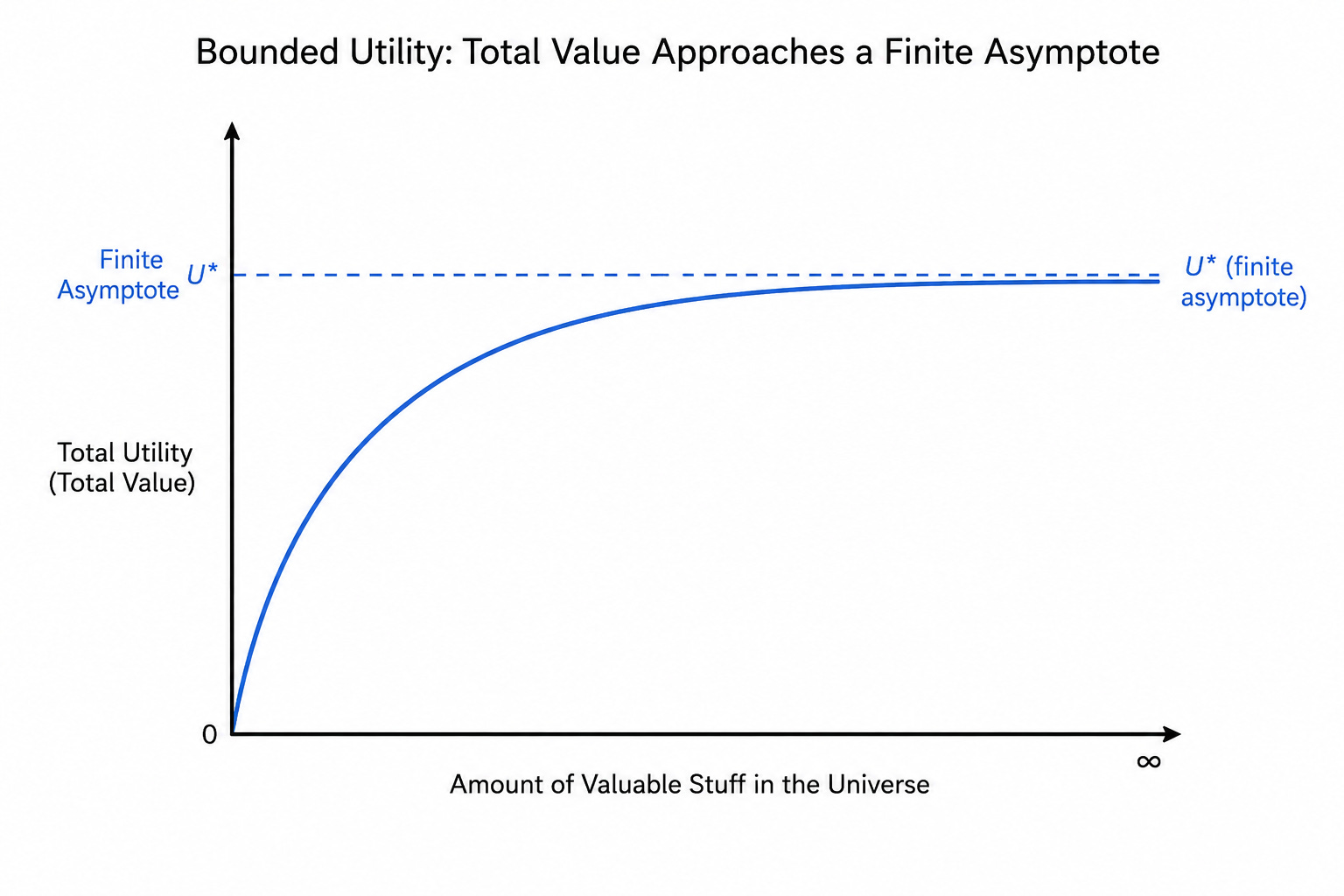
You might think this threatens the case for strong Longtermism. If value reaches a bound, then there’s a limit to how amazing the far future could be. So then the case for most value being in the far future gets weaker.
I do not think this is a very serious objection to Longtermism.
First of all, this only holds if the bound is pretty low. If the bound is very high, then the amount of value you can get in the far future is very large. Arguably we should expect the bound to be enormous, if there is one. It would be weird if after reaching a few trillion people, we ran out of value—so that whole galaxies stacked with love and joy had almost no value.
Second, if you don’t know where the bound is, then in expectation the bound is very high. As you fill the galaxy with more people, maybe value drops to near zero, but maybe it remains high. Still nearly all expected future value is in the future.
Third, along these lines, you should discount bounded views under moral uncertainty. On bounded views, there’s a limit to the amount of available value. In contrast, on unbounded views, way more value is on the table. So if you’re uncertain about whether bounded views are right, then you should mostly care about what unbounded views say. For a lot more detail on this, see here—the arguments for discounting bounded views under uncertainty strike me as extremely strong.
Fourth, even if you have a bounded view and a pretty low bound, you probably end up with pretty Longtermisty priorities. Suppose the world survives for a long time. It is very likely, then, that we’ll reach the bound—either positive or negative. So the top priority, from the standpoint of a committed bounded-utility adoptee, is mitigating existential risks and other catastrophes. So you’ll still end up in agreement with Longtermists about the main priorities.
Fifth, probably on bounded views, nothing we do much matters. The universe is likely big enough that we’ve already reached the bound. So then under uncertainty, you can ignore these views.
Sixth, even if your view is bounded on the positive end, being bounded on the negative end is a lot less plausible. If a billion extra people get tortured, it doesn’t seem like this would stop being significantly bad just because a lot of people are already being tortured. If a view is bounded on the positive but not the negative end, then nearly all expected value resides in preventing extremely bad scenarios—where the far future is filled with suffering. This still leads one back to Longtermism.
Seventh, bounded views are very implausible—see section 6. Among other things, they imply that peace on Earth wouldn’t be a big deal, so long as the world was filled with other happy people. In fact, it would be a smaller deal than giving a child a Starburst candy in a smaller world.
8 Conclusion
Some ideas have huge implications but rest on very modest ethical premises. Strong Longtermism is one such idea. It merely depends on the claim that future people matter, combined with the empirical premise that nearly all of those we affect are future people. It is our world that is surprising, not the moral claim—it is not odd that when we can benefit trillions of expected future people, we should.
It is no fault of a moral theory that it recognizes surprising facts about our world. Here is one such surprising fact: our actions might affect people in such numbers that there aren’t words to concisely describe them—joy across galaxies, stretched across vast epochs, depends on what we do today. Vividly hold this in your mind, and strong Longtermism won’t seem so weird.
I like this post and will use it in debate class.
Two things: First, it should be called strongtermism, because it's shorter and also makes the whole thing feel cooler. But second, have you ever read "Fanaticism and Knowledge" by Frank Hong? (https://philarchive.org/rec/HONFAK) I broadly agree with all your points here but I think it's a very plausible way to justify the "discount low risks" approach that solves a lot of the problems you're raising. But it also depends heavily on whether you buy knowledge-first epistemology and some other controversial views. If you haven't read it, you should check it out.