
Should Deontologists Assist With Wrongdoing?
A new version of Huemer's paradox of deontology poses a big challenge to deontology

The argument
Deontologists claim that their view is the intuitive moral theory, and I readily agree that it is the view that most immediately seems intuitive. But moral theories, like produce, can look good at first, yet turn out rotten upon more careful investigation. To see if deontology is ultimately intuitive, one has to think about the deep structure of the view. This is where the unintuitiveness lies—the view ignores what matters most, leaves people worse off to benefit no one, divorces what’s right from what you should care about, arbitrarily privileges the status quo, and so on.
In this article, I’ll give another argument against deontology, based on Michael Huemer’s paper A Paradox for Weak Deontology. Huemer, despite being a deontologist, doesn’t have a good solution to the problem. The puzzle I’ll present will be similar and even harder to get out of.
Here’s the setup.
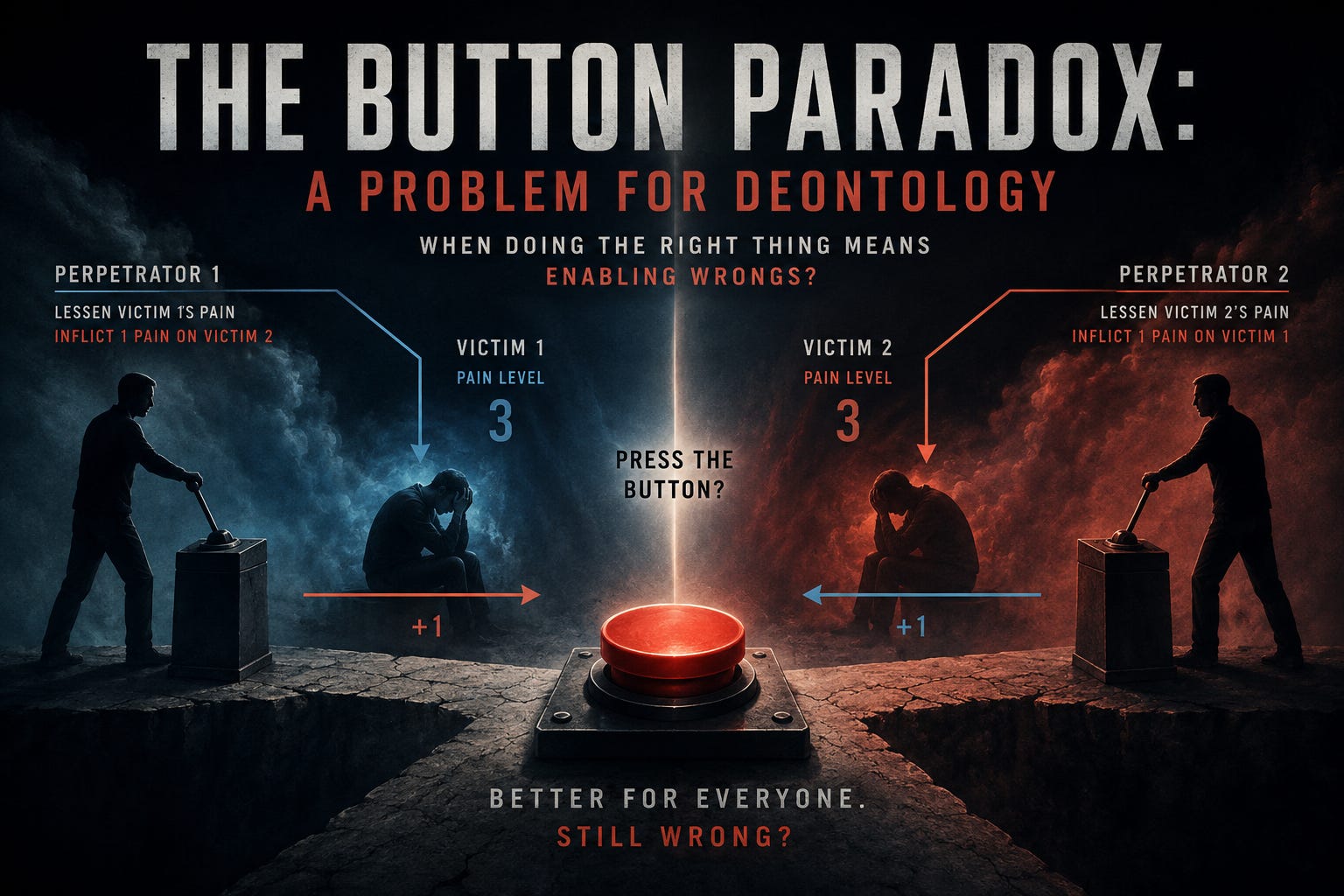
There are four people, conveniently named Victim 1, Victim 2, Perpetrator 1, and Perpetrator 2 (nominative determinism strikes again). Victims 1 and 2 are both suffering intensely :(. Both of their sufferings are currently at level 3. Levels of suffering measure their intensity—level 3 is worse than level 2, which is worse than level 1.
Perpetrator 1 can lessen Victim 1’s pain by two units, though doing so will inflict one unit of pain on Victim 2. Perpetrator 2 can lessen Victim 2’s pain by two units, at the cost of inflicting one unit of pain on Victim 1.
However, this will only be possible if you press a button. In other words, that button will allow both perpetrators to prevent some pain from being experienced by their paired victim, at the cost of inflicting a smaller amount of pain on the non-paired victim. Should you push the button? Here, I claim, deontologists have a problem.
The problem in a nutshell: it is wrong to press a button whose sole effect is to enable two people to perform seriously wrong acts. Yet this button is obviously permissible to press, because it lowers everyone’s suffering. Everyone is better off if you press the button. Deontology implies each perpetrator’s act is wrong, therefore implying a contradiction. By the principle that you shouldn’t take actions that solely facilitate wrong acts, the deontologist shouldn’t press the button—by obvious moral principles, they should. Or, put in a series of premises:
If deontology is true, Perpetrator 1’s action is seriously wrong.
If deontology is true, Perpetrator 2’s action is seriously wrong.
Pressing the button simply enables the actions of Perpetrators 1 and 2.
It is wrong to perform an action whose sole effect is enabling two people to perform seriously wrong actions.
Therefore, if deontology is true, pressing the button that enables the actions of Perpetrators 1 and 2 is wrong.
Pressing the button that enables the actions of Perpetrators 1 and 2 is not wrong.
Therefore, deontology is false.
Premises 1-2 (each perpetrator’s action is wrong)
Let’s first establish that both perpetrators’ actions are impermissible on deontology (premises 1 and 2). Deontology standardly holds that you shouldn’t cause one person to suffer to prevent another person from suffering a slightly greater amount. So then each of the perpetrators’ actions would normally be impermissible.
You might think that each perpetrator’s action is permissible in the above case, because it’s part of a sequence of acts that benefits everyone. But it is hard for deontologists to consistently maintain that you are permitted to take wrong acts that are part of sequences which benefit everyone. Suppose that you can punch someone in the face to prevent someone else from being punched in the face twice. However, that other person was, ten years ago, punched in the face to prevent the first guy from being punched twice. Intuitively, on deontology, the action is still wrong.
Similarly, imagine that a button is pressed that would inflict one unit of suffering on Bob and remove two units of suffering from Joe. Now imagine that ten years ago, one unit of suffering was inflicted on Joe and two removed from Bob, as a result of a button being pressed. However, you’re not sure if that button was pressed by a person or randomly stepped on by a bird. Surely you don’t need to figure out whether it was a human or bird that pressed it? Yet on this view you would, in order to see if it’s part of a sequence of acts that benefits everyone.
Lastly, this view runs into the problem that there isn’t a precise line between an act and a non-act. If two people each perform some act knowingly and deliberately, then they clearly act in the relevant sense. But what if two beings without moral knowledge do it? What if a philosophical zombie does it? Surely in order to know whether to press the button, you don’t have to know what degree of moral knowledge was possessed by the person who pressed the button ten years ago.
Maybe you think what matters is whether the button was pressed by a conscious being—but surely the random unconscious flailing of a jellyfish and the random tread of a bird aren’t relevantly different for present purposes. Whether you should harm Bob to benefit Joe doesn’t depend on what sort of creature pressed the button ten years ago that benefitted Joe and harmed Bob.
Now you might think what matters is whether the person who performed the earlier act did so with knowledge of the morally relevant features. But knowledge of morally relevant features comes in degrees. If they only partially grasp them—say, they have the wrong normative view—then do they count? This also seems arbitrary. When deciding to press a button to harm Bob and benefit Joe, why do the thoughts of the person who did the inverse ten years ago matter?
Another possible escape route: the deontologist might think that you are permitted to carry out some act that harms one person to benefit another, so long as it is part of a sequence of events that leaves everyone better off. In the earlier case where the button is stepped on by a bird, that is still an event. Because your action, combined with that one, still leaves everyone better off, it is permissible.
But this view doesn’t make any sense. Nearly any instance of wrongdoing can, when suitably combined with some event in the world, leave everyone better off. Consider a case where Jim can be killed to save five people. If you combine the event of Jim’s birth with that act, it leaves everyone better off. This view would then sanction nearly every real-world instance of deontological harming. You might deny that being born leaves someone better off—if so, then imagine that Jim was saved from an illness when he was a small child by being given medicine. Jim being given that medicine, combined with him being killed to save five, is a Pareto improvement relative to neither happening.
Premise 6 (it’s not wrong for you to press the button)
Backing up to the central argument, it seems the deontologist must say that each of the perpetrators’ actions are wrong. There are only two remaining ways to avoid the conclusion. The first is to say that it is wrong for you to press the button. The second is to deny that it’s wrong to perform an act whose sole effect is enabling two other seriously wrong acts to be performed.
You might think that it would be wrong to press the button on grounds that neither person has consented to the button being pressed. But this doesn’t help for a number of reasons:
We can simply imagine that you can’t ask any of them for consent. In this case, it seems obvious you ought to press the button—it would simply lessen everyone’s pain. If an act harms no one and benefits everyone, then you ought to perform it.
This makes the problem worse. Imagine that each person is self-interested. Thus, they would consent to you pressing the button that makes everyone better off, but wouldn’t consent to the perpetrator pressing the button that harms them. On this picture, each individual act to harm one person to benefit another is wrong, but your action to enable those acts is not wrong. This runs afoul of the principle that it’s wrong to perform an act whose sole effect is facilitating wrong acts.
Similarly, imagine modifying the case slightly. Perpetrators 1 and 2 have already performed their actions. These actions will be successful if and only if you press your button. Surely it is wrong to perform an act whose sole effect is to make two seriously wrong acts successful. But it isn’t wrong to press the button that lowers everyone’s degree of torture. Thus, the two acts must not be wrong, contra deontology.
Premise 4 (you shouldn’t do an act whose sole effect is enabling other seriously wrong acts)
Now, you might reject the principle that it’s wrong to perform an act whose sole effect is enabling multiple wrong actions. The problem here is that this principle is super plausible. Of course you shouldn’t do things whose sole effect is to enable others to do very immoral things. You shouldn’t, for example, buy a knife that others will use to carry out a murder.
Perhaps the deontologist would reply: “yes, this principle is intuitive, and it’s a cost to my theory that I must give it up. But we all have to accept some bad results, so maybe this is still the least bad option.” This doesn’t seem adequate—I’d give up most ethical principles before giving up this one. But fine, bite the bullet here, as long as you admit it’s a cost to your theory.
Just promise me you’re out of bullets to bite when we get to the next horrendously counterintuitive implication of deontology (like, say, the fact that deontology opposes lowering people’s risks of deaths from 5/6 to 1/6 when doing so would harm no one, or that it struggles to accommodate the result that it’s permissible to walk around). Biting one bullet is alright, but it cannot be your sole diet.
Another objection from the deontologist: it can be right to facilitate wrong acts. For example, consider an attempted murderer who accidentally saves their victim instead of killing them. They’re doing something wrong. But it wouldn’t be wrong for you to knowingly assist them, or make their act successful. Here, however, we must distinguish between objectively wrong acts and subjectively wrong acts.
Subjectively wrong acts are wrong because the person who did them shouldn’t have done them in light of their evidence. Objectively wrong acts are ones where a person with perfect knowledge would have been wrong to do them. If an act is objectively wrong, then a perfectly moral person who knew everything wouldn’t do it. The principle is simply that you shouldn’t facilitate objectively wrong acts. The attempted murder that accidentally saves someone isn’t objectively wrong, in that a person with complete moral information wouldn’t have refrained from doing it.
Here’s another way of seeing this: distinguish between intent-based and non-intent-based wrongs. Intent-based wrongs are wrong, in part, because of what the person who was doing them intended. The beneficial attempted murder is an intent-based wrong. Doing the same act with the right intent—to save someone—isn’t wrong. All we need for this argument to be successful is that you shouldn’t assist with non-intent-based wrongs. In other words, if an action shouldn’t be performed because of what the act does, rather than what the person doing it is aiming to do, then you shouldn’t assist with it. This is a principle that does not have any obvious uncontroversial counterexamples.
Another objection to the principle: perhaps it is sometimes okay to facilitate wrongs if the person doing them had a right to do them. Maybe it’s wrong to make a rude comment to someone, but you shouldn’t stop someone from making rude comments. Several things can be said in response:
It’s important to distinguish preventing people from taking some act and actively enabling the act. If a person has a right to perform some wrong act, perhaps you shouldn’t prevent them from taking the wrong act. But it still seems you shouldn’t go out of your way to facilitate the wrong act. You shouldn’t, for example, give someone a phone number, unprompted, that would allow them to make a rude comment to someone if you know that’s what they’ll do.
This applies most to acts that we think people have a right to, even if they’re wrong. But in the above case, it doesn’t seem the perpetrators have a right to harm their victims.
This at best only applies to acts that are just a bit wrong. It won’t apply to acts that are seriously morally wrong on account of harming others. But if the suffering units are large, then on deontology, the acts discussed in the above scenario are seriously morally wrong.
We can modify the principle to be even more modest: if some act is wrong, and people aren’t planning to do it, then you shouldn’t talk them into doing it. Yet that is incompatible with thinking you should talk the perpetrators into performing their wrong acts.
One last way out for the deontologist: as Richard Y Chappell has already shown, deontologists have to think that what you should do is different from what you should hope for. Deontologists must think that you should hope that one person kills to prevent multiple killings, even if you think it would be morally wrong to do it. For deontology, plausibly, the right act comes apart from the act you should hope for. Thus, if deontologists already think that you should hope for deontological wrongs done for the greater good, why not think that you should facilitate them?
The answer is that this runs directly counter to the spirit of deontology. To see this, imagine that a doctor will, if given a scalpel, kill one person and harvest their organs to save five. If deontology is true, is it alright to buy them a scalpel to facilitate this? No, clearly not! It’s wrong for you to be an accomplice to serious deontological wrongs, even if you hope for them. So then one can’t be permitted to facilitate deontological wrongs done for the greater good.
Here is the problem, in a nutshell: deontology holds that it’s wrong to do bad things to produce larger benefits. Sometimes, however, if multiple people do bad things for larger benefits, this is in everyone’s interests. Intuitively, then, if you can facilitate such a situation, you ought to. But if those acts are individually wrong, then you shouldn’t facilitate them. Thus, the acts must not be wrong, and deontology must not be right.
Premise 6 is question begging however, no deontologist would agree to it.
Looking at the reason why a lack of consent would make it wrong
So… if you can’t obtain consent then you can’t do it, this isn’t an issue for them. You seem to imply they wouldn’t be harmed because you can’t get consent, I’m confused by this.
“Biting one bullet is alright, but it cannot be your sole diet.”- this is a great line
“Sometimes, however, if multiple people do bad things for larger benefits, this is in everyone’s interests. Intuitively, then, if you can facilitate such a situation, you ought to. But if those acts are individually wrong, then you shouldn’t facilitate them. Thus, the acts must not be wrong, and deontology must not be right. “
Why would it being in everyone’s interest mean you ought to? If those acts are individually wrong and you don’t accept the consequences as where to assess moral valence, the acts being individually wrong is the end of the story. It’s entirely fair for them to say that the acts are wrong and it’s wrong to facilitate them even if jointly they are net good. So this seems kinds of like it’s assuming at least that most people have consequentialist intuitions (I think this is right).
If you accept premise (4) to be generally true across moral theories, I could see it posing a problem for utilitarianism too, because I have to imagine there are actions that are bad on a consequentialist lens in isolation, but better to do when done together with another action.
Consider the following case: If group A boycotts a restaurant because they don’t sell cage-free eggs, the company isn‘t incentivized to move to cage-free eggs, but conditions for animals get worse because the company has less cash to do other, more minimal welfare reforms. The same goes for group B. However, if group A and B boycott the restaurant together, that’s enough to push the company to adopt a cage-free reform.
Under utilitarianism, group A’s action is bad, as is group B’s action. Suppose group A and B are wholly uncoordinated. Indeed, they’d be seriously bad actions, for preventing a more-moderate welfare reform from occurring. But it seems good to press a button to cause group A and B to act simultaneously in this way.
I assume the way to hold premise (4) while defending utilitarianism here is to argue that the justifications for why the actions are wrong even sequentially in (1) and (2) hold for deontology, but not for consequentialism. I’ll think about it, but I’m not sure that’s true, as the actions are still done in isolation and without knowledge of the other group. I think the easier path for the consequentialist is to reject premise (4).
That said, I see why it might be harder for a deontologist to reject premise (4). Hence, I’d prefer to formulate the argument by modifying premise (4) with a “if deontology is true...” prefix.