
Book Review: Kakistocracy
Why populism leads to rule by the worst

There is a sense in which big sections of Richard Hanania’s book Kakistocracy: Why Populism Ends in Disaster are almost trivial. Hanania aims to illustrate that populism devolves into Kakistocracy—rule by the very worst people. In other words, Hanania argues that populist leaders tend to be morally unscrupulous, corrupt, dishonest, stupid, and in possession of every other serious vice that a leader can have. The evidence for such a thesis is overwhelming so long as one has paid attention to the goings-on in America over the course of the last few years. But Hanania’s book does a lot more than just prove this thesis—it explains both why and when it holds.
Hanania’s evidence for the populism to kakistocracy pipeline is both considerable and convincing. He starts by defining populism. Populist leaders are those who oppose elites and blame them for social problems. Elites, as Hanania defines them, are those in contact with long-lasting established institutions with traditional power.
The influence of the elites comes from their connections to those institutions. They gain status by impressing other elites. New York Times columnists are elites because they gain prestige from connection to an established journalistic outlet. Joe Rogan isn’t an elite, though he has a lot of influence, because his influence comes from connection with a mass audience, rather than with a traditional institution.
So what’s not to like about these populists?
Start with the empirical literature. On every measurable outcome, populists do worse. On average, electing a populist leader shrinks GDP by 10%. This holds across a wide range of measures of who counts as populist. The world’s economically worst-performing countries are all either war-torn African or Middle Eastern nations or Latin American countries with long-lasting populist control.
Populist governments expand executive authority and undermine existing institutions. Electing populist leaders is associated with an increase in corruption and democratic backsliding. Populists tend to rewrite constitutions at high rates, erode freedom of the press, and undermine civil liberties. 40% of populist leaders get charged with corruption—a fact particularly remarkable in light of their consistent remolding of the judicial process in their own image. And you shouldn’t attribute this academic opposition to populism as a byproduct of left-wing bias, given that academics find similar—and often worse—effects of left-wing populists. In addition, studies that compare places where populists won to places where populists almost won often show similar negative effects of populist leadership.
Yet one doesn’t need to consult studies to see how populism leads to kakistocracy. Just consider America today. Trump, the quintessential American populist, appointed RFK Junior, who holds a diverse assortment of crankish medical theories. That has not stopped him from being appointed to head HHS, where he has haphazardly dismantled research into mRNA. RFK Junior is a nice encapsulation of kakistocracy, given that he may be among the worst people on the planet to run HHS.
It is as if the Trump administration has been single-mindedly aiming to confirm the kakistocracy thesis. This is an administration that peddled easily debunked election lies and used them as an excuse to try to overturn the results of a fair election. Four years after Trump did this, he was elected president.
While Trumpism is based around the claim that traditional elites are stupid, corrupt, and immoral, Trump routinely manifests these vices to degrees that border on the infinite. As Hanania points out, despite Trump’s repeated promise to “drain the swamp,” he has been personally enriched by the presidency to a degree never before seen in history. Don Jr. founded a DC-based club with a $500,000 membership fee alongside Trump’s envoy to the Middle East and Trump’s crypto czar. When Hunter Biden was rumored to have done similarly, this dominated headlines for years on end; Trump’s son does it out in the open along with multiple high-ranking administration officials, and it barely makes the headlines.
Similarly, a Trump-branded real estate project in Qatar was announced weeks before Trump visited the Gulf States. Shortly after this, an Abu Dhabi-backed fund made a $2 billion business deal using the digital coins of Trump’s firms. Purchasing Trump-backed crypto allows people to easily buy leverage. And Hanania didn’t even mention a number of other instances of obvious Trump corruption—say, the fact that he was gifted a jet by Qatar! It is maddening that when a politician who has run on a platform of stamping out corruption engages in historically unprecedented corruption on a daily basis, nobody seems to care.
Trump has claimed repeatedly that American elites are stupid and incompetent. Yet his administration replaced competent elites with a ridiculous clown show of Trump sycophants who could be found at the local asylum. A priori, it would be extremely surprising if the most qualified people to run various complex federal departments included various unaccomplished graduates of low-ranking institutions without any relevant experience whose primary pre-appointment credential was their seemingly limitless zeal for kissing Trump’s ass.
Does anyone really believe that Pete Hegseth is the most qualified man in America to lead the Department of War? Does anyone believe that Christopher Wray—from Yale Law School no less—is less qualified than Kash Patel? Patel got his JD from Pace University, “which is not ranked among the top hundred law schools in the country and whose incoming students currently have a median LSAT score that is at the fiftieth percentile of all test takers.”
Patel’s primary credential was a willingness to publicly embarrass himself with North Korea-style displays of public loyalty, including selling Trump shirts and children’s books that detail Trump’s greatness. In addition, Patel sold quack supplements rumored to reverse the negative effects of vaccines. It would be extremely surprising if the nation’s most proficient sycophants also happened to be the best people to work various important jobs.
Trump is the most well-known populist leader, but other populist leaders have similar tendencies to induce disaster. Maduro obliterated Venezuela’s living standards. Chavez’s economic policies were similarly disastrous. When Sri Lankan populist leader Gotabaya Rajapaksa banned importation and use of synthetic fertilizers and pesticides, against the advice of all experts, this led to a nearly 50% increase in price. Illegitimate attempts to hold onto power are similarly common among populist leaders: Yoon Suk Yeol of South Korea declared martial law to try to maintain power and Jair Bolsonaro inspired a violent attack on his nation’s capital (sound familiar?).
Nor is it uncommon for populists to promote crankish conspiracy theories. Călin Georgescu of Romania was broadly opposed to the practice of importing things (an opposition that is, unsurprisingly, not shared by economists). One of the funnier sentences in the book notes that Georgescu “has questioned whether the moon landing was a hoax, claimed that carbonated drinks contain nanochips, and once asserted that residents of the Marshall Islands used to live between 150 and 200 years before they suffered the ill effects of US nuclear tests.”
Russian populist elites are also, at fairly high rates, either quacks or plagiarists—with one having made the rather interesting claim to have invented the “nooscope” “‘a device that scans transactions between people, things and money’—a breakthrough on par with the microscope or telescope.” Big if true! Perhaps he was employing the unconventional inference rule “induction from other words that have ‘scope’ attached to the end.”
This raises the question: why are populist leaders so terrible?
One reason is that they gain power by appealing to a generally uninformed public. Insofar as one hates elites, one won’t have any inclination to defer to elites. But if the public doesn’t know much and doesn’t defer to elites, the only people the public favors are those who endorse extremely simple solutions. That is why populist movements tend to espouse simplistic narratives—being more likely to believe high housing prices are the result of nefarious megacorporations than restricted housing supply. This is also why they blame problems on immigrants—being much more likely than economists to believe immigrants are behind economic woes. One doesn’t need to understand the world much to blame other people for their problems.
Another reason populists are so demented—explored by Hanania at length—is the cancerous media environment that births populist leaders. Populist news media promotes sensationalist news stories. The American right doesn’t have much interest in reading traditional news sources—preferring podcasts and other forms of alternative media. Despite the Wall Street Journal being ostensibly right-wing, it is read by more Democrats than Republicans.
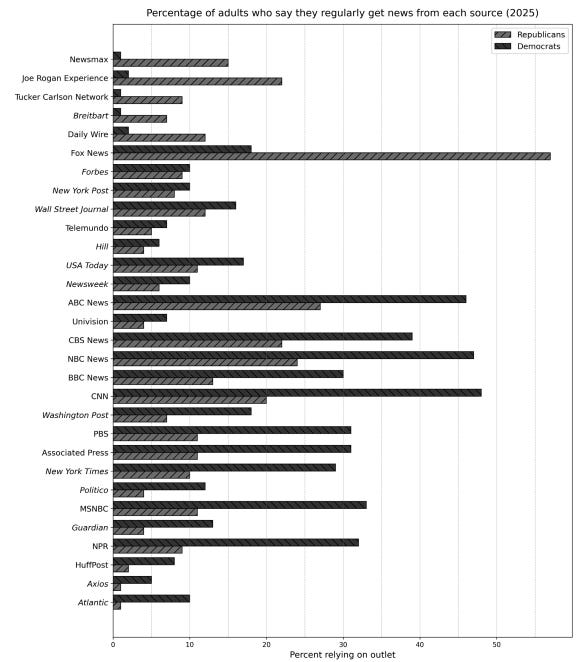
Traditional news media, though imperfect, tends not to make outrageously false and easily debunked claims. Yet alternative media selects for sensationalism; this begets a non-stop firehose of conspiracy theories and general craziness. Joe Rogan, America’s most listened-to podcaster, has promoted each of the following stories in the last few years:
There is an ancient city beneath the Giza pyramids; HIV does not cause AIDS; there were advanced human civilizations that predated those accepted by archaeologists and historians; 9/11 may have been a government operation; mind reading is real; Covid vaccines are more dangerous than the disease itself; and humans became more susceptible to polio due to vaccination.
Another darling of the alternative media world, Candace Owens, has over 6 million YouTube subscribers. She has claimed, among other things, that Macron’s wife is a man, that some odd Jewish sect called Frankism has orchestrated numerous major events in world history, and has even suggested that some of her political opponents may be robots. This is one reason why highly shared right-wing news stories are much likelier to be false than highly shared left-wing news stories.
The book has lots of other interesting content. Hanania discusses and criticizes a number of major theories of why populism arises. He discusses some cases of populist successes—usually under South American economic libertarians like Milei and Fujimori. He discusses many more instances of populist leaders being corrupt and crazy. Hanania is offering a year-long paid subscription to his Substack if you pre-order the book. If you want to learn more about the populist descent into madness and badness, it is hard to think of a better book.
The article is paywalled but I think it must be saying that having populist leaders for a long period of time reduces GDP by 10% - not that electing just one populist leader reduces GDP by 10%. Because the latter is just an impossibly strong effect.
Still sobering. I am thinking that while swing voters tend to bemoan the fact that the left and right in America are so polarized and far apart, that this is not a big deal. It's okay to have a far left and a far right who compete and balance each other out. The problem in America now is that both sides are too populist.
This does not read like a book review, more like going thru the main scandals of Trump and his clique.