
Political Slop
The ubiquity of nonsense

There are different kinds of political slop—useless nonsense that carries absolutely no useful information. But there’s one kind that really gets me. And it’s everywhere.
Here’s how it goes: make some totally inane point that would obviously never convince anyone on the other side that their position is wrong. This point might take the form of, say, pointing out that someone on the other side committed a crime. Or it might involve claiming the existence of some item of hypocrisy that is so obviously wrongheaded that its sole point is to throw sand in the other side’s eyes and to signal to your own side your commitment to the cause. Ideally it should cast the side in a negative light, but not be anything that might actually convince anyone. For example:
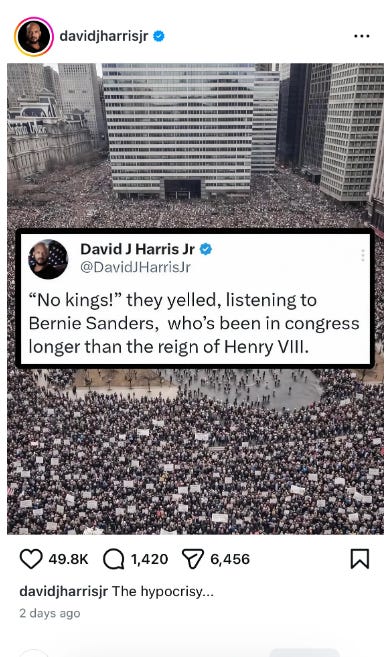
It’s just such outrageously silly reasoning. The main objection to kings is not that they serve for too long, after repeatedly being elected, but that they exercise too much power illegitimately. So believing that Trump is behaving in a needlessly power-grabbing way is obviously not in tension with supporting someone who has served in Congress for a bunch of years!
You wonder: did David Harris Jr. think, as he was typing this, that this was some bulletproof, unassailable point that people on the other side would have no answer to? That Bernie Sanders differs from a king in no important respects? Did he think that if someone on the other side was presented with this hypocrisy, they would throw up their hands, cry “my worldview is in fundamental tension,” and dissolve like a vampire before the light of the sun. My guess is that he did not give this comment much thought. It was simply a convenient piece of political feces to fling vaguely in the direction of the other side. It’s basically emoting—like waving a little flag and saying “boo! Democrats.”
Most claims of political hypocrisy are like this. Most of them are “you support [thing that you say is good] but this is hypocritical because you oppose [thing I think is good].” You will often hear that Republicans are hypocrites because they are only pro-life up until birth. This is a very silly claim. The Republican position isn’t that people’s lives stop mattering when they’re born. It is instead that the policies Republicans support are the best way to improve people’s lives. Perhaps they’re wrong about that, but it isn’t as if they have explicitly warring commitments that aren’t consistent. It is not hypocritical to be wrong.
And who is this supposed to convince? Who is the person who thinks that Republicans’ policies display wanton disregard for human life, but then, upon seeing that this indifference conflicts with opposition to abortion, comes to oppose Republican policies? It seems its sole purpose is to preach to the choir. To convince, in other words, those who are already convinced.
I suppose there is one exception to this, because there is a case where Republicans—and most people—are fairly explicitly indifferent to human life. A common political claim is that our duties extend only to other Americans. This view is in tension with being pro-life, because it implies that there aren’t any moral reasons to save the lives of most people in the world. But it’s still not hypocritical in any strict sense—there’s no contradiction—because the view of most pro-lifers is that we should prioritize American lives over others’ lives. They’re only pro-life about American children and not, say, PEPFAR recipients.
This kind of political slop is among Elon Musk’s favorite ways to communicate. Some vague and obviously question-begging claim will be made—and he’ll reply with a bullseye or by saying “interesting.”
Oftentimes the slop Elon posts will simply be an example of someone committing a crime in a way that’s supposed to favor your side (either because they’re black and Elon feels their sentence was too brief or because they committed election fraud or something). But obviously this style of argument is absurd. The world is a big place with many people committing crimes all the time; that you can find one person being sentenced too harshly or not harshly enough or committing some politically valenced crime tells nothing useful.

Certainly it seems that RFK Junior is more physically fit than Rachel Levine (assistant secretary for health under Biden). But how physically fit someone is obviously doesn’t tell you whether they’d make a good assistant secretary of health . Nobody who cheers this slop in this context would buy it in other contexts; nobody (save Clavicular) who cheers on this meme would favor an argument for Gavin Newsom over Trump on grounds that Gavin is significantly hotter.
Why does this slop go so far on the internet, especially social media? Because it doesn’t require making a sophisticated argument, it’s easy to make. It is a lot easier to post a picture of Biden’s assistant secretary of health looking less good than RFK Junior than to make serious arguments against Levine.
Social media also has a way of turning us into simplistic brutes who cheer for whatever our side does. As the algorithm rewards us for saying things that our side likes, our preferences get simpler, until we’re simply cheering for whatever our own side does, regardless of the merits. A number of people are sophisticated intellectuals outside of social media, only to become unhinged maniacs on social media.
The other reason partisan slop goes so far on the internet has to do with the phenomenon friend of the blog and alleged (though unconfirmed) happiness-inducing-cracker-feed-mumbling Scott Alexander explained in his article The Toxoplasma Of Rage. His thesis in a nutshell was that controversy generates intrigue far better than repeating obvious truisms.
You’ve no doubt heard about PETA because of their outrageous public stunts. But it’s less likely that you’ve heard about The Humane League, even though they’ve been behind efforts to free many millions of chickens from cages. You’ve heard of Peter Singer because he says controversial things publicly; you’ve probably never heard of Derek Parfit because, though generally more careful than Singer, he was less controversial.
Less controversial pieces also come with less ability to signal. If you post on social media “I hate EVIL so much,” people will think it’s some kind of weird joke. You get no social credit for posting “when the icebox killers brutally tortured and killed people, that was really bad, and they shouldn’t have done it!” If you post political commentary on some contested topic, you get to show your side you’re one of them. The more incendiary the political commentary is—the more it would be abhorred by the other side—the greater the signaling value it has.
This is one reason why social media makes us crazy. Outrage draws clicks, so people are incentivized to be maximally uncareful and outrageous. You get what you incentivize; social media incentivizes slop and slop is what you get. You end up with, well, whatever has happened to Elon Musk’s brain. As we like more and more things that appeal to our tribal impulses, we become more tribal, and more addicted to the tribalism, until we have become like a rat on heroin—simply pushing the button each time we see some partisan hackery.
So here is my suggestion: in general, if you are posting about politics, you should try to say things that are capable, at least in principle, of convincing the other side. You should not try to vaguely shovel bad karma in the direction of your political opponents. Each time any of us do this, we are contributing to making the discourse dumber and dumber.
A good post, but the pedant in me would like to note that Rachel Levine was the Assistant Secretary for Health, not the head of the HHS.
Also if we could also get term limits for members of Congress that'd be greeeeeaaaaaaaaat.