
Meat Eating Discussions Should Basically Only Be About Factory Farming
In the real world, it's all foie gras and veal

Discussions of meat eating very often veer into strange territory. When the subject comes up, people will bring up roadkill, consuming the eggs of sublimely joyous backyard chickens basking in the beatific vision, and a hundred other things. There’s a common thought that goes: “why are vegans so obsessed with factory farming, which we all agree is horrible? Why won’t they defend their radical ethical claims about the wrongness of meat eating?”
Here is why. Nearly all meat comes from factory farms. About 99% of animals in the U.S. are factory farmed. Factory farmed animals have lives much worse than those of all humans on earth who aren’t victims of torture. They’re locked in tiny cages, mutilated horribly, selectively bred to be so large that they can barely move, and forced to dwell in shit for their whole lives. The ones that aren’t factory farmed are still often subjected to conditions that we’d call torture if inflicted on any human.
Almost all the animals we eat are tortured. When you buy a chicken from a local restaurant, that chicken was tortured. It had about as much space as a piece of paper—too little to turn around. It developed horrible burns on its legs from constantly standing in feces. It choked on ammonia all day. It moved only minimally during its life. And the same goes for nearly all animals that people eat. Nearly all of them are tortured.
Thus, when you pay for meat in normal settings, you are causing animals to be tortured. You are paying for torture. You are paying for their bones to be broken, for a knife to slice their throats, for them to be stuffed by the hundreds into a transport truck and for their hideous bloated bodies to be almost entirely incapable of movement. You are paying for a degree of mistreatment that can scarcely be fathomed. You’re doing this for the sake of a pleasant taste.
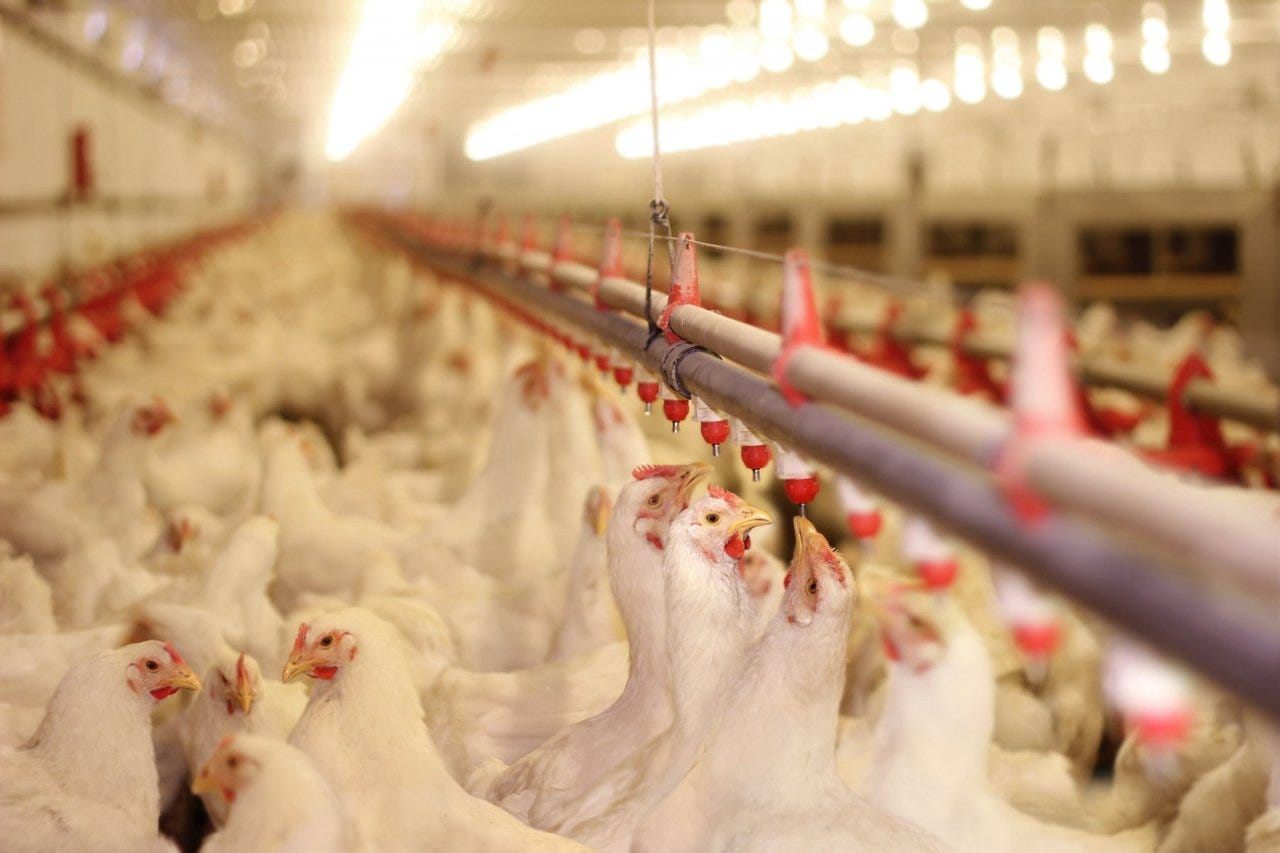
Giant torture farms operate in the heart of America. Most people patronize them multiple times per day. Multiple times per day, people perform acts that cause more cruelty than savagely beating a dog. If Americans all went vegan and took up intermittent recreational puppy torture, total animal suffering would decrease dramatically.
When you notice the giant torture farms that most people pay multiple times every day, it stops looking like some minor, irrelevant issue that should be set aside in favor of lofty philosophical musings about what sort of dominion man has over other animals. The big issue is the mass torture farms.
If almost everyone does something obviously extremely horrible multiple times every day, that is the most important topic of discussion. It is more important to discuss the giant obviously profoundly evil thing that people do all the time than weird edge cases. If you are against causing animals extreme suffering for trivial benefit, then you are against nearly all meat consumption as it actually exists in the real world, rather than in some far-off fantasy world of happy animals in red barns dotting the countryside.
Now, there are other interesting discussions to be had about the conditions under which it’s okay to eat animals. But we should have those discussions only after we’ve discussed the giant torture farms. We should only have those discussions after agreeing that most people are doing something very bad all the time—and that people should immediately stop.
What people say, when you bring up factory farming, is that everyone agrees it’s bad. But most people pay for it multiple times per day. Saying the sentence “factory farming is bad” doesn’t mean much if you pay for factory farming. And that’s what nearly everyone does.
Analogy: imagine that most people hired hitmen multiple times per day to kill random strangers. You suggested that they stop. They reply: “well of course everyone agrees you shouldn’t hire hitmen to kill random strangers, but surely it’s permissible for governments to hire mercenaries in certain limited contexts.” They give this speech midway through Venmoing a hitman to kill a random stranger. This would not seem adequate.
There aren’t really serious defenses of animal product consumption as it actually occurs in typical contexts. There are contentious arguments for why it might be okay in certain rare edge cases. This means that on every plausible view, the things people do routinely are horrific and unjustified. Making sure that everyone is clear on that essential fact—that when you go to the grocery store, you are paying for torture, and doing so is wrong—should be the priority.
Rather than punt to discussion of far-off hypotheticals, people should answer: which of the following do you think?
Almost all instances of animal consumption are immoral.
It’s okay to pay for the torture of animals for comparatively trivial pleasure.
If you know the facts, you have to think one of those two things. Either one of those is a pretty shocking conclusion. But that is because the facts are shocking. It is shocking that most people cause thousands of animals to be brutally tortured. Discussion of factory farming is not a distraction from the in-principle acceptability of meat eating. Discussion of the in-principle permissibility of meat eating is a distraction from discussing factory farming, because that is how most actual meat is sourced in the real world.
So I would ask you, dear reader: which of these do you think? Do you think paying for animals to be tortured is okay? Are you fine with causing animals to suffer intensely for pleasure that is minor in comparison? Or do you agree that almost all actual meat eating is wrong? After we’ve discussed that, we can discuss thornier ethical questions. But first, if we are to seriously discuss meat eating, we should discuss it as it mostly exists.
When you are aware of the facts, it is not the vegan’s position that looks radical. It’s the position of the person who thinks standard meat consumption is okay. Most people are uncomfortable with veal and foie gras. They think you shouldn’t purchase products from horribly mistreated animals. Don’t eat the livers of ducks force-fed with tubes down their throats and don’t eat baby cows forced to rot in a tiny crate.
But if people applied this standard consistently, they’d forgo nearly all ordinary animal products. In the real world, it’s all foie gras and veal. These products differ from others at most in degree, not in kind. It’s not even obvious that veal is crueler than chicken. I’d guess it isn’t.
If you are convinced that most ordinary meat consumption is horrible, you shouldn’t continue eating meat in the standard way. If you do, you should offset. If people are doing horrible things all the time, it is important to discuss that first, and only later to move on to subtle questions of philosophy. Giant torture farms cause more suffering in a few years than all the suffering experienced in human history so far. To ignore that fact is to ignore the central issue.
Very Good Opportunity to Start an Animal Charity

(This is a pretty important article, so please restack it).
Don't ever see myself going vegan, but then again, I was barely thinking about animal welfare before subscribing. We'll see where it goes. Planning to start donating regularly to animal welfare, possibly every time I eat meat, to be more conscientious about it. I don't believe animal welfare is as important human welfare (or that I should feel as bad about the death of a mosquito compared to an elephant), but the way we treat animals is a reflection of our humanity (or lack). "The righteous care for the needs of their animals..." Proverbs 12:10
Yep: "This distinction is often treated as nitpicky, but if it’s true then it has significant implications for how we ought to approach animal welfare. I suspect there is a large portion of Americans who would switch their meat consumption from pork and chicken to beef far more readily than they would skip to full-fledged veganism."
Of course, the current amount of meat consumed cannot be met with ruminants living in tolerable conditions, so meat consumption shall be reduced anyway. But there is a massive human welfare difference between "50% less meat" and "no meat".
https://forum.effectivealtruism.org/posts/L6wdRBCh3izCD244t/farmers-in-the-animalist-coalition