

Do effective altruists need to grow up? Leif Wenar thinks so—and has written as much in a recent edition of The Economist. However, if poor reasoning, assuming one’s conclusion with little in support of it, and downright bizarre argumentation is supposed to be a condition that one ought to outgrow, then it is Wenar, not the EAs, who should grow up.
Effective altruism is a movement of people trying to make the world better effectively. EAs have directed billions to effective charities, enough to save over 300,000 lives, spare 100+ million chickens from a lifetime in a cage, and plenty of other good. Even if you disagree with EAs about philosophy, you should be happy with the effect that EA has had on the world.
Wenar begins his article by snidely dismissing EAs on grounds that we are “the folks who can look at our fractious and bedraggled world and declare, ‘We must save the shrimp?’” You might, at this point, expect some discussion of what the shrimp welfare project does or why concern for shrimp is silly. We get none of this. Instead, Wenar is relying on the audience to agree with him that the idea sounds weird—and thus dismiss it. This is apparently the serious philosophizing that we EAs may one day reach after we hit puberty and outgrow our youthful dogmatism.
Now, is shrimp welfare a silly and crazy idea especially in our “fractious and bedraggled world?” It costs about one dollar to spare 14,000 shrimp from the pain of death. The Shrimp Welfare Project, despite having a tiny budget, has spared more shrimp from potentially intense agony than the number of people alive in the world. A penny given to the shrimp welfare project averts the equivalent of around 140 painful deaths. Is it supposed to be blindingly obvious that you shouldn’t spare a penny to save 140 shrimp, even knowing that they might be capable of suffering?
Call me crazy, but I would expect that if you are chiding others for their youthful unseriousness, you would give some argument for why we shouldn’t spare more plausibly conscious creatures from suffering than there are people on Earth, at a cost less than that of running a local McDonalds. Wenar rightly notes that “early British utilitarians championed human equality, as they campaigned to end slavery and win equal rights for women.” But those ideas seemed weird at the time too.
If you want to make moral progress, you have to think hard about the prejudices that are deeply ingrained in your society. You can’t just dismissively sneer at any counterintuitive moral claim. And in this case, the claim isn’t even counterintuitive. It just sounds a bit funny.
Wenar then spends several paragraphs talking about how little sense EAs have. He claims that in EA “you won’t see…much common sense about how the world works.” There is no argument given for this. Apparently this is another thing that you’re supposed to take to be true because Wenar says it several times. He then says:
My worry is the effective altruists who become too attached to being the hero. One popular EA book, Will MacAskill’s “What We Owe The Future”, tells you that “you can shape the course of history,” and explains how to “structure global society”. But if you check the footnotes on the climate-change charity that the book calls “extremely cost-effective”, you may be surprised by how shaky the book’s guesswork is and how shoddy its research.
Why are we supposed to think these claims aren’t true? Just because they’re in scare quotes? It really is true that you can shape the course of history. Many of the early EAs who were being mocked for making that claim have gone on to shape the course of history. Big chunks of the field of alignment were invented by individual people. As Dylan Matthews puts it, in an excellent piece lamenting his early errors in writing off EAs on the topic of AI:
Eleven years onward, it is extremely, extremely obvious that I was wrong. I did not take this then-nonexistent technology remotely seriously enough, and the people I met who did take it seriously were able to do incredibly impactful work because of that. Chris Olah more or less founded the field of mechanistic interpretability (and coined the term!) and went on to cofound Anthropic. Amanda Askell is responsible for Claude’s personality and one of the most influential people in AI. Buck Shlegeris founded Redwood Research, perhaps the most interesting center of technical AI safety work outside of a major lab.
Or look further in the past: Norman Borlaug, Stanislav Petrov, Florence Nightingale, and Vasili Arkhipov have all had enormous impacts on history. So have Donald Trump, Elon Musk, and many others in the modern day. The claim Wenar is criticizing is true. At the very least, if you’re arguing that it’s bad enough that EAs believing it means that we have a diabolical savior complex, you’d better at least explain why you think it isn’t right! Otherwise this is just Bulverism.
As it happens, these quotes are also taken out of context. “You Can Shape the Course of History” is the title of a section arguing that history is often “plastic” in the sense that how it turns out isn’t predetermined. For instance, it’s reasonably plausible, as MacAskill argues in his book, that British abolitionism’s success wasn’t inevitable—and was a major part of the global abolition of slavery. There are ways history could have turned out where slavery would continue to be legal and be tolerated to this day. Maybe this thesis is wrong, but it’s hardly evidence of a savior complex. It’s about history being influenceable, not about individuals.
The other quote is even more thoroughly ripped from context. The phrase “structure global society” appears in the sentence “This last point—that we need to structure global society so that cultural evolution guides the world towards better values and better societal structures—highlights an issue facing the design of a morally exploratory world that I’ll call the lock-in paradox.” Will’s saying that cultures that are good at sticking around and gaining dominance will persist, even if they are bad.
This is an important point. The societies that are best morally might not be mimetically adaptive. As a point of comparison, evolution led to lots of needless horrendous suffering, because the traits that are most adaptive aren’t the ones that are morally best. This hardly seems like—as Wenar implies—some plan for planet-wide social engineering.
Wenar then explains why he thinks GiveWell’s estimate of the number of lives their top charities have saved isn’t accurate. He writes:
Or consider the EA poverty-relief charity, GiveWell. Its front-page pitch is that its grants “will save over 340,000 lives” in poor countries. When you dig into GiveWell’s calculations, you’ll see that they omit many negative factors well known to development economists. GiveWell’s numbers also omit actual deaths. For example, a top-rated GiveWell charity that gives out cash in northern Nigeria reported that one of the many armed bandits who confronted its staff killed two people while looking for the cash. Those deaths are not counted as “minus two” in GiveWell’s “total lives saved” calculations, as by the charity’s own cost-effectiveness reasoning they should be.
The 340,000 lives number comes from:
Getting high quality evidence—largely from randomized control trials—about the effectiveness of their top charities.
Using that to figure out the cost per life saved.
Dividing the total amount of money given to each of those top charities by the cost per life saved number to reach a total number of lives saved.
This number is obviously imperfect. Still, it’s pretty good, especially as far as hard-to-ascertain fuzzy analyses of total lives saved from charity aggregators go. In order to argue that this estimate is unreliable, one would need to argue that it’s leaving out some major factors. Finding one case of a recipient being killed by bandits isn’t evidence that there’s any major overestimation going on, just like finding out that one person died in a car accident on the way to a Medicaid appointment wouldn’t be good evidence against the reliability of a study on lives saved from Medicaid.
GiveWell’s number is much likelier to be an underestimate than an overestimate. It only counts GiveWell top charities, not other grants they’ve given out or charities they used to recommend but don’t anymore. So, for instance, it completely ignores GiveWell efforts to speed along the malaria vaccine and benefits of Give Directly and the Schistosomiasis Control Initiative. It also leaves out all sorts of desirable second-order effects—if you save someone’s life, you improve their ability to take care of others, saving even more people.
And GiveWell has written at length about possible sources of overestimation. For example, Wenar has elsewhere talked about the use of malaria nets for fishing. But GiveWell has a detailed analysis of this and found it to be mostly negligible.
So yes, obviously GiveWell’s estimate is imperfect. It fails to consider second-order effects and various rare possibilities. But Wenar has given no reason at all to think that a more complete analysis would give a lower number. Almost certainly it would give a higher number, given that the benefits left out include incredible numbers of lives saved from other charitable efforts and the only harm Wenar named was a one-off bandit attack.


If we took the Wenar approach seriously—throwing out every estimate so long as it doesn’t account for every single anecdote of a person being harmed—then we could never estimate everything. Those trying to estimate the impacts of USAID or Medicare cuts would be hopelessly drowning in anecdotes. This approach is totally unworkable in practice. Thus, it’s clearly an isolated demand for rigor. The fact that we cannot be fully exact in our estimation doesn’t mean that we shouldn’t try to quantify.
Wenar next portentously pronounces, “What effective altruists love is portentous pronouncements.” He then unaccountably declares “What they don’t tend to love is accountability.” Why does he think that? He says that GiveWell “has never published its “lives saved” claim in a peer-reviewed journal, and the people targeted by its grants seem to have few rights to redress if things go badly.” Ironically, GiveWell top charities are some of the only charities that have been comprehensively evaluated in a peer-reviewed journal.
My guess is peer reviewed journals wouldn’t take papers on the impact GiveWell has had. This kind of estimate is too inside-basebally for general publication. Still, GiveWell reports are subject to rigorous scrutiny from many experts prior to publication. There is no more rigorous charity evaluator anywhere in the world. While it would be nice if it was subject to peer review, I don’t think this would substantially increase the scrutiny that it’s subject to.
Next, Wenar continues the weird and uncharitable psychoanalysis from earlier (perhaps he is doing this because of his childhood):
I sometimes wonder whether effective altruists have begun to pronounce so much about the “long-term” future because they know they’ll be dead long before they’re proved wrong.
This is a ridiculous claim. Among other things, many of the claims EAs make about influencing the long-term future route through near-term impact. For instance, several years ago, EAs were saying that AI would be a big deal. The Leif Wenars of the world were laughing at us and suggesting we were presumptuous, naive, tech bros who believe in a supernatural machine God. Now that these people have been proven wrong, they’ve moved on to laughing at us about other things.
Perhaps the most irritating sequence of sentences in the whole article is:
Effective altruism may be ending as a coherent movement. The proponent who most fully lived out its credo to do the most good with the resources available was the crypto whizz-kid Sam Bankman-Fried. He quite logically saw other people as resources to be used, and he’s now serving 25 years in federal prison for fraud. The old EA leaders who clustered around him have been discredited by their consistently bad judgment.
The first claim is false: EA has been growing extremely quickly recently. The second claim is completely ludicrous. Defrauding people out of billions of dollars—an action that obviously risked the collapse of his fortune and EA’s goodwill—wouldn’t pass any kind of remotely sane cost benefit analysis. This is why EA leaders have been clear repeatedly long before SBF: you should not risk doing grossly immoral things, even if you think it will turn out for the best. The track record is very bad. So treating SBF as the person who “most fully lived out its credo to do the most good” is a statement that is so ludicrous as to be discrediting on its own.
As for the claim that EA leaders who clustered around him have been discredited, that claim has the more limited virtue of not being obviously completely absurd. But it still isn’t right. EA leaders were mostly advising Sam on how to spend his money. They did not know the details of crypto-trading. The markets didn’t predict the staggering scale of his fraud either. To demand that people with no technical crypto background advising SBF on how to spend his money would deduce something none of the markets did—that he was committing staggering fraud—is quite unreasonable. Be specific: how should they have known? If the whole market isn’t to blame, what specific insider info should they have had?
Do the effective altruists in AI have good judgment? Anthropic’s recent safety problems are being investigated by groups with close ties to the boss’s EA friends and family. The main author of the moral “constitution” of Anthropic’s Claude has long intellectual and personal involvement in effective altruism.
The reason that most of the groups concerned about AI safety have ties to EA is that EAs worried about AI safety for about ten years before anyone else did. For being early on this problem, EAs should get credit, not condemnation.

Note that aside from vaguely gesturing at the SBF scandal and saying that EAs have overstated a few stats, Wenar has given no argument for thinking EAs have systematically bad judgment. Seems like this would be a more productive feature of the piece than snarky evidence-free psychoanalysis that we speculate about the future so that we can’t be disproved in the near-term.
If Wenar has criticisms of the Anthropic constitution then he should raise those criticisms. Instead, he has suggested that Amanda Askell is tainted in her ability to write good model constitutions by her bad judgment and nefarious ties to EA. Of course, by all accounts, Askell is an extremely gifted and careful philosopher, whatever her “intellectual and personal involvement in effective altruism.” Anthropic’s constitution may be one reason why Anthropic has a better safety record than OpenAI. And if one reads it, it’s abundantly clear that lots of thought went into it.
Wenar ends his piece in the following way:
I tell them to start by living among the people they want to help. Then get deep expertise—and dwell on the human consequences when some brainy scheme goes wrong. For simple life experience, maybe go into local politics. Or mentor a neighbour’s struggling kid.
It’s probably too late for the effective altruists in AI to do any of this. Their movement’s final legacy may indeed be measured in human lives—just not in ways that they ever imagined.
Despite Wenar’s early criticisms about EAs making decisions without having high enough quality data to support them, his life advice is formed in the absence of any data in favor of it. Certainly mentoring a neighbor’s struggling kid is a decent thing to do. But if the suggestion is that EAs are stupid idiots who should do community action instead, then it seems one should present, I don’t know, some reason to think this is comparably effective to EA activities. We get none of that (and there’s abundant contrary evidence).
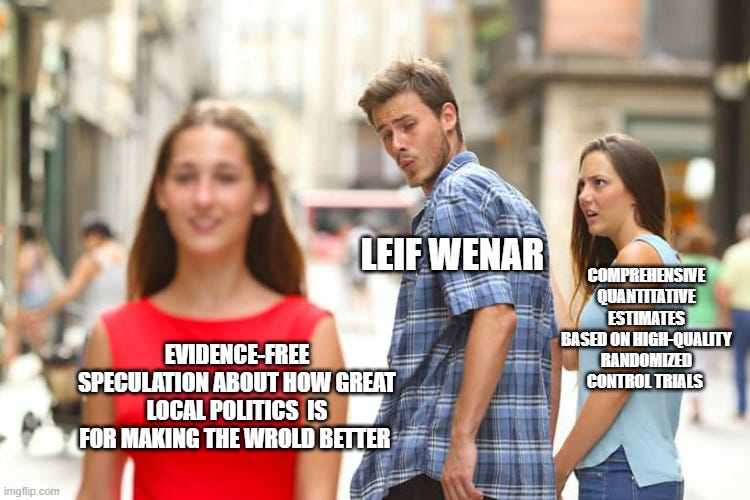
Wenar closes his piece by claiming that EAs’ mistakes will be measured in human lives. He gives no argument for thinking EA will lead to any lives lost remotely comparable to the number saved. Wenar’s charge is far more plausibly made against the critics of EA. Running flak against a movement that has demonstrably prevented large numbers of innocent children from dying is very likely to lead to more children dying needlessly. If we’re going to tally up lives lost from attempts to make the world better, we might as well start there.
Briefly took a class with Prof. Wenar and he seemed intelligent.
Can only, charitably, psychologize that he has a profound level of distrust of EA or perhaps some resentment that ppl in the movement have attained status or power while pursuing goals in a similar vein as himself.
I assume SBF is a kind of damning moment for him, and the other poor arguments on bandits or whatever are made after already determining that EA is untrustworthy and ought to be taken down a peg.
Without this psychologizing, I can only assume he is not a serious thinker.
The best response to the bandits anecdote-as-argument is this gem from Scott Alexander: https://www.astralcodexten.com/p/verses-on-five-people-being-killed