

1 Blinded by the light
A while ago, a mysterious internet writer of great intellectual power called Veritatis Splendor wrote a reply to me on the miracle of the sun. Their aim in that piece was to disprove the arguments that Dustin Crummett and I make against the miracle of the sun. It turns out (though I knew this ahead of time) that the authors were none other than my good friends Joe Schmid and Noah McKay.
The piece was really well researched. Joe and Noah are brilliant. They are also amazing people. Nonetheless, I had major disagreements with their response. In this reply, I comprehensively reply to their reply to my reply to Dustin’s reply to Ethan’s reply to skeptic’s replies to the Fatima sun miracle. I won’t respond to their points in order, but instead in order of importance: I’ll start with the points most relevant to determining whether a miracle happened and then move on to the complex weedsy details.
In Joe and Noah’s piece, they refer to the objections shared by Dustin and me as the Cradelstein objections. I think Cradelstein sounds insanely cool—a bit like Kripkenstein—and so will repay the favor by referring to the Joe and Noah hybrid as Joah.
Before I proceed, let me present a very brief summary of the miracle. Three shepherd children claimed to witness apparitions of the Virgin Mary that adhered to a monthly schedule. Crowds would often witness their conversations with a figure that the crowds couldn’t see. The children predicted that on October 13th, 1917 there would be a big miracle done “so that all may come to believe.” Then, in October, a giant crowd of people gathered and witnessed the sun be painless to gaze at, change colors, look like it was crashing to Earth, spin, etc. This is reported by almost everyone in attendance.
Joah’s first section is dedicated to rebutting the claim made by Dustin and me that the miracle of the sun doesn’t have anything to do with Mary. They point out that there is actually a pretty long-standing tradition relating Mary to the sun. Fair enough! I never thought this argument had much weight, but I consider this a good response and hereby retract this objection.
2 I’m not the only one staring at the sun
(Context for title).
The most serious objection to Fatima is that there are lots of other cases where people look at the sun and report similar experiences to the ones the Fatima witnesses experienced. Often we have it on video that the sun was physically normal. Other times, the apparitions conflict with Catholicism, so it would be really embarrassing for the Catholic if they were a miracle. Other times we have lots of people saying they see nothing, so that it’s pretty clear there was no miracle. Other times, as in Medjugorje, the appearances are so common that it’s pretty implausible that they’re miraculous.
So it’s pretty clear that phenomenology like Fatima—where people see the sun spin, not be painful to gaze at, change the colors of the landscape—can be repeated naturally. Read Scott’s post linked above for more details. For example, after a kind of crazy woman who warned of the Rothschilds and said that she saw George Washington predicted a sun miracle in Necedah, one report on the topic notes:
Reading hundreds of documented, independent testimonials from the Van Hoof vision on November 7, 1950, I was overwhelmed by the number who claimed to see the sun spin and abnormally glow. I leafed through the pages, searching statement after statement, some written a decade or more after the event, but none less passionate than the first. How could hundreds of people see the exact same manifestation? What really happened?
At exactly noon, as Mary Ann Van Hoof was about to share her spiritual message with the crowd of 50,000, the clouds rapidly parted and the sun broke through. Many in attendance claimed they were instantaneously warm and dry.
People exclaimed, “Look! The Sun!” And according to the written documents, the sun appeared, spinning. Muted from its normal hue, the brilliant light did not hurt their eyes. The orb turned lavender, navy, gold and red. Then, the sun came careening toward earth and zigzagged across the sky, not only once, but again nearly 30 minutes later. (Sourced from the book: Testimonials of Pilgrims, Queen of the Holy Rosary Mediatrix of Peace Shrine)
…
I am spellbound by the knowledge that my family, Mary Ann Van Hoof and the bizarre public apparitions all came together at the exact time predicted – like some kind of extraordinary cosmic force.
Edit 9/7: Taylor Belrose has pointed out that most people in attendance at Necedah reportedly saw nothing. So while I think Necedah is still useful for showing the kind of phenomenology possible, it doesn’t seem very impressive. Scott’s other examples are better.
Edit 9/11: my friend got the Necedah book. Apparently we have just insane numbers of testimonies very similar to Fatima. So this might be a pretty good analogy.
And note: her apparition occurred at solar noon, when the sun was very bright. Another of Scott’s examples Heroldsbach includes testimony like the following, from Johann Brädl:
When I reached the open field and looked up at the sky, I saw a red, sun-like disc, one and a half meters in diameter, at an altitude of only 100 meters. It spun around itself at great speed, changing color in succession: red, blue, green; the yellow was especially beautiful. This sun shimmered brightly, but it wasn't blinding. One could look directly at it without any pain. The rotation often stopped and then started again. This peculiar sun came very close to us, to within 50 or 60 meters, so that people became completely beside themselves and confused. Hundreds and thousands threw themselves to the ground, even though it was dirty, and screamed loudly in fear. They believed the sun would fall on them and kill them all.
From Olga Konstantin:
Only then did I look up at the sun and see how it rotated and how all sorts of colors gushed forth from it. But I didn’t see the Virgin Mary. I said, “Yes, the sun is huge!” I noticed the unusual size of the sun. But I didn’t lose my composure. I tested myself. I firmly wiped my eyes, thinking that my eyes were just flickering and that I was probably blinded. But that wasn’t the case. Although I deliberately looked away from the sun and let my eyes rest on the ground and the green forest, when I turned back to the sun, I saw exactly the same play of rotation and colors. My eyes didn’t hurt in the slightest. I could look at this sun without any hindrance. It rotated with great speed, emitting the finest, most delicate colors. But these were completely different from, say, a rainbow. There’s no comparison. You can’t even describe how beautiful it was. I said, “This reminds me of Fatima.” I was momentarily shaken and chilled with emotion.
From Johanna Siebenlist:
To my astonishment, I saw through the bare spruce trunks how the sun broke through here, appearing as a fiery red disc low in the sky, moving rapidly within itself. The sun’s contours now appeared jagged, and a radiant light emanated from them. The entire sun itself seemed to contain countless tiny figures (which I couldn’t decipher), separated at regular intervals by straight lines. (I involuntarily thought of the Rosary painting in our cathedral with its many saints.)
Suddenly, above the sun, I saw a pale blue color, from which the three letters JHS quickly emerged. This happened in a few moments, then it vanished again. I was mesmerized, my gaze fixed on the sun. The sun, which continued to rotate rapidly, suddenly shone brightly orange, radiating not only a wondrous light but also sending out millions of fine, uniformly long rays to the right and left, shimmering in all the colors of the rainbow and bathed in a white mist. These marvelous rays penetrated far into the grove, forming a gauntlet on either side, leaving the path clear in the middle. A great warmth emanated from them! The sun’s rapid movement in this orange hue continued. Involuntarily, I took three steps forward.
Then, all of a sudden, I saw in the sun on the right, quite clearly, the image of the Virgin Mary – on the left, the small figures already described! But the Virgin Mary was not in a white robe (as children usually see her), but entirely in the golden yellow color of the sun, with a domed crown and a long, close-fitting cloak. (She was about the size of a statue half a meter high.)
…
These events lasted about half an hour, and it was remarkable that one could look directly at the sun without being blinded the entire time. I went back to the small wood and saw large orange spheres above the trees, spaced evenly and running in a straight line, which other people also noticed. In contrast, the hill in the background was completely bathed in orange light.
…
Everyone was overwhelmed by what they had witnessed at the Marian celebration. Even men who had previously been skeptical of the events in Heroldsbach confessed that they now believed in Our Lady of Heroldsbach!
It’s pretty clear, however, that Heroldsbach wasn’t miraculous for reasons I’ll put in a footnote (Ethan agrees it wasn’t miraculous).1 Another case that’s clearly non-miraculous (at least, if Catholicism is true) is Medjugorje, but a lot of the testimonies are similarly impressive—I’ll put them in a footnote.2 In the video below, witnesses describe it spinning, not being painful to gaze at (despite their having very sensitive eyes), and coming closer, even though it is clearly bright enough that the camera is freaking out.
At Knox, there were two different sun miracles both predicted in advance, both at 3 pm. At one of them:
The sun more or less moved as if it was coming towards you and danced in the sky and then a black ring spun around the sun like as if it was the host in the sky.
A newspaper report on the same event claimed:
“Outside, thousands gazed towards the wintry sun which every now and again was making its way through the clouds. Many claimed to see the sun dance, others say they witnessed the host and other sightings. Some claimed they saw a golden ball of beautiful light over the old apparition church move across to the basilica and shroud the processional square in a golden haze.”
However, it notes that hundreds saw nothing. Or see this one from Puerto Rico.
Maybe the best midday sun miracle is the one at Agoo, summarized here.
In Trevignano Romano in Italy, the sun high in the sky produces similar sun miracles (though in the video below, we don’t have reports, so it’s a bit hard to know what people are seeing; it may just be that they filmed a Church service and then later filmed the sun). One witness reported (according to Claude—I couldn’t access the video) “We've been coming for three years... I saw the pulsing of the sun like at Medjugorje. We saw it, but there were lots of us.” Asked how the phenomenon presents, the reply was "Do you have glasses? You have to look at the sun.” The Church, after investigating, concluded this was non-miraculous for good reason.
Arthur T also has been able to find other sun “miracles” that occurred at solar noon. Now, maybe you think Necedah was demonic, but a bunch of people in attendance saw nothing—which would be weird if demons were making people see things. He was also able to find much of the same phenomenology in eclipses.
Scott Alexander found many examples of people seeing sun “miracles”—some are on YouTube, and in some areas of the world, like the Philippines, similar sun miracles supposedly happen all the time. Arthur T also found one from Thailand, various ones before Fatima, and John Palamas found some Eastern Orthodox ones that are at least somewhat similar. Fatima isn’t unique.
Why is this such an embarrassment for the Fatima crowd?
Three reasons. First, it means that there’s a natural explanation of a lot of the weirdest features of Fatima. People can, in mundane natural settings, predicted in advance, see the sun appear to fall to Earth, not be painful to gaze at, change colors, change the colors of the landscape, etc. This was what seemed impressive at Fatima originally. Now, we learn that it’s demonstrably natural and happens all the time in some places.
Second, natural events generally happen more than once. So the naturalistic explanation of Fatima ~guarantees that there would be other similar events. The supernatural explanation doesn’t. In fact, it’s pretty weird if God does a bunch of miracles that are a lot like Fatima, when their main effect is to cast doubt on the veracity of Fatima.
Third—and this is the most important point—it makes the Fatima miracle ridiculously weird. If there is going to be some naturally-explicable sun miracle, given naturalism, it is guaranteed that it will resemble the standard thing that people see when they stare at the sun in suggestible settings.
In contrast, if God is going to do a miracle, then it would be very surprising if the light that he chooses to manifest in the sky bears many different striking similarities to what people see when sungazing in religious settings. If God is going to do a sky miracle, why in the world would he make the sky light he creates look in many different surprising and independent ways exactly like what you see when sungazing?
If God was doing a miracle in the skies over Fatima, the odds it would resemble in all its most impressive features mundane sungazing is very close to zero. Ask: if ahead of time you were told that God was going to do a giant miracle in the sky, would you expect it to bear about six different suspicious features that also accompany mundane sungazing. The features shared by mundane sungazing are:
The sun not being painful to gaze at.
The sun changing colors.
It appearing to spin.
It changing the colors of the landscape.
It looking like it’s crashing to Earth.
The odds of having all those features is ~0 if it was a miracle, while it’s ~1 if it was natural given that all these things happen when people look at the sun in suggestible settings. So this fact alone ends the debate. It’s a KO; Fatima is dead, find a new miracle!
Joah’s first reply strikes me as very weak:
It’s unclear what is suspicious about it. Surely the fact that the Miracle of the Sun looked superficially like something natural is not a good reason to doubt that it was miraculous. Most miracles are bound to look superficially like something natural, simply because there are so many natural things they might superficially look like.
It’s not suspicious that it looked like something natural. It’s suspicious that the natural thing that it looks like is precisely the natural thing that you should think they were staring at if it wasn’t a miracle. If Fatima looked like some exotic rare weather event, that wouldn’t discredit it much. But if it looks like what people say the sun looks like when you stare at it—and people were staring at the sun—that’s a big problem.
Sungazing effects would cast doubt on the Miracle of the Sun if they constituted a remotely plausible alternative explanation of the evidence.
Even if sungazing doesn’t match every single detail, the presence of religious analogues is still strong evidence against the miraculous explanation of Fatima for the reasons I described before. If God was doing a sun miracle, it’s very surprising that he’d make it look like mundane sungazing in ~6 different ways. So the sungazing explanation has both a defensive and an offensive component. The defensive component gives the non-Catholic a good explanation of Fatima’s most surprising features. The offensive component makes the miracle that the Catholic has to posit occurred look ridiculously weird. It’s as if God was going out of his way to make the evidence weak, by having Fatima’s phenomenology match ordinary sungazing.
Joah then run through a list of reasons they don’t think the sungazing explanation could have been adequate. I don’t buy any of these.
The light source seen by the witnesses at Fatima was comfortable to stare at, which means it did not cause the retinal overstimulation necessary to produce sungazing effects.
But the same thing is reported during mundane sungazing. At Necedah, for example, which very clearly wasn’t miraculous, the earlier source reports “Muted from its normal hue, the brilliant light did not hurt their eyes.” As Scott notes, many of the Fatima witnesses claimed, after seeing Fatima, to see later recapitulations of the same phenomena. At Medjugorje, sun “miracles” happen all the time—one witness reported:
I saw the solar phenomenon in Medjugorje with my dear late mother, along with a large group of people, in 2010. It was a wonderful and unforgettable spectacle. It was possible to watch it without discomfort. It pulsated and changed colors around me, red, blue, green... incredible. I’ve read various explanations, but none can match or explain what I saw. Only something from the sky could have created it. I rule out an atmospheric phenomenon. From what I’ve heard, it doesn’t happen often, but only every now and then.
So not being painful to gaze at isn’t at all unique to Fatima. It seems to be the rule rather than the exception—and we could give many more examples of it being present.
Not only was the light source comfortable to stare at, but at least fifteen witnesses noted that the object was seen against the backdrop of a “clear sky”, “blue sky”, “free from all clouds”, etc. The midday Sun is not comfortable to stare at in the absence of cloud coverage.
A bunch of witnesses also describe the sun being obscured by clouds—about as many as say it was cloudless. In fact, some make it sound like the sun passed through clouds of differing depth, which would explain why some testimonies describe it passing away from clouds. They may have confused lighter clouds with no clouds. In addition, if the witnesses started by looking at the sun behind clouds, and then it moved out from behind clouds, the difference in brightness might not hurt their eyes—because their eyes were already used to the sun when it was veiled by clouds but still bright.
In any case, at Benin city, witnesses describe the sun being unobscured, even though on video it seems like it was partially obscured by clouds (though it’s a bit hard to tell what was going on). At Necedah, the earlier source declares “At exactly noon, as Mary Ann Van Hoof was about to share her spiritual message with the crowd of 50,000, the clouds rapidly parted and the sun broke through.” So this kind of testimony is not unique to Fatima. And remember, at Necedah, it’s clear there was no miracle—as even Ethan agrees—because lots of people saw nothing!
The colors cast by the light source on the surrounding landscape were noted by witnesses who had their backs turned to the Sun in order to avoid optical illusions.
There were two people who noted this: Manuel Gonçalves Júnior and Carlos Silva. Goncalves said that he didn’t deliberately look at the sun, not that he didn’t see the sun. He also reports the presence of smoke, which may, if real, have partially contributed to the sun’s optical effects. I’m not that surprised that one of the hundreds of witnesses reported this kind of thing—especially given the ambiguity of the testimony. Also, as best I can tell, he’s giving a second-hand report of somebody else’s testimony—Dr. António Maria de Figueiredo—about a year later.
Mouthy Infidel found the testimony of Silva. In it, Silva reports “the sun appears bright, spreading its luminous rays over the audience.” So Silva did look at the sun—he then stopped looking at the sun and said the landscape was clothed in various colors.
The witnesses experienced convergent visual phenomenology, whereas sungazing effects would have been idiosyncratic.
It was similarly convergent at Dhammakaya, Necedah (edit 9/7: here I meant “of the people who saw something”; it seems most people saw nothing at Necedah), and most of Scott’s other cases. There’s agreement about the basic phenomenology, even though there’s disagreement about exactly which colors the sun became—both at Fatima and the other cases.
The witnesses all saw the miracle at the same time, whereas the onset of sungazing effects would have been staggered.
Again, same with all of Scott’s cases. Rather than trying to speculate from the armchair, without any evidence, about what crowds in suggestible religious settings would see when they look at the sun, you should look to see what actual crowds do see when in suggestible religious settings they look at the sun.
Multiple witnesses distinguished the light source from the Sun.
As best I can tell, there are two people who report this. If there were two light sources in the sky, probably a lot of people would have noticed. So if anything, I take this to be reasonable evidence against Joah’s hypothesis.
Photogrammetric evidence and testimony from distant witnesses show that the light source seen by the Fatima witnesses was not the actual Sun but a localized emitter. Many of the distant witnesses saw precisely what we would expect them to see given their distance and orientation relative to the Cova. Especially probative here are cross-group undesigned coincidences between testimonial reports. For instance, witnesses in Alburitel describes a threefold descent of the “Sun” when looking towards the Cova (and away from the actual Sun), which exactly corroborates testimonies to threefold descent from people at the Cova.
Neither I nor Joah have the technical competence to evaluate the Dalleur photogrammetry evidence, so I’m not sure why they’re confident it holds up. In any case, I’m skeptical for the reasons Mouthy Infidel gives in his piece:
In terms of the photogrammetry and ophthalmology arguments, both appear to rest on empirical premises that I do not have the technical expertise to investigate but that have nonetheless not yet been verified by somebody who doesn’t already believe in Catholicism. In terms of photogrammetry, while multiple capable skeptics such as Mark Grant and James Fodor have gone back and forth with Ethan on the first order arguments for Dalleur’s method, I am also just skeptical in principle that we can establish the reliability of some method for measuring the elevation of a light source in a photograph based on this sort of mechanistic reasoning. In the natural sciences, it appears that the norm is for empirical methods, even when justified by plausible mechanistic reasoning, to flop upon an actual verification analysis that subsumes all known and unknown sources of potential error.
As for the distant witnesses, we know that people can report seeing events they didn’t see, like a plane crash that they just heard about, but that left behind no video footage. In very large numbers, people report having seen the plane crash. So I’m not sure why a few people out of the hundreds of thousands in the surrounding towns can’t report having seen Fatima when they saw nothing. Nor am I impressed by the “undesigned coincidences” which friends who have looked into don’t even think match what would have been seen from the town and mostly just involve correspondence between what happened at Fatima and what distant people saw. It’s not very surprising that some people would misremember having seen Fatima from afar—nor that when they do, the things they saw would resemble what the Fatima witnesses described.
In addition, and I know this is above my paygrade, but Ethan’s counterarguments to the claim that we’d have had more distant witnesses if people near Fatima could have seen the miracle—when there are roughly 150,000 such people and we have about six testimonies—don’t seem plausible. I haven’t the technical competence to do the relevant calculations, but it doesn’t pass the sniff test.

I know of others who do have the technical competence and agree with me. See here for more on the distant witnesses. Among other things, the testimonies generally come much, much later and in one case, the woman was specifically looking for a miracle.
There are lots of testimonies to extremely rapid drying of clothes, which sungazing couldn’t explain. Multiple photographs exactly align with these testimonies, as do testimonies to a sense of heat radiating from the emitter.
I’ve talked about this in more detail here. In short, the supposedly mysterious wet-dry contrast pattern match a bunch of other photographic anomalies in the pictures. It would also be weird if the way that God makes it clear that he did a miracle is by drying some people’s pants.
We have only one witness writing shortly after the events who mentions the miraculous drying. It is much more common for witnesses to mention being soaking wet than miraculously dry! I had Claude make a chart based on these testimonies, though Claude botched the Carlos Silva testimony—he did mention rapid drying.
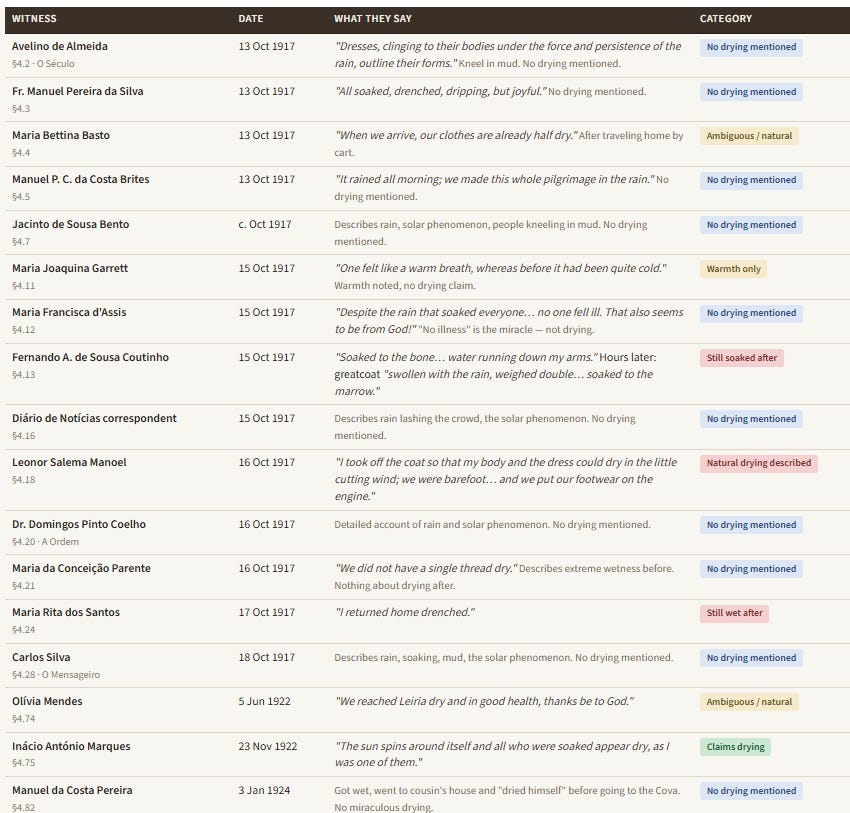
Sungazing, of course, also doesn’t explain the not-yet-known-to-science apparition phenomena. (Of course, one could posit once-in-a-millennium psychological phenomena happening to three children on six different occasions following a predictable pattern, which just happened to coincide with a months-in-advance prediction of the exact date, time, and location of a spectacular, once-in-a-millennium atmospheric phenomenon. But that is not believable. And even if it were believable, promise me you’re out of massive coincidences when you start thinking about Padre Pio or Calanda or Lanciano or Zeitoun or Lourdes (one, two) or Tixtla or Legnica or…)
I think the children’s reports aren’t that naturalistically improbable, and I give a bunch of natural parallels here.
First, other alleged sun miracles differ from the Miracle of the Sun in highly evidentially relevant ways — for example, they were not seen by distant witnesses, and/or the phenomenological reports are neither highly convergent nor saturated with striking undesigned coincidences, and/or they weren’t they seen by hostile witnesses who were present, and/or they didn’t dry wet clothes at thermodynamically impossible rates, and/or they weren’t predicted months in advance, and/or the seers associated with them don’t live lives of heroic virtue
None of these are remotely convincing:
It’s not true that the other cases are not convergent—read Scott’s post.
The “striking” undesigned coincidences are that 30 years later, some people report that they saw stuff kind of like what the people saw at Fatima. This is supposed to make me Catholic? This is why I’m supposed to think that you shouldn’t masturbate to prevent the extinction of humanity, that the Bible doesn’t err when it says God commands child sacrifice (and then contradicts itself), and that some people suffer forever in hell? Come on!
The wet/dry clothes is a nothing burger as explained above. So are the distant witnesses.
The other cases were often predicted in advance at Necedah, Lubbock, and (sort of) at Ghiaie (the schedule of apparitions was predicted in advance, a specific miracle wasn’t). It also isn’t that surprising that a lot of these are predicted in advance given the non-Catholic explanation: if sun miracles like the one described in Fatima happen when large crowds gather expecting a miracle, it isn’t surprising that some times this is caused by someone predicting that a miracle is going to happen.
Our earliest records of Lucia not backing down even under threats come years later and were denied by the administrator later. So it doesn’t really seem that clear that they manifested heroic virtue. In any case, that the seers were nice people does not make a miracle.
Indeed, Cradelstein once again faces a dilemma. Either the evidence for other sun miracles is comparable to the evidence for the Miracle of the Sun or it is not. If it is, then assuming that other sun miracles were natural begs the question against the Fatima proponent.39 If it isn’t, then the alleged fact that other sun miracles were natural has no interesting implications for the Miracle of the Sun.
This is not a dilemma. Here is the evidential situation: there are natural events that mirror much of the Fatima phenomenology but that we’re very confident aren’t miraculous. This is because:
They vindicate revelation that wouldn’t be expected of demons but is inconsistent with Catholicism.
They’re on video. It’s clear that no objective event is occurring. So in order to think Fatima is miraculous, you have to think God does a purely subjective miracle whose main effect is to discredit Fatima (e.g. Benin city).
In a lot of cases, some witnesses see nothing.
Many of them, like the ones at Medjugorje, apparently happen all the time. Presumably God isn’t doing sun miracles on a weekly basis.
The phenomenology doesn’t have to be exactly the same for it to majorly undermine the case for Fatima being miraculous. If there are natural events that display 6 of the 8 surprising features of Fatima, then it’s way more likely that Fatima was natural than that God did a miracle that bore repeated suspicious convergences with the nearest natural event.
Another dilemma afflicts this ‘horizontal strategy’, as Muse calls it. Either the objector can explain those other events naturalistically, or they can’t. If they can’t, then obviously those events are not going to help the naturalist explain Fatima. If they can, then they should be able to show how the relevant natural mechanisms explain Fatima.
No, what? The other events have some of the features at Fatima, but a lot of features that make it clear they’re natural (see above). So this illustrates that there are natural events that have many of the most surprising features of Fatima. Thus, even if they don’t have all the same features of Fatima, they make it pretty likely that we can explain the few remaining anomalies (and they make the miracle explanation weirder—because it has to posit that the miracle God did to vindicate Catholicism bore a bunch of phenomenological similarities to mundane sungazing).
(Slightly off color joke, apologies to all the Catholics reading: I was thinking of writing a piece called “In Defense of Two Kinds of Horizontal Strategy” in which I defend the horizontal strategy against the Muse Joah objections and also argue that Catholics are wrong about sexual ethics).
3 War is over, if you want it
Dustin and I argue that Lucia gave a failed prophecy. Right after the miracle of the sun, she reported “the war ends today.” It didn’t end. Joah think that her prophecy was conditional—she only said the war would end if people did enough penance.
I think it’s clear the prophecy was unconditional based on a vast confluence of testimony. This was included in my earlier article so I’ll just self plagiarize and repeat it. In 1917, Mendes wrote the following in his letter to his brother (p.61).
At the end I also took in my arms the eldest child, the seer; and how different her attitude was from that of 13 September!!... Now she seemed to me the messenger of some news, because in my arms she gesticulated and cried out, saying to everyone that they should do penance, because thus the Lady wished...
It is true that she also said that the Lady had assured her that the war would end that day and it is still going on, but for me the extraordinary thing in all that I saw is the coincidence of the atmospheric signs with the warning of the child, and then that immense mass of people with the best and greatest order, with the deepest reverence and without the slightest invitation.
Other important sources that establish this:
Doc 22 relays Jacinta on November 2 saying Mary “told us to expect the soldiers here very soon, and that the war would end that day.” It seems unlikely that Mary would tell them to expect the soldiers soon unless the war was ending soon.
Doc 80 relays Manuel Pedro Marto saying of Lucia “she also declared that Our Lady had told everyone to pray the rosary and that the war would soon be over.”
Doc 65 quotes Mary saying to Lucia, “When I get to heaven, the war ends today.”
The author of the newspaper O Seculo wrote on the fifteenth, just two days after the miracle “Lucia, who speaks with the Virgin, announces, with flowing hand gestures while being carried in the arms of a man who transports her from group to group, that the war will end and that our soldiers would be returning.”
O Mundo, describes Lucia saying “On October 13, she [the Virgin] would descend from heaven to earth for the last time to bring peace to the world and end the war.”
Some more I found since then.
In Doc 14, Ferreira notes Lucia said Mary said “the war ends today; wait here for your soldiers, very soon.”
In Doc 18, Formigao questions Lucia and she answers that Mary’s exact words were “The war ends today; wait here for your soldiers very soon.”
Doc 30 says “Francisco Brás das Neves, assistant of the parish of Freixianda,
of this Patriarchate of Lisbon, declares: that, having interviewed on the
twentieth of October of the current year, the two girls of the parish of
Fátima, who say that Our Lady appeared to them in the place of Cova
da Iria, of the same parish, on the 13th of the months from May to
October, inclusive, also of the current year, the eldest, named Lúcia,
told him that Our Lady, when she appeared to her on the 13th of
October, had promised her that the war would end on that same day.”
In Doc 24, written in 1924, we get an account from Lucia that reads “I think she also said it this way: “Convert, the war ends today, expect your soldiers very soon.” My cousin Jacinta told me at home that Our Lady said this: “Convert, the war will end within a year.”” So clear evidence of retconning (as that’s not what Jacinta said).
So the people who were at the place where the miracle supposedly occurred agree that Lucia said “the war ends today.” However, Joah argue “there is very strong evidence that the apparition’s prophecy was conditional: If the people prayed and did penance, the war would end.” Let’s see this evidence. ‘
Joah first quote Dr. Formigao’s interrogation of Lucia on the evening of October 13, 1917, which says:
She said that if we repented, if we did not offend Our Lord—who was very offended—if we prayed the Rosary and asked for forgiveness for our sins, the war would end today and we would see our soldiers back very soon.
This sounds conditional! Crucially, however, I’m pretty sure it’s not conditional. I have some friends who have been looking into it carefully, and they say that there was an old feature of Portuguese speech that vindicates this as unconditional. One of these people writes, in a private message to me:
It was extremely common to express unconditional wishes, desires or commands nested inside indirect speech via the imperfect subjunctive in early 20th century Portuguese, though this grammatical form has fallen out of use in recent decades and now sounds archaic. Countless examples of this can be adduced both inside the DCF series, in standard literature of the era and in language corpuses of local Portuguese speech painstakingly collected by field dialectologists. Moreover, parsing Lucia’s statement in this way yields a perfectly grammatical reading, whereas parsing it as conditional yields the bizarre broken grammar that Joe and Noah found so puzzling. Finally, Jacinta also phrased Mary’s words in a mostly similar way - very surprising if they’re both coincidentally phrasing the same conditional in the same unusual structure, especially when the unconditional reading is more natural on both of them, a reading that other native speakers of the era like Formigao took for granted. (In fact, there are even semantic reasons in addition to these syntactic ones to find the unconditional reading a more natural fit for Jacinta’s utterance - otherwise the antecedent of the condition, people praying every day, will transpire after the consequent, the war ending today!)
It’s apparently discussed more here. Formigao himself interpreted it as unconditional. He wrote (Doc 120):
She contested this, insisting that the vision had stated that the war would end that very thirteenth day, because she had used the word “today.” “She said the war ends today, today,” were the visionary’s actual words. Since it is an absolutely indisputable historical fact that the armistice that put an end to the great armed conflict in which the world’s greatest powers clashed was signed at Rethondes at eleven o’clock in the morning on November 11, 1918, and that peace was definitively established by the Treaty of Versailles on June 20, 1919, how can these acts be reconciled with the seer’s statement, whose sincerity there is no plausible reason to doubt? Can it be admitted that the undeniable reality of events inflicted a decisive, categorical, and, so to speak, brutal denial [37] of Lucia de Jesus’ prediction? This difficulty, perhaps apparently the most serious one opposing the supernatural origin of the apparitions of Fatima, can, it seems, be resolved in several ways, any of them reasonably satisfactory to sensible and educated minds, familiar with ecclesiastical history and with a sense of proportion.
I won’t get into too much detail, as I don’t want to steal the thunder of my friends (one of whom is Henri Mourant), which will probably be published as a substack piece at some point, but this is a big reason why I don’t put that much weight on this statement. See some more discussion here. And note: this explains why you shouldn’t much trust the testimony of the Portuguese speakers who Joah cited—this turn of phrase has apparently fallen out of favor.
The next bit of evidence Joah cite comes from a statement by Lucia in doc 8:
I want to tell you to keep praying the Rosary to Our Lady of the Rosary, that she may bring an end to the war, for the war is about to end; on the last day, St. Joseph will come to bring peace to the world and Our Lord will bless the people; come here on October 13.
However, the translation I have, that I asked Claude about, goes:
“I want to tell you to keep on always praying the rosary to Our Lady of the Rosary, so that she may ease the war, that the war is going to end; for the last day Saint Joseph will come to give peace to the world, and Our Lord will give his blessing to the people; that you come here on the 13th of October.”
So this version declares that she’ll end the war, and invites prayers to ease the war. This fits well with other statements—e.g. from doc 36:
“I want to tell you to come back here on the thirteenth: pray the rosary to Our Lady of the Rosary, that she may ease the war, for only She can avail against it.”
Joah cite this one, but this one seems like a point for me. That Lucia says people should pray to ease the war doesn’t mean she thinks that the end of the war is conditional on the 13th! And doc 3 advises:
“Pray the rosary to Our Lady of the Rosary, that she may ease the war, for only she can avail against it.”
So it seems that the best reading is that she was saying that people should pray to ease the war. And, in fact, she seemed to definitively declare that the war would end on 13th October. In fact, Joah’s citation says straight up, “St. Joseph will come to bring peace to the world and Our Lord will bless the people.” In October, Lucia does report that St. Joseph came to give peace to the world. So even if the prophecy was conditional, the condition was met. Joah cite a statement from October 11th, saying:
No, she didn’t; she just told me to pray to Our Lady of the Rosary so that the war would end.
But that Mary wanted them to pray for the end of the war ahead of time tells us very little about whether the declaration of the end of the war on the 13th was conditional! If I say “pray for Bob being healed of lupus,” and then two days later I say “God told me he’ll heal Bob of lupus,” if Bob isn’t healed, that’s obviously a failed prophecy. It wouldn’t do to say that the earlier recommendations were to pray for the healing of Bob from lupus!
Vibe check: everyone who wrote shortly after the events on the 18th say unanimously that Lucia predicted that the war would end that very day. On the other hand, we have statements from before about how people should pray for the end of the war and one extremely confusingly worded, grammatically dubious statement that maybe sort of indicates conditionality.
Joah quote Jacinta’s statement on the 19th, where she quotes Mary saying:
I have come here to tell you not to offend Our Lord any longer, for He was deeply offended; if the people were to amend their ways, the war would end, but if they did not, the world would come to an end.” Lucia heard what Our Lady said more clearly than I did.
She reiterated that telling on the 19th again. Note that in November, Jacinta said Mary “told us to expect the soldiers here very soon, and that the war would end that day.” This shows how Jacinta’s memory can be influenced by Lucia’s telling. But in any case, Jacinta’s testimony is weird because, as you may know if you’re an expert on the history of the 20th century, the world didn’t end. So this doesn’t save Lucia’s prophecy. In fact, Jacinta getting a separate prophecy that didn’t come true is itself pretty weird! And it’s not plausible that Jacinta’s was the one Mary gave, because it really doesn’t seem like you’d forget about warning of the apocalypse delivered by Mary herself! That’s not just some minor forgettable detail. And if Lucia can accidentally leave out tales of an imminent eschaton, then that is reason not to trust her testimony very much.
Joah claim that this conditional reading is corroborated by Mendes, writing in 1927, who testified:
Afterwards I again took Lúcia in my arms and, an extraordinary fact, she tried to raise herself still higher on my shoulder and with a strong and assured voice cried out: ‘Do penance, for the Lady wants you to do penance. Do penance, for the war will end. Do penance,’
Now, even this statement isn’t clearly conditional. But in any case, this comes 10 years later. In contrast, his letters from just a few months later read “It is true that she also said that the Lady had assured her that the war would end that day and it is still going on.” So it seems pretty clear that Mendes counts against conditionality (and illustrates how fallible one’s memory of events can be). They also quote a version of Mendes’s telling from 1948—obviously I’m not very impressed by testimony from 30 years later.
Joah then quote Fr. Manuel Pereira da Silva from October 13th, 1917, saying:
The girls said that he had told them that today, or soon, the flag of peace would be raised; that they should pray the rosary because soon our troops would arrive; that they should do penance and change their ways because, otherwise, the world would end.
This indicates that there was some prediction of the end of the world, but it doesn’t indicate that the end of the war prophecy was conditional—the opposite in fact. Also, this corresponds to Jacinta’s testimony, which I’m willing to grant was conditional, so probably he just heard it from Jacinta. They then quote Leonor de Avelar e Silva Constâncio who said:
Little Lucia said that Our Lady had asked her to build a chapel there dedicated to Our Lady of the Rosary; that the war was coming to an end; that the Portuguese soldiers would soon return to their homes; that the Portuguese should unite and do penance, for God was weary of so many offenses; that they should pray the Rosary in order to avert the punishments that would befall Portugal if the Portuguese did not amend their ways.
Joah write “For the claim that the Portuguese would have been punished (or that the world would have ended) had they not done penance strongly implies that the war only would have ended if they had done penance.” No, what the heck? Saying that God wants you to be good and pray the rosary or you’ll face judgment—in a comment that says nothing about the war ending—doesn’t vindicate the conditionality of the war. (Joah cite another source for the claim that God would bring judgment on Portugal if they don’t do penance. I agree the seers said that, but it doesn’t have to do with the war prophecy).
Joah then respond to the testimony from Formigao, which I’ll reproduce:
Interrogation of Lucia by Dr. Formigao, October 19, 1917
I began by questioning Lúcia, as follows:
1st – On the thirteenth of this month, did Our Lady say that the war would end on that very day? What were the exact words she used?
– She said, “The war will end today; wait here for your soldiers very soon.”
2nd – Did she say, “Wait here for your military” or “Wait here for your soldiers”?
– She said: “Wait here for the military.”
3rd – But look, the war is still going on!... The newspapers report that there has been fighting since the thirteenth!... How do you explain this, if Our Lady said the war ended on that day?
– I don’t know. I only know that I heard her say the war would end on the 13th. I don’t know anything else.
4th – Some people claim that they heard you say that day that Our Lady had declared that the war would end soon. Is that true?
– I said exactly what Our Lady had said.
Joah says:
when Lucia insisted that she was reiterating “exactly what Our Lady had said,” she was not pronouncing on whether the prophecy was conditional, but rather on whether Our Lady had said “soon” rather than “today.”
I don’t think this is true—the obvious reading is that her earlier accounting of what Mary said is “exactly what our lady said.” But Lucia also says that they should wait for the military. That wouldn’t make sense unless it was an unconditional prophecy. In any case, we have lots of other immediate testimony saying that she had given an unconditional rendering right after the events, so the exact wording here is less important.
Joah go on to say “Lucia claimed to have forgotten the immediate context of the prophecy since October 13, including the conditional warning of judgment reported by Jacinta and corroborated by other eyewitnesses.” It’s not surprising that you might worry that you were misremembering after your prophecy didn’t come true—you might hedge a little bit. And besides, the talk of punishment for repentance may have come later or only been from Jacinta. You can read the transcript below and see if you think this undercuts the evidential significance of the transcript two days after the miracle reporting her remembering the lady saying clearly that the war ends today.
Interrogation of Lucia by Dr. Formigao, October 19, 1917
Did She say that the people would be punished if they did not repent of their sins?
– I don’t remember if She said that. I don’t think so.
14th – On the 13th, you had no doubts, as you do now, about what Our Lady said. How do you explain your doubts today?
– On that day I remembered better; it had been less time ago.
Joah then note that five years later Lucia wasn’t sure if she’d gotten the wording right. If she got the prophecy wrong, it’s not surprising she’d have some kind of ret con five years later. Doomsday cults also have similar sorts of explanations when they incorrectly predict things.
Joah then attempt to accommodate the contrary evidence where everyone immediately after said that it was unconditional. They suggests Lucia may have inferred that the people would do penance, and so publicly declared that the war would end that day. Of course, this requires thinking that the people attesting to her claims being conditional were wrong. But even then, it requires a vast confluence of coincidences:
Mary for some reason made the end of the war conditional on some random people in Portugal doing enough penance.
Lucia was told that the war would end today if and only if they did penance. For some reason, she relayed this as the war would end that day. She also left out any talk of the potential impending apocalypse! Ask: if you were told “if you do penance, the war will end, if not, the world will end,” would you summarize this as “Our Lady says the war will end?”
Then, she misremembered what Mary had told her later. She had no recollection of the prophecy being conditional, even when she heard Jacinta’s conditional version.
Then, the people didn’t do enough penance, so the war didn’t end, even after they witnessed the giant miracle and were in a state of religious fervor.
The real prophecy said that either the war would end or the world would end. The world didn’t end (Joah have some cope about this—we’ll come back to it later).
If you believe this is what happened, I have a bridge to sell you!
Joah’s next hypothesis is:
Second, it’s entirely possible that some of the witnesses in the crowd (i) heard the children proclaim ‘the war is ending!’, (ii) understandably failed to realize that the children’s immediately preceding injunctions to pray the Rosary and do penance were causal conditions for the war’s end, and consequently (iii) assumed an unconditional prophecy about the war’s end.
So now here’s the story:
Mary for some reason made the end of the war conditional on some random people in Portugal doing enough penance. If they didn’t, she decided to immanentize the eschaton.
Lucia said “the war ends if and only if you do penance, if not, the world ends.” All early accounts of what she said report it as her saying “the war ends today, wait here for your soldiers very soon,” or some variation.
The people didn’t do enough penance, so the war didn’t end.
Then, Lucia misremembered what Mary had told her later. She had no recollection of the conditionality, even when she heard Jacinta’s conditional version.
But the war didn’t end either, for some reason.
Joah next claim:
It’s also plausible that the unconditional form of the prophecy was transmitted by one or a few mistaken eyewitnesses to others in the crowd. Note that even proponents of the unconditional prophecy view must say this (or something similar) about some of the eyewitnesses, like Mendes and da Silva, since they reported that the prophecy was conditional.
But da Silva wasn’t relaying what they said immediately, but instead what they said later—and that was also plausibly based on Jacinta’s testimony, which was conditional. Mendes’s statement, remember, came a decade later, so it’s a lot less surprising that there’d be errant transmission 10 years later than immediately!
So now the story is:
Mary gave the conditional prophecy relayed by Jacinta, where either the war would end or the world would end.
Lucia stated it correctly.
The crowd misheard, so that basically everyone in the crowd who we have contemporary reports from thought it was unconditional (except one guy correctly remembered it a decade later but incorrectly remembered it a few months later).
Lucia later misremembered, so that her memory of what Mary said converged with what the crowd heard but she didn’t really say.
The people didn’t do enough penance so the war didn’t end.
The world didn’t end.
Again, all of these are improbable. Stacking six major coincidences against one objection to Fatima isn’t a sustainable strategy.
Lastly, we have:
Third, although the evidence suggests that Lucia originally understood the prophecy conditionally, even if we grant the skeptic that she originally understood it unconditionally, she may simply have misheard it. People mishear things often, especially during commotions, and especially during absolutely singular, highly emotionally charged commotions.
So now the story is:
The prophecy was about the war ending or the world ending. Lucia misheard the prophecy and didn’t hear the bit about the apocalypse.
The people didn’t do enough penance to end the war.
There was no immediate end of the world.
It’s possible I guess. Though it’s pretty weird if Lucia doesn’t hear the thing about the apocalypse. Surely if Mary wants her to relay that the people need to do penance to stop the end of the world, she’d ensure Lucia heard her correctly. I think this option is the least bad for the Fatima proponent, but still, it seems pretty bad. And still, there’s the triple coincidence: not hearing correctly, not enough penance, no imminent eschaton.
Joah then say that Lucia “testified under oath that she was distracted when the apparition prophesied the end of the war.” The evidence for this comes from 1924—7 years later—when she’s explaining why she incorrectly predicted the end of the war. This isn’t very impressive.
Joah rightly note that because this is a positive argument against authenticity, so for it to be good, it must be that their explanations are all very implausible. True. They are.
Joah’s next section argues that Jacinta’s earliest telling of the prophecy was conditional. I now agree with this—Jacinta said either the war or the world would end.
4 It’s the end of the world and it makes no difference to me now
(Reference to the banger song Alarms In The Heart).
How do the Fatima proponents explain the world not ending? Here we see levels of cope rarely before seen in human history.
They say that maybe the world didn’t end immediately but the war not ending merely inaugurated the series of events that would lead to the end times and second coming. Reply: do you buy this excuse when it comes from doomsday cults? If not, you shouldn’t buy it here.
They say that maybe the phrase “the world will end,” was used metaphorically to just mean some big calamitous things would happen. Reply: if some cult leader predicts the end of the world, and it doesn’t end, would you buy this excuse? No! You shouldn’t buy it here either.
They say that maybe God was going to end the world but relented based on the penance of some people in Portugal. But Mary allegedly said either the war or world would end. So if neither of those happened, then the prophecy was false. Again, ask: would you buy this excuse coming from someone predicting the world was ending in the modern day?
They suggest that because Mary never said the world would end today, maybe the degree of cataclysm would parallel the degree of penance.
(a) The people repent today → the war ends today and the world is ultimately spared.
(b) The people repent eventually → the war continues but the world is ultimately spared.
(c) The people never repent → the war continues and the world ultimately ends.
They then argue condition b was met. However, this typology is never given by Mary. It’s just entirely made up after the fact. And while it’s not strictly impossible as an interpretation, obviously it’s very strong evidence against authenticity—especially because this is just one of many implausible things Fatima defenders have to think happened.
Joah say:
I have identified four reasonable, vindicatory interpretations of Jacinta’s prophecy. So long as at least one of these interpretations is defensible — indeed, so long as the disjunction of all four is defensible — the skeptical objection fails.
I disagree. I think they have identified four absurd, ridiculous, farcical interpretations that we’d all laugh at if given as a defense of, say, a failed prophecy from Joseph Smith. And remember: this is just one of the ridiculous things the Fatima proponents must believe.
Another objection to the Fatima apparition being genuine is that it’s not plausible that God would make the end of WW1 dependent on a bunch of random people in Portugal doing enough penance. The war was nowhere close to ending! So to believe this, you’d have to think God would intervene in some enormous way like he has never uncontroversially done before. And if he did this, then he’d no longer be hidden—so this would violate the hiddenness model.
Joah point out that there are a bunch of biblical stories where God ends wars. Fair enough, but I don’t think those happened, and neither does Dustin. In any case, no direct massive divine intervention to end a war has occurred since the birth of Jesus, so it would be surprising if it was going to happen if some random people in Portugal did enough penance.
It also seems to reflect poorly on God. Here is a principle: one shouldn’t make very significant things depend on much less significant things. For example, the president shouldn’t make American foreign policy towards an entire country depend on whether his daughter picks up her toys. Similarly, it is capricious to make the fate of millions of people depend on whether a comparatively tiny number of people in Portugal do penance.
He could have appeared to the German emperor and commanded him to offer terms of peace or simply order a ceasefire while terms of peace were drafted. He could have made similar appearances to other world leaders to ensure the peace talks were successful. He could have induced a few German officers to defect, giving the Allies a window to achieve a swift and decisive victory on the battlefield and prompt the Central Powers to surrender. He could have orchestrated a secret peace treaty signed on October 13th between the warring countries.
But this would have been just about the weirdest thing that ever happened. You should think it’s pretty unlikely that God was going to do the weirdest thing ever to stop a global war—but only if some people in a field in Portugal did enough penance.
Joah give some reasons why God might make us responsible for helping one another. It’s true that if God exists, it makes sense that prayer might be efficacious. But it would be surprising if very major world events depend on the prayers of comparatively small numbers of people.
I’m now 10,000 words into this post. Joah claim that “The pattern of failed objections recurs.” Is this true? Remember: here is what they think happened. God decided to have whether the world ended or the war end depend on whether a small number of people in Portugal did enough penance. They didn’t. Then the world didn’t end. Neither did the war. Then his prophetesses all—according to the eyewitnesses—grossly misstated the content of the prophecy, claiming that the war would end. Then the main seer claimed to have secrets warning of World War Two which, among other things, only appears in demonstrable public letters after WW2. She also, in her memoirs, claimed Mary told her a bunch of things that are independently implausible but very much fit with the prevailing sentiments of the time.
Certainly I don’t feel as though the Fatima skeptic is embarrassed. Quite the opposite in fact. I don’t mean this to be mean or triumphalistic, and Joe and Noah are both brilliant. But I will just confess: I find it completely and utterly baffling that they don’t feel that the position they’re forced into is ridiculous and untenable. Probably they feel the same way about me.
5 Making things up again
A big part of the evidence that Fatima vindicates Catholicism comes from the secrets Lucia allegedly received in 1917 that she relays in her 1942 memoirs. One of these secrets said that a second world war was going to break out, but it could be stopped by the Pope consecrating Russia to Mary’s immaculate heart, in which case the war would end, Russia would be converted, persecution in Russia would stop, and there would be peace. A consecration is the act of declaring one thing dedicated to another thing. So supposedly Mary demanded that the pope consecrate Russia to her immaculate heart to secure the conversion of Russia.
Early testimony attests to the fact that Lucia had secrets as a child. But the secret about Russia was only made public in Lucia’s memoirs in 1941. Team Cradelstein argues that the secrets were made up around 1940 after war was imminent. Team Joah disagrees.
Edit 9/11: I found a letter from 1939 that indicates the war war imminent. So it seems like they were made up in 1939.
Here is the Adelstein hypothesis: Lucia, as a conservative Portuguese Catholic, around 1929 came to believe that Russia should be consecrated so as to stop their godless communism. This secret got embellished, so that when war was imminent, it included predictions of the war. I have three main arguments for this.
First, the only unambiguous revelation of the secret came after the war broke out. This is, to use a technical term, sus. It’s what we’d expect if Lucia was making up secrets later, but it’s surprising if the secret was revealed to her as a child. The war secret isn’t mentioned until 1941 in Lucia’s third memoir.
Second, Lucia repeatedly “predicted” things but only after they occurred. It turns out that it’s easier to predict something after it happens.
Lucia reveals in her memoirs that Mary revealed that Jacinta and Francisco would die young but Lucia wouldn’t. We don’t hear about this until long after the fact. Lucia even says in the earlier bit of her memoirs that she at one point “thought, therefore, that [her] last hour had come,” which would be a bit surprising if she knew that she wasn’t going to die young. You’d also think that Francisco and Jacinta might mention their incoming death—from their behavior in the memoirs, it doesn’t seem like they thought they’d die really soon.
Lucia in her memoirs also relays that there were earlier 1916 apparitions of the angel of peace. There are no records of this before her memoirs.
Allegedly Lucia got a secret mentioning Russia when she was a child. But she was only permitted by Mary to reveal it in 1927! By 1927, the Soviet Union was a big deal and the major enemy of Catholics. So on the assumption that Lucia was making up the secrets as she went along, it makes sense that she would mention them in 1927, but not as a child, given that little kids have no concern for geopolitical relations and the Soviet Union was a pretty minor thing in 1917.
Third—and here’s the clincher—we have a bunch of letters from Lucia. There is a massive sea change in 1940, where the letters begin to talk about consecrating Russia being sufficient to stop the incoming war. Before 1940, the letters talked about the importance of consecrating Russia, but they conspicuously omitted talk of an impending global war, even when written to people who Lucia allegedly confided in ahead of time.
I’ll try to be exhaustive, but there may be some letter that I’m missing. Note that a lot of this stuff is contained in hard to access archival material, so if anything, there is a strong selection effect in favor of letters with strong apologetic value. The sources I’m citing mostly were revealed through a somewhat frenetic and one-sided polemic called The Whole Truth About Fatima. And yet still, despite the smattering of letters revealed to the public being primarily selected for apologetic usefulness, they still make it clear that the secrets were made up later.
1930
In a 1930 letter to her superior director, Lucia wrote:
This is what seems to have passed between God and my soul, concerning the reparatory devotion to the Immaculate Heart of Mary, and the persecution in Russia.
THE REQUEST FOR APPROVAL OF THE REPARATORY DEVOTION
If I am not mistaken, the good Lord promises to put an end to the persecution in Russia, if the Holy Father himself deigns to make a solemn and public act of reparation and consecration of Russia to the Sacred Hearts of Jesus and Mary, as well as ordering all the bishops of the Catholic world to do the same, and if the Holy Father promises that, upon the end of this persecution, he will approve and recommend the practice of the reparatory devotion already described.
A few things are notable:
The letter doesn’t present this as a second secret but instead as a seeming that Lucia has based on “what seems to have passed between God and [her] soul.” It’s totally bizarre to refer to it this way if this is the content revealed directly by Mary in 1917!
There’s no mention of Russia spreading her errors throughout the world.
There’s no mention of an impending global war.
There’s a bit in this letter that doesn’t line up with the later secret. The later secret says nothing about the Holy Father promising that “upon the end of this persecution, he will approve and recommend the practice of the reparatory devotion already described.”
The website also has another passage from (I think) the same letter, saying basically the same thing, with the same conspicuous omissions.
1931
From a 1931 letter of Lucia to the bishop of Leiria, we read:
My confessor orders me to inform Your Excellency of what took place a little while ago between the Good Lord and myself: as I was asking God for the conversion of Russia, Spain and Portugal, it seemed to me that His Divine Majesty said to me:
“You console Me a great deal by asking Me for the conversion of those poor nations. Ask it also of My Mother frequently, saying:
Sweet Heart of Mary, be the salvation of Russia, Spain, Portugal, Europe and the whole world.
At other times say:
By your pure and Immaculate Conception, O Mary, obtain for me the conversion of Russia, Spain, Portugal, Europe and the entire world.”
“Make it known to My ministers that, given they follow the example of the King of France in delaying the execution of My request, they will follow him into misfortune. It will never be too late to have recourse to Jesus and Mary.”
Again, no mention of the impending global war. All talk is of conversion of Russia. There’s also this line about the King of France which will appear later, with embellishments.
1935
In a 1935 letter to Goncalves, Lucia wrote:
Regarding the matter of Russia, I think it would please Our Lord very much if you worked to make the Holy Father comply with His wishes.
FOR THREE YEARS OUR LORD HAS NOT ASKED FOR ANYTHING…
About three years ago Our Lord was very displeased because His request had not been attended to and I made this fact known to the bishop in a letter. Up to date Our Lord has asked nothing more of me, except for prayers and sacrifices.NEVERTHELESS, THE PROMISE CONTINUES.
When I am speaking intimately with Him, it seems to me that He is ready to show His mercy toward Russia, as He promised five years ago, and whom He wishes so much to save.But you can see that to speak intimately with God is very different from speaking personally, and that the doubt of error is always greater.
Keep in mind:
Again, this isn’t presented as a definite secret but as a sort of vague sense she gets through prayer.
She admits that it’s a bit uncertain as “the doubt of error is always greater.” This is a totally bizarre way to refer to the things she directly heard from Mary.
There’s no mention, again, of the second big war that would break out.
1936
Lucia wrote in a 1936 letter to Goncalves:
Intimately I have spoken to Our Lord about the subject, and not too long ago I asked Him why He would not convert Russia without the Holy Father making that consecration?
“Because I want My whole Church to acknowledge that consecration as a triumph of the Immaculate Heart of Mary, so that it may extend its cult later on, and put the devotion to this Immaculate Heart beside the devotion to My Sacred Heart.”
“PRAY VERY MUCH FOR THE HOLY FATHER!”
“But my God, the Holy Father probably won’t believe me, unless You Yourself move him with a special inspiration.”
“The Holy Father! Pray very much for the Holy Father. He will do it, but it will be late!”
AN UNCONDITIONAL PROMISE.
“Nevertheless the Immaculate Heart of Mary will save Russia. It has been entrusted to Her.”
So now we get an unconditional promise that Russia will be saved and converted from Lucia’s letter. And once again, there is mention of the conversion of Russia but absolutely no mention of the second impending global war.
In another 1936 letter, Lucia allegedly sent a letter to Father Goncalves containing the following. We don’t actually have the letter. What we have is a copy supposedly made in 1941 when the original letter was destroyed. Our source for the existence of this copy is this book written in 1984:
«At this time Our Lord informed me that the moment had come when He willed for me to make known to the Holy Church His desire for the consecration of Russia and His promise to convert it... The communication took place in this way:
…
«Later on, by means of an interior communication, Our Lord said to me, complaining: “ They did not want to heed My request!... Like the King of France they will repent and do it, but it will be late. Russia will have already spread its errors throughout the world, provoking wars and persecutions against the Church: the Holy Father will have much to suffer.”»
Like a lot of the Fatima sources, our source here comes from the highly energetic Frère Michele author of The Whole Truth About Fatima, who is citing books that are very hard to track down. I say highly energetic because of passages like this one:
The evidence on the apparitions and miracles of Fatima pose a fascinating problem for the critic. Whether the historians consider them credible or not, they are facts which must be explained. Yet, neither one of the two solutions we have just proposed is acceptable. The modernist explanation? It is fundamentally incoherent! The rationalist explanation of a fraud perpetrated by the clergy? It is unfounded, ridiculous and grotesque! Only one solution remains: that of the most serious historical criticism, concluding in favour of the perfect credibility of the witnesses, and thus the supernatural origin of the events of Fatima.
More in a footnote.3
I think it’s possible that this wasn’t really written in 1936, as the paper trail is pretty sketchy and it doesn’t fit with the other publicly revealed secrets. But even if this letter was written in 1936, it isn’t a big problem for my position. The Soviet Union was the big enemy of the Portuguese clerics and had started a bunch of wars—so it’s not surprising that there’s mention of wars breaking out. There’s no mention of a single great war breaking out.
And remember, we already had the relaying of a letter making the comparison to the king of France in 1931. Nothing about wars was mentioned.
1937
In 1937, Bishop Da Silva sent a letter to Pope Pius the eleventh, that talked in detail about the secret:
Of the three children to whom Our Lady appeared, two are dead and the surviving one is a religious in the Institute of Saint Dorothy in Spain.
This religious asks me to communicate to Your Holiness that according to a revelation from Heaven, the Good Lord promises to end the persecution in Russia, if Your Holiness deigns to make, and order all the bishops of the Catholic world equally to make, a public and solemn act of reparation and consecration of Russia to the Most Holy Hearts of Jesus and Mary, and also deigns to approve and recommend the practice of the reparatory devotion.
Remember, this was a world in the shadow of World War one. So if there was another world war that was going to break out unless the consecration occurred, you’d think that fact would be, you know, worth mentioning! You wouldn’t just talk about ending the persecution in Russia.
1938 onwards
Edit 9/11: I earlier thought the secret was made up in 1940. Now I think it was made up in 1939.
It is claimed in The Whole Truth About Fatima—again by the energetic Frère Michele—that Lucia wrote letters to her bishop in 1938-1939 saying the war predicted in the secret was imminent. The evidence for this is “Statement of Cardinal Cerejeira” from “March 19, 1967.” Reportedly the 1939 one said that Portugal would be spared. The source there is also from testimony of Cardinal Cerejeira, relayed in March 19 1967. I don’t place much trust in these, written many decades later.
In another source, also from Michele, it is alleged that Lucia predicted, in a letter to Father Aparicio on June 20, 1939 the upcoming war. It wouldn’t shock me if this was real. I was able to track this down, the letter is real, and this is what it says. So she must have had the secret by 1939.
By 1940, we have letters definitively relaying the secret. So my position requires that Lucia made up the secret about a second global war around 1940, maybe a year or two before. Joah reply to me by pointing out:
At least two cardinals testified that they received a letter from Lucia (forwarded by her bishop) predicting the outbreak of the war in February 1939, many months before war was declared:
The two are Cardinal Cerejeira—in both 1948 and 1956—and Cardinal Ottaviani. Ottaviani’s testimony, in 1967, sounds better for Joe and Noah’s case, and it originally included the line:
The imminence of this war, along with its violence and scope, was communicated to the Bishop of Leiria seven months before it began. In fact, I have in my possession the letter dated February 6, 1939, in which the visionary described as imminent (she wrote “eminent”) “the war foretold by Our Lady,” and promised Our Lady’s protection over Portugal “thanks to the consecration to her Immaculate Heart made by the Portuguese episcopate.”
It turns out, however, that this is a mistranslation (Joah now agrees with this, and has issued a correction). Here’s Claude’s rendering:
The imminence of this war, together with its violence and its extent, was communicated to the Bishop of Leiria seven months before it began. Indeed, I have held in my own hands the letter of 6 February 1939 in which the seer described "the war foretold by Our Lady" as imminent (she wrote "eminent"), and promised Our Lady's protection over Portugal "thanks to the consecration to her Immaculate Heart made by the Portuguese episcopate."
Note that we have another source that relays the fuller quote. We know it’s the same because it was also delivered at Rome, also dated February 10th, also delivered by a cardinal, though Frère Michele attributes it to Cardinal Cerejeira (I have been unable to figure out who is right about its attribution, but I’d welcome anyone who can). Here’s the quote in full:
«I can add that the imminence of this war and its violence and extent was communicated to the Bishop of Leiria seven months before its beginning. Indeed, I had in my hand the letter of February 6, 1939, where the seer called “the war predicted by Our Lady” imminent (her handwriting says eminent), and promised Our Lady’s protection to Portugal “thanks to the consecration to Her Immaculate Heart made by the Portuguese episcopate”.
«I don’t know what became of this letter. But I possess only a summary of it drawn up by the hand of the Bishop of Leiria, dated the following October 24, which says the following: “The principal chastisement will be for the nations that wanted to destroy the kingdom of God in souls. Portugal is also guilty and will suffer something, but the Immaculate Heart of Mary will protect it; the good Lord desires that Portugal make reparation and pray for itself and for other nations. Spain was the first to be punished, it has received its chastisement which is not yet over, and the hour approaches for others. God is resolved to purify in their blood all the nations which want to destroy His kingdom in souls; and yet He promises to be appeased and grant pardon, if people pray and do penance.» 20
So the more complete version of the message reveals that:
This is a memory of a letter that is lost, reproduced via later correspondence.
Portugal “is also guilty and will suffer something, but the Immaculate Heart of Mary will protect it,” which is a lot less strong than the earliest statement.
I think she probably made up the secret in 1939. It was pretty clear that war was brewing by that time.
The two people I’ve heard make the argument that they wouldn’t misremember the contents of the pre-1940s letters—Ethan and Noah—have both misremembered the contents of the pre-1940s letters. Ethan, for example, claimed in his debate with Dustin that the letter in 1937 from Bishop Da Silva to Pope Pius mentioned the war. It didn’t. It’s a bit funny that everyone other than Joe who I’ve heard make the argument that the people wouldn’t misremember the contents of the letters to add a false mention of an incoming war has misremembered the contents of the letters to add a false mention of an incoming war.
Joah write:
Her use of the elliptical phrase “the war foretold by Our Lady” indicates that the original recipient of the letter, the bishop of Leiria, had corresponded with her about the war in the past.
This isn’t right. The context for the war might be given elsewhere in the letter.
Next Joah note Lucia’s response to the skeptical Father Dhanis, who questioned whether the secrets were made up later:
Lucy declared in 1946 : “this Jesuit Father can write to my confessors, to ask them what I communicated to them in 1927 ; they are Fathers José da Silva Aparicio and José Bernardo Gonçalves.” When asked : “To whom else did you reveal the secret before the war ?” she answered: “To the Provincial Superior, to the Bishop of Leiria, and to Canon Galamba.”
But again, I agree that by 1946 people thought that Lucia had foretold the alleged upcoming global war. My theory is that they misremembered the contents of the earlier letters. And this is believable because we know that multiple people have misremembered the contents of the earlier letters while defending Fatima! Eyewitnesses are very fallible. They can very easily embellish the details of a letter they got about eight years prior (I definitely couldn’t remember all the details of a letter I got when I was 14!).
In addition, we have other evidence that Lucia didn’t actually reveal the contents of the secrets to the spiritual confessors in question. At one point she mentions relaying the secret after 1927 but says “I think he did not read it.” More in a footnote.4
If Lucia was slowly adding on accretions to the contents of her letters it is totally believable that people would misremember them being in her letters. And we have strong evidence this is the case from every single publicly available letter written before 1940.
Thus, I think we have strong evidence that the secret was majorly embellished over the years. Every letter before 1938 clearly omits any discussion of the “second worse war.” Early sources are clear that it’s a sense Lucia got via prayer, not a secret she got as a child. Over time, the secret was embellished massively until it took its modern form around 1940.
On the one hand, we have the unanimous testimony of the letters that are publicly available—despite many having been leaked specifically by pro-Fatima sources for theological reasons. On the other, we have reports from much later about the contents of the letters. Obviously I find the first kind of evidence a lot more convincing.
Joah argue that even if we don’t have records of the secret until later, this wouldn’t be evidence against her trustworthiness. She may just not have wanted to reveal the details of it on the advice of her superiors, because if the prediction came out untrue, it would be scandalizing. But this won’t explain the conspicuous omissions from all the earlier letters that mention the secret but leave out discussion of the war. And even if you can come up with some explanation for omitting any discussion of the secret, it’s still evidence against her reliability. If the secret was made up later, then it’s guaranteed there wouldn’t be early mentions of the war.
6 Who's to blame
Joah make some good points about the idea that Lucia didn’t really try that hard to consecrate Russia. I didn’t place that much weight on this originally and I think their replies are good! Strike it from the record.
Our next argument is that it’s pretty weird that the secret focuses so much on Russia when talking about World War 2. This is what you’d expect from a Portuguese cleric at the time in Portugal under the Fascist Salazar government. However, if Mary was talking on behalf of heaven, she’d probably mention Germany and the other axis powers. Here’s the text of the secret:
To save them [poor sinners who are on the road to hell], God wishes to establish in the world devotion to My Immaculate Heart. If what I say to you is done, many souls will be saved and there will be peace. The war is going to end; but if people do not cease offending God, a worse war will break out during the reign of Pius XI. When you see a night illumined by an unknown light, know that this is the great sign given you by God that He is about to punish the world for its crimes, by means of war, famine, and persecutions against the Church and against the Holy Father.
To prevent this, I shall come to ask for the consecration of Russia to My Immaculate Heart, and the Communion of Reparation on the First Saturdays. If My requests are heeded, Russia will be converted and there will be peace; if not, she will spread her errors throughout the world, causing wars and persecutions against the Church. The good will be martyred, the Holy Father will have much to suffer, various nations will be annihilated.
Joah say that “the Second Secret does not portray Russia as the primary instigator of World War II specifically. It portrays Russia as the primary instigator of the wars, famines, errors, persecutions, and national annihilations that characterized the 20th century. And this portrayal is perfectly natural and wholly accurate.”
But again, this it’s weird for Mary to provide a detailed description of when World War II is going to break out—and a way to recognize it—with the gloss being that this is God punishing the world for the Soviet Union’s crimes. If you were a Portuguese Catholic, this is the kind of thing that it’s likely you’d say, but it would be a lot more surprising coming from Mary.
The fact that Mary also mentions a bunch of other things being caused by the Soviet Union—that they did cause—is irrelevant to this argument. Joah claim “from a Catholic perspective (and many non-Catholic perspectives), the most malign geopolitical actor of the 20th century, by far, even in hindsight, was Russia. This is yet another striking forecast by Lucia.” But it’s not a striking prediction because we know independently that the main enemy of Portuguese Catholics in 1941, at the time Lucia’s memoirs were revealed, was the Soviet Union.
Moving on:
The second problem with Cradelstein’s argument is that Russia was among the primary instigators of World War II, since the Soviet Union deliberately facilitated Hitler’s conquest of Western Europe and launched its own invasion of Eastern Europe in the early years of the war.
But the secret says that WW2 is God punishing the world for the crimes of the Soviet Union, not that the Soviet Union was specifically instigating the war. So this isn’t a correct prediction! And in any case, it’s not surprising you’d mention the Soviet Union. It’s surprising you’d conspicuously omit any mention of, say, the Germans—even as they were shooting millions of people.
Suppose you were giving a gloss of WW2 to someone in 1917. Would it be a responsible summary to give it as “God punishing the world for the Soviet Union’s errors,” and then omit discussion of the massively evil force. At the time the secret was published, the Soviet Union was on the right side of the war, fighting against the axis powers. So talking about it being the byproduct of Soviet errors gives a substantively misleading impression.
The third problem with Cradelstein’s argument is that, if its premise were true (namely, that the Second Secret blames Russia for World War II specifically), it would conflict with Cradelstein’s own timeline for the Second Secret. Recall that, according to Cradelstein, the final form of the Second Secret is a fabrication dating to shortly after the outbreak of World War II. If someone were fabricating a Secret after the outbreak of the war, we would expect the Secret to blame (or at least mention!) Nazi Germany for the war, not Russia.
This isn’t true on two counts. First, the secret isn’t clearly about the cause of the war. Instead it says the war is punishment for Soviet malfeasance. Second, by 1940, the Soviet Union had already invaded Poland, Finland, the Baltic States, and Romania. So it’s not that surprising that a Portuguese Catholic at the time would have heaped blame on the Soviet Union for the war.
So it doesn’t seem like as of 1940, she was clearly attributing specific blame for the war on Russia. Just at a high level, I find it pretty silly that Joah think there’s something surprising on my theory about Lucia blaming World War Two on Russia, when Russia was the major enemy of Portuguese Catholics.
Lastly, Joah argue that even if the second secret was made up later, this wouldn’t much undermine Catholicism. Even without the second secret we have:
Mary telling the children to pray the rosary which has a bunch of Catholic elements.
Mary calling for sacrificial penance and offering up suffering as penance.
Mary promising to convert several specific people to Catholicism.
Joah write:
Vibes check: If the Virgin Mary is appearing to Catholic children, enjoining people to pray the Rosary and practice mortification and vicarious sacrificial penance, and answering prayers to convert people to Catholicism, that is clearly extremely powerful evidence for Catholicism.
Vibes check: if the main seer at Fatima is fabricating secrets that the message allegedly vindicates, that is clearly extremely powerful evidence against her credibility and the credibility of the apparitions. It would mean Lucia is capable of hallucinating revelations she never had. I’m also pretty sure the sacrificial penance is only attested much later, in Lucia’s memoirs.
In addition, it’s not that surprising if theism is true that God tells people to practice religious devotionary prayer. If God appeared to a protestant, and told them to pray some protestanty prayer, I wouldn’t think that was decisive evidence for Protestantism.
7 Back to Moscow, Irresolution doesn’t suit you
(Reference—great song).
In the second secret, Lucia reported that Mary had claimed that if the pope consecrated Russia, then Russia would be converted and there would be a period of peace. There were four attempted consecrations. The first two weren’t made, as Mary had suggested, along with all the bishops of the world.
The third was made under Pope John Paul II in 1984. Joah argue that this one was successful and lead to the conversion of Russia and a period of peace:
A year later, almost to the day, Mikhail Gorbachev was elected president of the Soviet Union. He almost immediately implemented an informal policy of religious toleration which culminated in official recognition of religious freedom in 1988 (the end of persecution). By 1991, the Soviet Union had collapsed, and Russia had abandoned Communism and consequently state atheism (conversion).9 Europe did not see another major war for thirty years (a period of peace). Notice that, like her prophecy of World War II, this prophecy vindicates Lucia when interpreted in light of the documentary evidence: Lucia forecasted highly contingent historical events decades in advance.
Gorbachev became General Secretary in 1985; he became the Soviet president in 1990 (this is just a nitpick—in 1985, he had the most influence of anyone in the Soviet Union). I don’t think it’s accurate to describe the collapse of the Soviet Union as conversion. Russia didn’t convert! In fact, Lucia was clear that conversion meant conversion to Catholicism. As Mark Docherty writes:
Father Joaquin Alonso, probably the foremost Fatima expert of the 20th Century, had many interviews with Sister Lucy. In 1976 he wrote: “… we should affirm that Sister Lucia always thought that the ‘conversion’ of Russia is not to be limited to the return of the Russian people to the Orthodox Christian religions, rejecting the Marxist atheism of the Soviets, but rather, it refers purely, plainly and simply to the total, integral conversion of Russia to the one true Church of Christ, the Catholic Church.
In addition, while Gorbachev was elected in 1985, it wasn’t until 1991 that the USSR officially ceased to exist. It took several years after 1985 for religious persecution to end. So there was no “conversion” in 1985. In fact, in 1985, Gorbachev escalated the war in Afghanistan and many other wars followed in the wake of the collapse of the Soviet Union (Claude-generated list in a footnote).5
Also, the consecration didn’t mention Russia by name. This is why Ethan thinks it was invalid. So Joah’s claim that the 1984 consecration vindicates Lucia depends on a very tortured reading of both the prophecy and the history. It’s not an impressive prediction if you say that there will be conversion and then the fulfillment of that is that about six years later, there’s a kind of conversion that the prophetess didn’t have in mind.
The clearer successful consecration is the one done in 2022 by Pope Francis. That one, obviously, hasn’t been met with conversions or a period of peace.
Obviously, none of this requires that Mary bizarrely fixates on hyper-specific linguistic formulae, contrary what Cradelstein suggests. Intentions matter in consecrations, and if the Popes were intentionally avoiding singling out Russia out of cowardice and faithlessness, it is unsurprising that Mary would regard their pseudo-consecrations as inadequate. (Why didn’t Mary try to clear things up? Because she was already clear — she asked for a consecration of Russia specifically, not the whole world, and under the operative hypothesis, the Popes failed to designate Russia in particular — and not only that, but they sinfully refused to single out Russia in particular. It is unsurprising that Mary would not look kindly upon that.)
It’s weird to condition the conversion of Russia on a very precise statement by the pope. It’s especially weird for it to depend sensitively on exactly what the pope says, so that the pope can say something that he thinks fulfills it, that Lucia thinks fulfills it, but that doesn’t really fulfill it. We’re supposed to believe that the reason that millions of people had to die for decades was because the pope didn’t say the right words during the failed consecrations of the 1940s?
To recap, then, Joah give a pretty good argument for why the 1984 consecration was insufficient. They also argue that the 1984 consecration was successful. I basically buy their argument for its insufficiency—but I think the 2022 consecration under Francis was clearly successful. That one clearly failed. Thus, accepting the success of both their arguments, the failed prophecy remains.
Also, if none of the consecrations so far have been successful, this would falsify her statement in 1936 to Goncalves that “Nevertheless the Immaculate Heart of Mary will save Russia. It has been entrusted to Her.”
8 Nonsense?
Joah has a section titled “Does Cradelstein’s Explanation Make Any Sense?” They think no. I think yes. Most of this section simply involves regurgitating previous points. They provide only three new arguments.
First, they say that my theory requires positing “scientifically unprecedented psychological anomalies to explain Lucia’s sincere belief in the apparitions.” I don’t think this is true at all—the phenomenology of Lucia isn’t very different from that of the Piraha who see spirits in broad daylight, UFO appearances, and other apparitions of the virgin Mary that conflict with Catholicism. Maybe Joah thinks these are miraculous, but they can no longer claim without begging the question that these are unprecedented. The fact that they attribute a lot of the precedent to demons doesn’t mean there is no precedent.
Second, they say Lucia and her cousins stories converged miraculously under questioning. I’ve investigated this claim in detail—I don’t think it’s true. The children’s testimony diverges a lot, and they were often questioned together.
Lastly, they say “there are many medically attested healings associated with Our Lady of Fatima and with physical artifacts from the site of the original apparitions.” I am 14,532 words into writing my response to Joah, so I’m not going to do a massive deep dive into the healings. I’ll simply say that if God sometimes heals faithful people who go to Fatima to pray, I’m not that bothered. I already think God miraculously heals people. Also, if a lot of people visit Fatima, it wouldn’t be that surprising if we have some testimony of healings—just as we do from a Protestant woman named Maria Woodworth-Etter who claimed revelations that affirmed crazy Proestant distinctives, e.g. about the rapture.
Does Joah’s story hold up? Here’s the theory: God decides to vindicate Catholicism (a religion committed to about a billion implausible things including absolutist deontology, Biblical inerrancy, and eternal hell). To do this, he has Mary appear to some shepherd children in Portugal, where the phenomenology of the reports matches various clearly non-veridical appearances. Mary tells them that a miracle will be done “so that all come to believe.”
Then, in October, Mary did a giant miracle, where all its most striking features resemble what people see when, in suggestible settings, they look at the sun. This makes sense on the naturalistic theory, because they were looking at the sun—it is otherwise very surprising. Various people saw nothing. Despite there apparently being two light sources in the sky at the time, virtually no one reports this, and just a few distant witnesses report seeing the miracle.
Before October, the children were kidnapped, but if they hadn’t been kidnapped, Lucia alleges that Mary told her (Doc 4) “if they hadn’t left with you to Aldeia it would have been the most famous miracle; Saint Joseph would have come with the Baby Jesus to give peace to the world and Our Lord would have come to bless the people, Our Lady of the Rosary would have come with an angel on each side and Our Lady with an arch of flowers around her.” This very likely refers to a promise to bring about world peace for reasons I’ll explain in a footnote.6 So suspiciously, Mary’s plan for world peace happened to be foiled by the one day the children were kidnapped.
Then, Mary reveals that either the war would end or the world would end. Neither the war nor the world ends. The people don’t do enough penance, so the war doesn’t end. Lucia relays this as “the war ends today,” and forgets that the prophecy that she relayed had been conditional. Then, Lucia goes on to say that Mary gave her parochial secrets warning of future events, but we suspiciously have no mention of them until after they occur—and repeated instances of letters where their omissions are surprising and conspicuous. They also reveal that the pope could end the war by consecrating Russia, but he repeatedly fails by slightly botching the wording. Lucia also provides a great abundance of other implausible later revelations that Mary supposedly gave her. And against all odds, Mary did a miracle within the Overton window, even though it’s overwhelmingly likely that the best miracle to do would be crazy and bizarre and wouldn’t produce similar phenomenology.
This does not seem very plausible.
Joah suggest that God follows a hiddenness model:
Hiddenness Model: In disclosing himself to humans through natural and supernatural revelation, God’s general modus operandi is epistemically fine-tuned to provide enough (objective) evidence to make belief rational (or rationally obliged) and enough counter-evidence to preserve the psychological possibility of doubt.
So God leaves behind counterevidence when he does miracles specifically so that the case looks weaker? And then sends people to hell if they culpably aren’t convinced? Doesn’t sound very plausible. This seems way more like the kind of thing you’d say if your case wasn’t very good. In any case, even if we adopt this model, it doesn’t explain the—in my view ridiculously strong evidence—against Fatima, or the complete collapse of the pro-Fatima case.
Joah think that the hiddenness model is vindicated by the fact that in a bunch of other cases, Catholic miracles are supported by strong evidence but leave weird little anomalies that give skeptics an excuse to shut off their brains and ignore the powerful evidence. I don’t agree with their reading of the other miracles, but that’s a topic for another day. Just at a high level, I think you should be suspicious of the explanation “God makes a bunch of weird things happen that give evidence against my theory so that the case isn’t too good.” The odds there’d be evidence against basically every Catholic miracle are higher if Catholicism is false than if it’s true.
So there you have it. Having now written about a book’s worth of material about Fatima and spent countless hours reading about it, I am very confident that it was not a miracle. If Catholics want to convince me that God does miracles to prove Catholicism, they will need to find better evidence or better miracles.
A bunch of people reported seeing nothing. Olga Konstantin says:
I should also mention that neither my husband nor my little daughter, who were also at the site of the apparition—my husband and daughter spent more time in the woods—saw this solar miracle.
From Julius Eichinger:
Two gentlemen I knew, whom I alerted, saw nothing. Likewise, these two gentlemen hadn't seen the preceding miracle of the sun. One of them did notice a faint hint of the colors on the snow.
From Margarete Schnabel:
I drew the attention of the lady standing in front of me, saying, "Look at that strange beam in the sky!" She replied that it was the sun.
From Veronika Bladl:
After all these events, I thought to myself: "Everyone must have seen this, the gentlemen of Bamberg must have seen it too. Now they can't doubt it anymore." – I still can't comprehend how they saw nothing and how they now want to deny us this clear, distinct, and long-visible sign.
From Valentin Dünninger:
While the people were pointing, I also looked at the sun, but saw nothing because I was blinded. However, as the people continued pointing, I looked up a second time and noticed an ash-gray disc in front of the sun, which obscured it. Behind the disc, the sun trembled back and forth, and behind the sun was another coal-black ring, about two to three centimeters wide. The phenomenon lasted for approximately the duration of the devotion to the Immaculate Heart of Mary. When the sun disappeared into the clouds, the phenomenon weakened and then vanished.
There’s a selection effect—these were gathered by a believer looking for reports of people who saw something, so we should expect there to be more people who saw nothing.
From Medjugorje.com:
“On August 2, 1981, the Feast of Our Lady Queen of the Angels, in the late afternoon, before the sun had set, the sun was seen to spin in its orbit, then descend toward the watching people of approximately 150, then retreat – a ‘dance of the sun’ that reminded the people of the miraculous phenomenon at Fatima. When the people were able to look at the sun without hurting their eyes, they saw figures around the sun, as it seemed to circle, in the shape of a cross. The strange phenomena caused many to cry, or pray, or even run away. Then six small hearts appeared in the sky, centered around a large heart. Then a white cloud covered the hill and the site of the first apparition, and the sun returned to its normal place. The people interpreted this unusual happening as the sun’s witnessing to its Creator. All of this happened over approximately fifteen minutes.” 1
In a book by a skeptic who converted largely because of Medjugorje:
At the apparition on August 2, the Feast of Our Lady of Angels, a crowd of more than 150 reported seeing the sun spin in orbit, descend toward the crowd, then retreat. All present either wept, prayed, or fled. The hundred or so who remained said they had been able to stare at the sun without discomfort, let alone damage, to their eyes, and that they had seen “figures” materialize out of the orb and arrange themselves into the shape of a cross. Moments later, six small hearts appeared in the sky, these witnesses would insist, centered around a large heart. Then a white cloud formed and covered Podbrdo; gradually it dissipated, and the sky was clear, the sun once again in its normal place.
Later:
Still, dozens of witnesses continued to report observing a pulsating and spinning of the sun that threw off giant red, purple, and blue bubbles, or seeing crosses that appeared and disappeared, or being dazzled by brilliant surges of light before and during the apparitions.
MICHELE BEING ENERGETIC PROVED BEYOND DOUBT BY THE FOLLOWING PASSAGES:
The truth of Fatima I is demonstrated by a threefold collection of mutually supporting proofs. The negative proof shows the impossibility of another solution, the inconsistency of all «natural explanations». The positive proof directly establishes the credibility of the witnesses. The reader will discover it for himself in all its persuasive force during the detailed account of the apparitions that we shall give. Here there are innumerable arguments which can be developed at will.
Other banger:
THE STRIKING POSITIVE PROOF. Let us recall just one fact, which alone is enough to decisively establish the authenticity of Fatima. Costa Brochado, one of the better historians of Fatima, explains very clearly:
«Considered in the light of history, the events of Fatima do not depend on the three seers. It is not they who gave the events their historical character, but the unimpeachable witness of thousands of people. The astonishing solar phenomena of October 13, 1917, which we shall study, are historical realities which even the seers themselves could not contradict today, if by chance they could rise from the tomb to claim that they saw nothing.»880
This extraordinary historical event has only one explanation: the divine miracle confirming the authenticity of the apparitions, the day and hour of which had been announced three months in advance. Even Father Dhanis himself, in spite of all his prejudices, is obliged to agree with the pro-Fatima historians on this point. The great solar phenomenon of October 13, 1917, whose undeniably miraculous character we shall establish, following in the footsteps of a plethora of authors, appears as the founding miracle, the major event on which rests our faith in the supernatural origins of the apparitions of 1917. It is to the events of Fatima what the miracle of the Resurrection of Christ is to the Gospel: the solid foundation of the whole edifice, the objective and certain historical fact that guarantees by its necessarily divine origin the authenticity of the Revelation indissolubly connected with it.
Third:
II. FATIMA II VICTORIOUS OVER CRITICISM
The thesis of Father Dhanis, which tries to cast suspicion and doubt on Fatima II, is untenable because it is incoherent, both from the theological and critical point of view, as we have shown at length. But it is also untenable because it is false in its very principle, resting entirely on an erroneous affirmation, and propped up by utterly worthless objections. This is what we will demonstrate now.
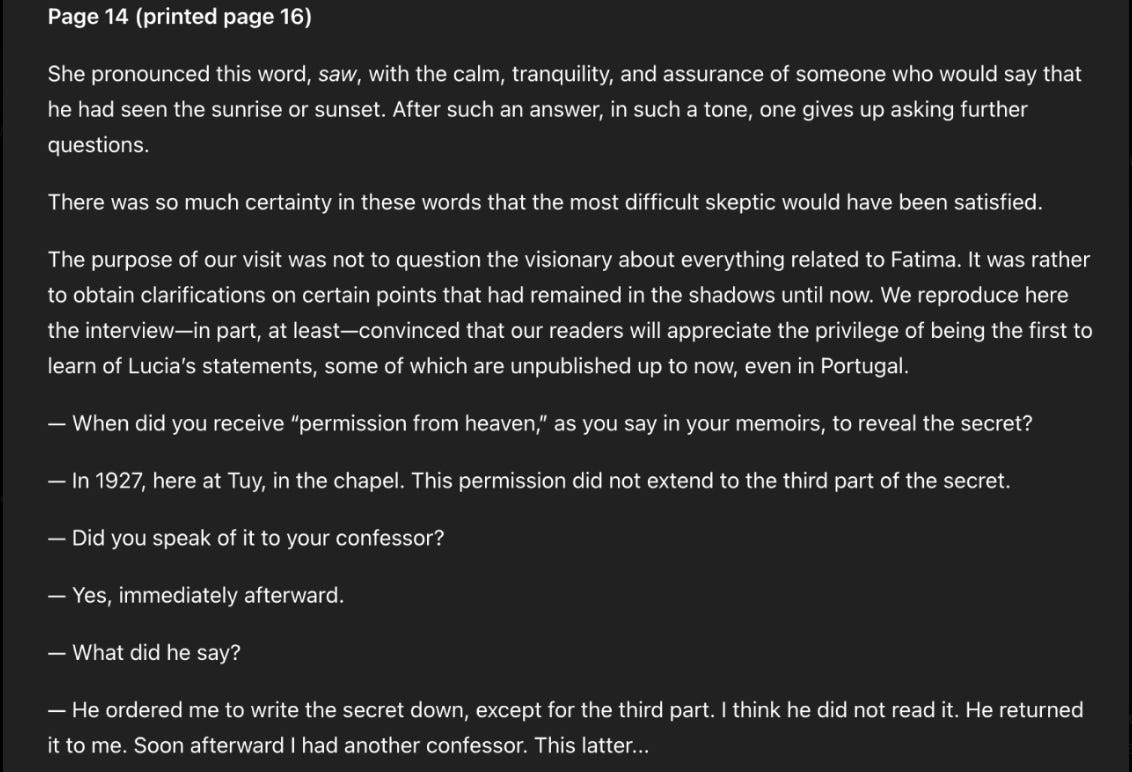
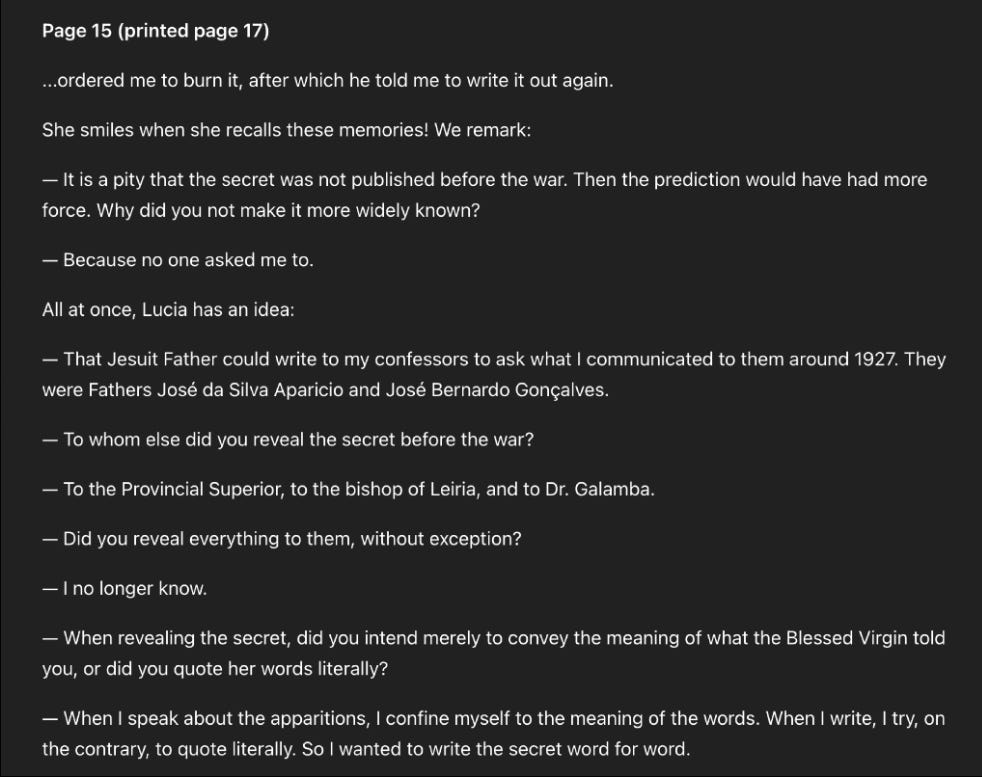
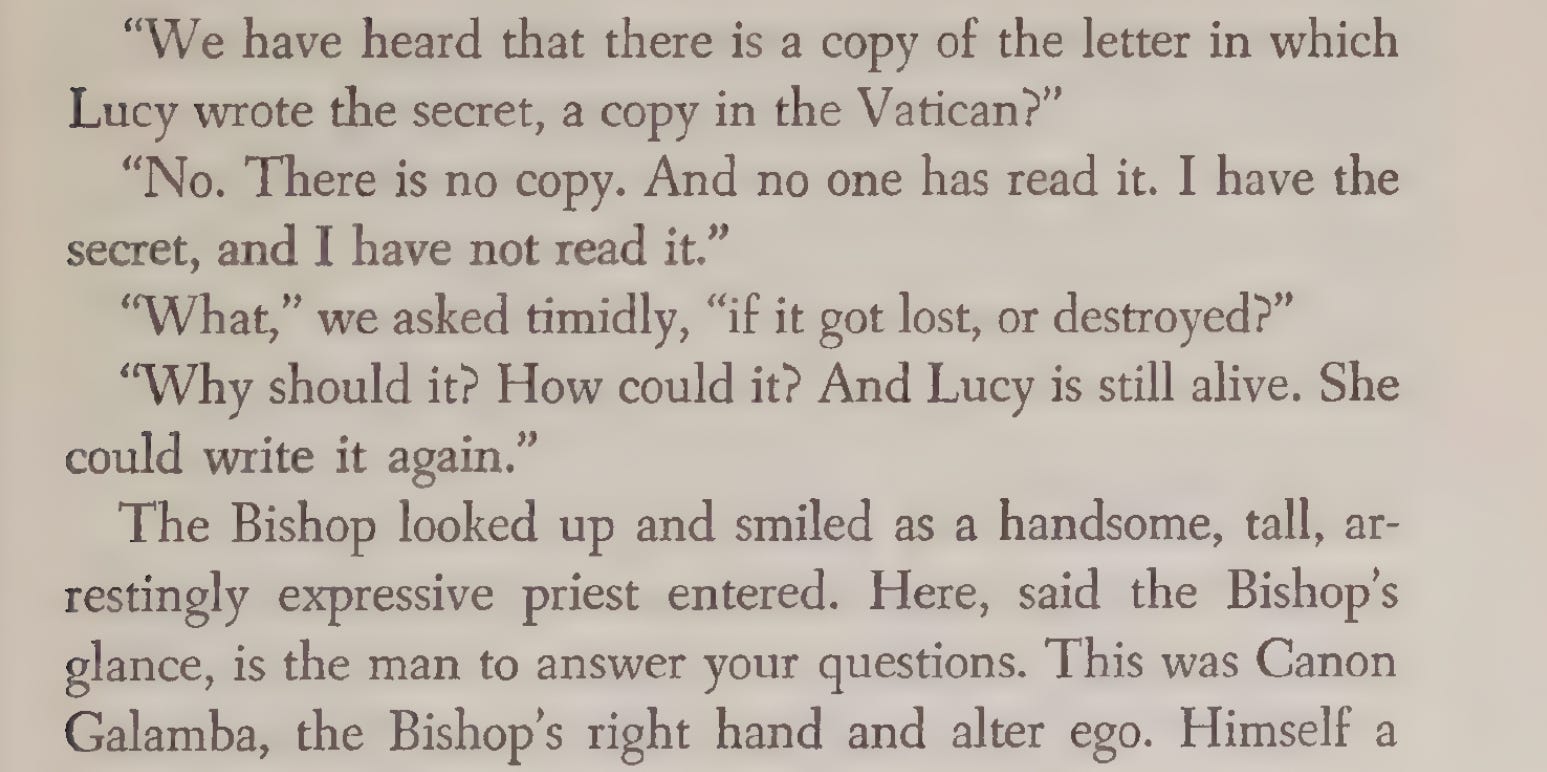
Grouped by how directly Russia is implicated, since that affects how much weight each carries.
Soviet-era, under Gorbachev (all post-1984)
Afghanistan, 1985–89 — escalated before withdrawal; 1985 was the war’s deadliest year.
Nagorno-Karabakh, from 1988 — pogroms escalating to war; Soviet forces joined Operation Ring in 1991.
Internal lethal force: Tbilisi 1989, Baku 1990, Vilnius and Riga 1991.
Ethnic pogroms in the Fergana Valley 1989 and Osh 1990.
Wars Russia fought directly after 1991
Transnistria, 1992 — the 14th Army intervened against Moldova.
Georgia/Abkhazia and South Ossetia, 1992–93 — Russian backing for separatists; mass expulsion of Georgians.
Tajikistan civil war, 1992–97 — the 201st Division involved throughout; roughly 50,000–100,000 dead.
First Chechen War, 1994–96 — Grozny destroyed; tens of thousands dead.
Dagestan and the Second Chechen War, 1999–2009 — Grozny destroyed again.
Georgia, August 2008 — a five-day interstate war.
Ukraine, 2014 — Crimea and the Donbas; about 14,000 dead before 2022.
Syria, from 2015 — air campaign for Assad, including Aleppo.
Ukraine, from 2022 — the largest European land war since 1945 and the world’s deadliest conflict.
Russian proxy or paramilitary involvement
Wagner in Libya, Mali, the Central African Republic, Mozambique, and Sudan, from roughly 2018.
Post-Soviet wars arising from the collapse, without Russia as a direct belligerent
Croatia 1991–95, Bosnia 1992–95 (including Srebrenica), Kosovo 1998–99, Macedonia 2001.
Second Nagorno-Karabakh war 2020 and the 2023 Azerbaijani offensive, which emptied the enclave while Russian peacekeepers stood by.
There are various reasons to think this probably referred to literal peace:
It mirrors the language used in October about the end of the war. From the 4.61 Deposition of Joaquim Gregório Tavares, we read “Asking Lucia what was in the sun, she said that it was St. Joseph giving peace to the world; and that the Lady had descended over the carrasqueira and had said to her: – “That she was Our Lady of the Rosary, that she was going to end the war and that we should soon hope for the return of our soldiers, that men should amend their lives and pray the rosary every day, so that God may forgive sins, and that they should build a little chapel on the spot where she spoke to her, according to the will of the people, whom she finally blessed.””
The literal language seems to describe granting peace to the world.
It’s repeatedly described as “the most famous miracle,” which makes a lot more sense if it involves bringing about world peace than giving a blessing.
We already know Lucia thought that Mary was planning on ushering in world peace.
In Doc 5, Ferreira says Lucia relayed that Mary said “the war is about to end ; for the
last day Saint Joseph will come to give peace to the world and Our Lord will
give his blessing to the people; that you come here on the 13th of October.” So giving peace to the world is explicitly paired with the end of the war.
Fantastic work, Matthew. I’ve honestly gone now from thinking Fatima is unsettling but ultimately explicable to thinking it’s a complete nothing burger. Really seems like it only looked impressive at first because the evidence was selectively presented (though only partly through the fault of proponents—I wouldn’t expect them to have known about the sungazing Reddit etc). Like no one would have ever taken it as seriously if it was presented like “Okay so you know that thing where people sometimes look at the sun and it does crazy stuff, well here’s a case of that with some medium-interesting anomalies on the periphery, isn’t that a clear vindication of Catholicism?” It’s really tempting to apply a big higher-order update regarding other miracle claims.
I'm going to pretend like this is a Christian Wagner comment section.
Total Skeptic Victory