
Inconsistent Moralists
Mostly against the charge of moralism

It is often claimed that vegans and effective altruists are preachy moralists because we argue that other people should change their behavior by giving money to charity and not eating animals. It’s fine for us to behave how we want, but why do we need to bother other people? I think this charge cannot be right as an in-principle objection. And nearly everyone who makes it is a hypocrite.
First of all, is it always wrong to “moralize?” Should you never tell people they’re behaving badly? No, obviously not. Nobody serious thinks the abolitionists were evil, even though they told people to behave differently. If people are doing immoral things, it isn’t wrong to tell them to stop.
Now, if you’re wrong in your moral beliefs, then maybe it’s bad for you to be moralistic. But then you can’t dismiss people on the grounds that they’re moralistic. You must first show that they are wrong before you can object to them moralizing. And even if you think someone’s beliefs are wrong, you can still recognize that given that they have the beliefs they do, they ought to moralize.
The charge is also self-defeating. If you complain about other people moralizing, you are moralizing. You are complaining about behavior that you think is bad. If you can complain about other people being annoying, you can also complain about them permitting children to die via culpable omissions and regularly paying for horrendous animal torture.
I’m not a Christian, and I certainly don’t think non-Christians have a one-way ticket straight to eternal torture. But if you do have that belief, you better be out there trying as hard as you can to convert people! I have way more respect for preachy Christians who try hard to convert people than placid Christians who think that you’ll suffer forever unless you convert in this life, but make no effort to get people to convert. The second group is behaving terribly.
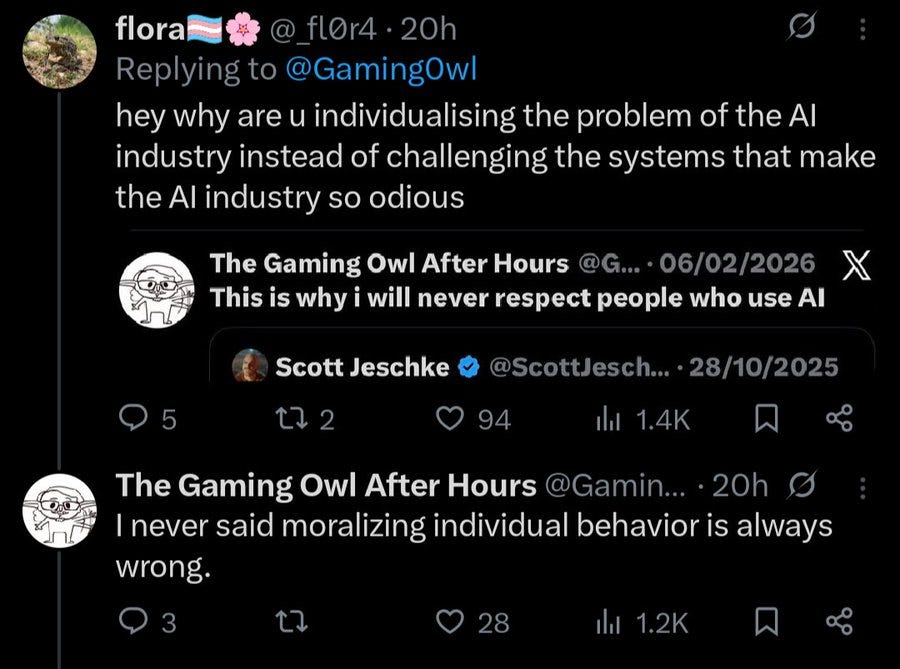
The other thing about those who chide EAs and vegans for moralizing is that they are almost never consistent. It seems to be a law of nature that everyone who criticizes vegans for condemning individual decisions has, at one time or another, condemned individual decisions. Often they complain about the use of AI.


The case against AI use is vastly weaker than the case against meat-eating. People often complain about how much water AI uses, but a single hamburger uses over a million times as much water as an AI prompt. And yet excessive water use isn’t anywhere near the best reason not to eat animals (a more significant reason is that by going vegan, you cease being an accessory to the torture of the innocent).
When you point out to those who moralize about AI because of its measly expenditure of water that there is a several-million-times stronger argument for abstaining from meat consumption, the standard response is “we need food to eat, but we don’t need AI.”


This is a bad response. Yes we need food to eat, but we don’t need meat specifically. Also, one certainly doesn’t need the marginal item of meat consumption. If one was so concerned about AI water use that they abstained from AI, they should at least try to minimize their consumption of meat.
If you use AI all the time but eat one fewer hamburger, your total water use will decrease. You’ll also be better off and not pay for as much horrific torture. It thus seems to make much more sense to criticize the independently indefensible horrorshow of meat consumption than to criticize AI use. You shouldn’t moralize about small things and ignore much bigger things.
The assumption that we should not criticize individual behavior so long as it contributes to a problem caused by institutions is similarly bizarre. Even if the main problem is the meat industry, it might still be wrong for you to purchase meat. As an analogy, the deeper problem with child pornography is its production rather than its consumption, but this is no defense of those who consume it.
This dichotomy also omits the possibility of multiple causation. Sure, the meat industry is obviously responsible for the production of meat. But so is global consumption. If there was no consumption of meat, there wouldn’t be any production either. It can be that two people are both behaving wrongly by together performing some act that is very terrible.
The same is true with effective altruism. Maybe global poverty is the result of institutions. I’m doubtful of that thesis—poverty is the norm, prosperity the exception—but fine, let’s grant it. Let’s even grant that these institutions are the cause of all poverty in the global south. Even if this is all correct, it is still good to do something to prevent global death and suffering. If you came across a child drowning in a pond, you’d have a duty to save them even if they were drowning because of global capitalism.
Nobody would buy the excuse “the child was in the pond due to bad institutional design, therefore, I don’t have to save them.” So then why in the hell does anyone think it’s an adequate excuse here? It’s just a transparent excuse for inaction.
Complaints about people being preachy or moralistic are excuses not to take morality seriously. If people are doing extremely horrible things all the time, you should let them know. If some action is wrong, you should encourage others to stop doing it. Michael Huemer put it well:
Most vegans are people who think eating meat is morally wrong. Furthermore, we don’t think it is a little foible. We think it is an extreme wrong. In terms of quantity of harm, this class of actions outweighs all other wrongs done by human beings combined, and by a wide margin.
…
If that’s what one thinks, what should one do? Should one just shut up and drink one’s kale juice in silence – so as to avoid annoying the people who are committing the horrific wrong by momentarily making them feel bad about it?
Nobody makes this complaint when the evil activity is socially approved of. No one thinks that the people who prosecuted Ted Bundy were being preachy moralists. In practice, the charge of moralism seems to be a blanket defense of all accepted societal practices. But there shouldn’t be any such defense. Often accepted social practices are very bad.
Now, perhaps the things EAs and vegans are moralizing about are wrong. Perhaps doing nothing as children die and paying for animal torture is okay. But if we are right, then the very least we can do is mention, on occasion, the ubiquitous evil running all throughout society—reenacted daily by almost everyone.
The only good argument against moralising is that it is often ineffective because people are dumb
Maybe the charge of moralizing can permissibly be used when circumstances make one unwilling to challenge the underlying moral beliefs.
For example, I always felt that the charge of "virtue-signaling" was very unfair to woke people. They really believed that the reason Black people are overrepresented in prison was racism, and that racism was so systemically ingrained in American institutions their total destruction was required. If that were actually the case, it would be appropriate to "virtue-signal" about this cause and to try to cancel people opposed to this project.
Obviously, people were unwilling to dispute the underlying belief, but didn't want to be told they were bad people for not wanting to destroy American institutions on the basis of a falsehood: thus the charge of "virtue-signaling."
Similarly, atheists who find Christianity extremely implausible do not wish to be preached at, but most people do not regularly wish to interrogate someone's sacred beliefs; thus it is more convenient and polite to simply request they not break the norm against proselytizing, when the true norm is against proselytizing on the basis of extremely implausible beliefs.