
Greenlighting Mass Slaughter: Clinton in Rwanda
Western failure facilitated one of the century’s worst crimes

Content warning: all the most horrific imaginable crimes.
Piles of skulls
History’s fastest genocide, and one of its most shocking, took place in Rwanda in 1994. In just a few months, between 500,000 and 800,000 people were brutally murdered; between 250,000 and 500,000 women were raped. The worst atrocities occurred in spades: rape, gang rape, torture, mutilation, murder with machetes, and a hundred other unspeakable crimes.
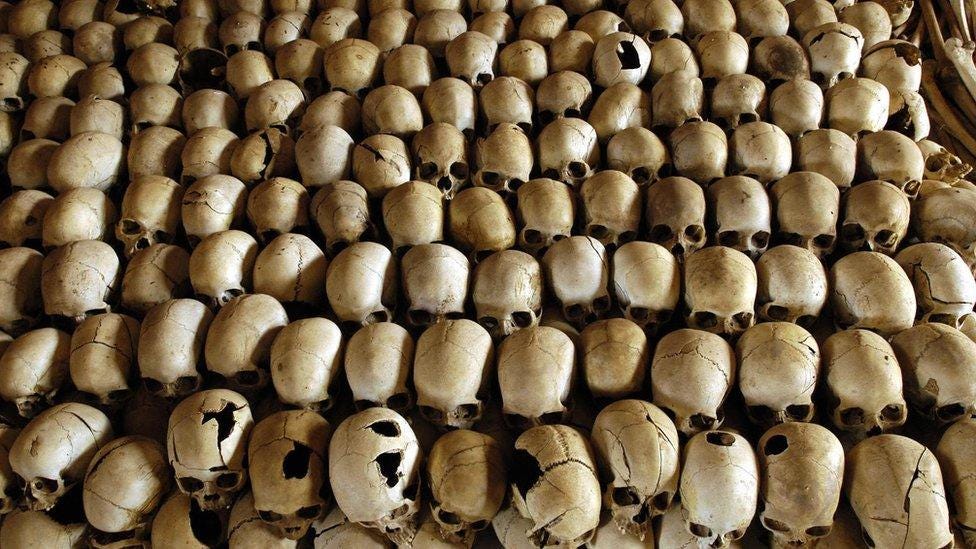
Reports from the perpetrators describe killing becoming “an ordinary activity.” Neighbor hacked to death neighbor; rivers ran red with the blood of the dead. The nearly 300-page report entitled Rwanda: The Preventable Genocide encapsulates the most common outside sentiment: “How could they have done it? How could neighbours and friends and colleagues have slaughtered each other in cold blood? Could it happen to anyone? Could we have done it? How could an ordinary man kill innocent women and children?” It memorably concludes:
But when it came to trying to understand the actual act of killing, we confess our total failure…We studied the literature, some of it highly controversial, that attempts to account for collective human breakdowns in which ordinary citizens turn into monsters…But we do not pretend for a moment that we have reached any understanding of the act of one neighbour or one Christian or one teacher actually hacking another to death.
The perpetrators were not organized killers; they were a haphazard band of ordinary people who joined state militias. They used machetes and crude household objects for lack of more sophisticated weaponry. Often, killers knew their victims. When the genocide ended, Tutsi survivors had to live alongside those who had murdered members of their family.
Yet the brutality against Rwandans was not limited to the killers. It was displayed by Western leaders who sat around in air-conditioned rooms and deliberately greenlit the slaughter. When Bill Clinton apologized to the people of Rwanda and called his failure to intervene one of the greatest regrets of his presidency, he declared “there were people like me sitting in offices, day after day after day, who did not fully appreciate the depth and the speed with which you were being engulfed by this unimaginable terror.”
President Clinton was lying. His administration appreciated full well the scale of the crimes and repeatedly took deliberate action to avoid having to do anything. American behavior toward Rwanda was not an accident. It was a choice. When, in the wake of Rwanda, we wonder how “ordinary citizens turn into monsters,” we would do well to ask that question of our own leaders.
Before getting lost in the blur of complex details, I want to read one account from a survivor named Chantal. There were hundreds of thousands like her.
I met Fifi in town during the war. We went together to hide at the prefecture office… where we hoped we would be killed by guns… but not by machetes.
They gathered us in a big house and raped us all together. Those who refused were killed. Four different people raped me. By the end I wished for death, but death would not come.
I, myself, saw Fifi raped during the war. That is how she was infected with HIV. It saddens me. We’ve already lost another close friend. And now Fifi is the last one in our group who is dying.
I’m sorry that she can’t hear me very well and that she can’t speak. Before she went to the hospital she came to me and asked… “Do you think I’ll be alright?” I encouraged her and said… “Let’s take you to the hospital and hope you’ll be fine.” I told her to have courage and that I would be behind her all the time. Those were the last words we ever spoke.
What Clinton knew
Three months before the genocide began, Dallaire, head of the peacekeepers in Rwanda, learned of the Hutu extremists’ murderous intentions. So brazen were the future killers’ actions that this didn’t even require intelligence gathering. Hutu extremists required all Tutsi in Kigali—the capital of Rwanda—to be registered; this obviously portended subsequent slaughter. Dallaire sent a cable to UN officials, now infamously known as “the genocide fax,” requesting reinforcements and the authority to raid weapons-storage sites. He was turned down.
The genocide began in the wake of Hutu president Juvénal Habyarimana’s plane being shot down. This act was blamed on the Tutsis, and numerous Hutu extremists came out for blood. Even before the genocide started, it was obvious that Rwanda was a powder keg in serious danger of exploding. When the early reports of mass slaughter began to roll in, it was clear that something had set it ablaze.
If Clinton didn’t know what was happening, why did he mention the massacres publicly on seven different occasions during the first two weeks of the slaughter? Clinton’s daily briefing contained many different news reports on the slaughter. These mentioned massacres that left tens of thousands of people dead. Just ten days into the slaughter, one of these news reports estimated that 200,000 people had been killed. We know that many different members of the Clinton staff were aware of what was happening—the director of the CIA noted, “It was pretty clear what was going to happen in Rwanda.”
In fact, Clinton floated the possibility of protection efforts from surrounding nations, declaring “I don’t think it would take all that many troops to stop a lot of this fighting if several African nations would go in together and do it.” When it turned out that the surrounding nations would have been unable to provide armed troops to stop the genocide, Clinton chose not to intervene. In fact, “during the entire genocide the possibility of U.S. military intervention was never even debated.” Clinton later acknowledged that intervention could have prevented 300,000 deaths.1
The withdrawal of the peacekeepers
In fact, it may have been better if the Clinton administration had truly been unaware of the slaughter. Albright, Clinton’s UN ambassador, acting on behalf of the administration, pushed for the withdrawal of peacekeepers from Rwanda in the wake of the killings of the Rwandan prime minister and ten Belgian peacekeepers. U.S. support was a major catalyst of the withdrawal of peacekeepers. This decision was one of the most fateful and despicable decisions made in the last forty years.
The peacekeepers, called UNAMIR, were an extremely effective deterrent force due to their comparatively advanced weaponry and the genocidaires’ desire not to draw in Western intervention. One man with a machine gun can stop many with machetes. Samantha Power notes that “The Hutu were generally reluctant to massacre large groups of Tutsi if foreigners (armed or unarmed) were present. It did not take many UN soldiers to dissuade the Hutu from attacking.”
The day the U.S. expressed support for withdrawal of peacekeepers, civilian and military leaders in Rwanda “made the decision to extend the genocide, both in area and in intensity, a decision they began to implement the day after. By the middle of the next week, humanitarian agencies were estimating 100,000 people killed throughout Rwanda.” For the first time, it became clear that the West wasn’t going to intervene. The Rwandan butchers could do as they wished.
Before the peacekeepers left, 25,000 Rwandans were assembled at locations protected by the UNAMIR. When the peacekeepers left, many of these people were slaughtered. The U.N.’s report on the matter noted:
During the early days of the genocide, thousands of civilians congregated in places where UN troops were stationed, i.e., the Amahoro Stadium and the Ecole Technique at Kicukiro. And when UNAMIR later came to withdraw from areas under its protection, civilians were placed at risk. Tragically, there is evidence that in certain instances, the trust placed in UNAMIR by civilians left them in a situation of greater risk when the UN troops withdrew than they would have been otherwise.
If the extra soldiers sent in to evacuate the peacekeepers had instead joined the peacekeepers, the resulting force would have been large enough to seriously reduce the scale of the killing. Dallaire, head of the main peacekeeping force summarized, “Mass slaughter was happening, and suddenly there in Kigali we had the forces we needed to contain it, and maybe even to stop it,” “Yet they picked up their people and turned and walked away.”
The decision to withdraw peacekeepers ran contrary to the explicit requests of Dallaire. Heroically, Dallaire and a small group of other peacekeepers refused to leave even when instructed to. This decision, by some estimates, saved 32,000 lives. Those who remained behind displayed profound courage—a courage absent in Washington.
The order to remove peacekeepers reduced their numbers from 2,500 to 270. Those residing in zones protected by the peacekeepers were murdered en masse. One such account:
In the days after the plane crash some 2,000 Rwandans, including 400 children, had grouped at the Ecole Technique Officielle, under the protection of about ninety Belgian soldiers. Many of them were already suffering from machete wounds. They gathered in the classrooms and on the playing field outside the school. Rwandan government and militia forces lay in wait nearby, drinking beer and chanting, “Pawa, pawa,” for “Hutu power.” On April 11 the Belgians were ordered to regroup at the airport to aid the evacuation of European civilians. Knowing they were trapped, several Rwandans pursued the jeeps, shouting, “Do not abandon us!” The UN soldiers shooed them away from their vehicles and fired warning shots over their heads. When the peacekeepers had gone out through one gate, Hutu militiamen entered through another, firing machine guns and throwing grenades. Most of the 2,000 gathered there were killed.
In the three days during which some 4,000 foreigners were evacuated, about 20,000 Rwandans were killed. After the American evacuees were safely out and the U.S. embassy had been closed, Bill and Hillary Clinton visited the people who had manned the emergency-operations room at the State Department and offered congratulations on a “job well done.”
Genocide denial and other failures
In the early days of the genocide, intelligence reports used the word “genocide” to describe the massacres and warned of a “final solution to eliminate all Tutsis.” Despite this, Clinton administration officials deliberately avoided calling it a genocide in public so that they wouldn’t be compelled to act.
A discussion paper on Rwanda urged members of the administration to be “careful” about using the word genocide because a “Genocide finding could commit [the U.S. government] to actually ‘do something.’” Susan Rice was rumored to have said “If we use the word ‘genocide’ and are seen as doing nothing, what will be the effect on the November election?” The administration only called it a genocide six weeks into the slaughter.
In fact, so extreme was the administration’s double-talk that even after six weeks they publicly referred to “acts of genocide,” without ever calling it genocide. In one memorable exchange, Reuters correspondent Alan Elsner asked a State Department spokeswoman “How many acts of genocide does it take to make genocide?” She refused to answer. Similarly, she refused to answer whether she had “specific guidance not to use the word ‘genocide’ in isolation, but to preface it with…'acts of.’”
Nor did the U.S. exert diplomatic pressure to get the Rwandan government to stop the slaughter. The most serious attempt came when, in response to lobbying from Human Rights Watch, National Security Advisor Anthony Lake encouraged Rwandan military leaders to “do everything in their power to end the violence immediately.” This feeble statement was the extent of U.S. diplomatic pressure.
Nor did the U.S. jam the broadcasts from the RTLM, nicknamed “radio genocide.” The RTLM played a crucial role in facilitating the genocide. Its presenters consistently referred to Tutsis as cockroaches and called for “those who have guns to immediately go to these cockroaches [and] encircle them and kill them.”
Another presenter told listeners “Do not kill those cockroaches with a bullet - cut them to pieces with a machete.” The station often gave out specific instructions for carrying out the killing. One study estimated that the station was responsible for 10% of the violence, though this number is disputed. Fifteen percent of perpetrators cited radio broadcasts as a key influence in their decisions to kill.
The U.S. was the best-positioned country to jam the radio broadcasts. It had various options: destroying the antenna, transmitting counterbroadcasts to urge the killers to stop, or jamming the station’s broadcasts. These options were brought up to the Defense Department, yet were rejected with complaints about excessive financial costs and undermining free speech (even though direct calls to murder people with machetes obviously do not count as protected speech).
Other misconduct
The Clinton administration was not the only administration complicit in grave evil. France was even more directly involved, having armed, financed, and trained the Rwandan army carrying out the massacres. They continued to provide arms while the genocide was going on. After the ten Belgian peacekeepers were killed, Belgium also pushed particularly hard for the UNAMIR withdrawal.
In fact, after the UN proposed to send in reinforcements, member nations spent about two months haggling over terms and costs, even as hundreds of thousands of people were being killed every month. In one representative case:
The Clinton Administration promised to lease to UNAMIR 50 armoured personnel carriers (APCs), which Dallaire believed could play a significant role in freeing trapped civilians. Washington decided to negotiate with the UN over the terms for leasing the vehicles, and to negotiate from strength. Before it would agree to send its APCs to Rwanda, the world's wealthiest nation raised the original estimate of the cost of the carriers by half, and then insisted that the UN (to which the US was already in serious debt) must pay for returning the carriers to their base in Germany. The entire exercise was costed at $15 million.
This is not the kind of moral urgency proper when trying to stop a genocide. By the time the troops arrived, it was too late to make a difference. This means that through the entire duration of the genocide, the West sat around and did nothing that made any difference, with the exception of withdrawing the peacekeepers already in the region. The genocide was only ended when the Tutsi-led government took back control, under the leadership of Paul Kagame.
I want to note one fact about Rwanda which is often overlooked: serious crimes were also committed against the Hutus. Alison Des Forges notes that the RPF troops who ended the genocide “committed grave violations of international humanitarian law by attacking and killing unarmed civilians.” Tens of thousands of people were killed; a report by Gersony estimated between 25,000 and 45,000 Hutu were slaughtered, while Seth Sendashonga estimated the real number was 60,000. There are reasons to think these may be underestimates of the true number.
And when Rwanda under Kagame invaded the Congo, this began the first Congo war, in which Kagame-backed forces slaughtered around 200,000 Hutu refugees. The first Congo war also led to the second Congo war, which killed over 5 million people by some estimates, making it the deadliest conflict since WW2. Whether the slaughter of refugees constitutes genocide is unclear, according to the UN report on the subject. However, there is no doubt about the presence of ubiquitous human rights abuses against Hutu refugees:
The extensive use of edged weapons (primarily hammers) and the apparently systematic nature of the massacres of survivors after the camps had been taken suggests that the numerous deaths cannot be attributed to the hazards of war or seen as equating to collateral damage. The majority of the victims were children, women, elderly people and the sick, who were often undernourished and posed no threat to the attacking forces.
It is hard to read about Rwanda and have anything but profound disgust for those who say a nation’s only duties are to its own people. When this kind of cruelty is happening, it doesn’t matter if its victims aren’t Americans. When innocent people are beaten to death with clubs and hacked to death with machetes, any remotely sane moral calculus implies that there is strong reason to stop it.
Many of the complicit Western leaders faced no accountability. The worst they got was occasional criticism in the press, years later. When you hear Bill Clinton’s name, you don’t generally think of Rwanda. But if you saw the young children hacked to death with machetes, the women killed by the HIV they contracted through rape, and the babies burned alive, perhaps you would think of this as the defining failure of the Clinton presidency—and one of the major defining failures of the West in the past forty years. I close with the words of international prosecutor Stephen Rapp.
I see what happened in the Rwandan genocide, with the slamming of babies against the walls of churches…of families seeing their own children killed in front of their eyes, and other loved ones. And I see the brutality and the animus in the eyes of the people doing those crimes. I say, those people should answer for those crimes.
This exact number is controversial. Some, like Alan Kuperman, argue that intervening would have only saved between 75,000 and 125,000 lives. Others, like Dallaire, Power, Des Forges, and Stanton think that most of the killings were preventable. In general, I find Kuperman’s estimates less credible.
This is context, not exoneration:
Eighteen U.S. dead in Mogadishu, Somalia on 10/03/1993 produced Clinton's 10/07/1993 order to leave Somalia by 03/31/1994 — weeks before Habyarimana's plane fell. That incident, dramatized in "Black Hawk Down" made Washington casualty-averse toward exactly Rwanda's kind of operation.
Note however, that PDD-25's restrictive draft predated Mogadishu (September 1993), so Somalia hardened an existing reluctance rather than creating it. And among the damning choices were those that carried zero American risk: the peacekeepers gutted from UNAMIR were Belgian and Ghanaian, not American; jamming "radio genocide" needed no troops.
To borrow BB's words, this is the defining failure of the Clinton administration, but critics would prefer to remember him well or damn him for an affair with an intern.
America's callous disregard for Africa continues to this day, most recently exemplified by Trump's and Musk's deadly cutbacks at USAID. The only debate left on that issue is what exact form of killing this was and how many people died. Like Clinton's, this administration is left with no ground to stand on.
"Only saved 75,000 lives"
Only 75,000 human lives saved, imagine that. Scope neglect is insane. How much money did we spend on stretching for Titan submersible again?