

A personal update: I’ve been hired as a visiting scholar by Forethought, where I’ll work for six months. Forethought is a non-profit that researches how a world with very advanced AI goes well. I think the research they’ve produced has been super high-quality, and the people on the team are amazingly nice and talented. Super excited to be working for them. This will maybe reduce my blogging output somewhat, though it’s a bit unclear (every other time I’ve predicted some event reducing my blog output, I’ve been wrong!)
Starting February 2, I’ll be in Berkeley for a few weeks. Then I’ll move to Oxford. If you’re a reader of the blog who lives in either area, feel free to shoot me a dm if you’d like to hang out. I’ll also be at EAG Bay Area and probably London—feel free to say hi!
Okay, without further ado, here are 50 interesting facts.1
Lots of leading experts think that mirror bacteria—bacteria with reversed molecular structure—could bypass biological defenses and end life on Earth. Despite this, the number of people working on this huge threat is around 10.
The era of declining global poverty has likely ended. Historically, extreme poverty has fallen dramatically. The places it remains are mostly countries with sufficiently screwed up institutions that they haven’t really seen economic growth in decades. For this reason, progress looks to be hitting a wall. Countries without growth in GDP per-capita also tend to experience unusually fast population growth.
Lots of population numbers are pretty made-up. In many countries, there just isn’t really the infrastructure to do a good census. In Papua New Guinea, they’re not sure if the number of people is ~9 million or ~17 million. Similar things are true in other countries like Nigeria, which may have tens of millions more or fewer people than is standardly reported. In lots of countries, the way they get their official census numbers is “do napkin math on population growth from the corrupt census they did 30 years ago, which wasn’t trustworthy then.” Our estimates of the number of people in the world might be off by tens of millions.
Similarly, GDP statistics in lots of poor countries are largely fake. Many nations’ economies are mostly informal and thus hard to estimate. For this reason, GDP statistics are often loose guesses from surrounding countries. Sometimes they update the metrics a bit, and this leads to GDP estimates growing by like 50%. In one case, all of Zambia’s economic statistics were being calculated by one guy. Often there’s no agreement about whether a country’s GDP grew by like 30% or declined 20%, which isn’t exactly a small error.

Standard economic models imply that growth will, on average, be faster in poorer countries. Empirically, however, the opposite has been true. Poorer countries generally grow more slowly. (This, like the other three most recent facts, comes from David Oks blog—it’s amazingly good, I highly recommend reading it. By far the best blog I’ve encountered recently).
There are about 100 million insects per person. The average year of human life prevents about 14 million insect life years. This is sort of insane.
In expectation, almost everyone in the history of the world will be a digital mind. This is crazy when you think about it; most of those who will exist in world history, in expectation, will be totally different from us, and from every sentient being who has ever lived in world history.
Roughly all the livestock in the U.S., and the vast majority in the world, are factory farmed. If you want to get meat from animals that had high welfare, you need to be extremely judicious—it isn’t enough to just find some nice-sounding label.
It isn’t very clear if fishing has, overall, reduced fish populations. We mostly eat big fish, so this has led to an increase in the population of many small fish.
The Pinker thesis that humans before agriculture were hugely violent is wrong. Violence increased significantly after civilization developed, after the world stopped being mostly bands of roving hunter gatherers.
Intuitively I would have guessed populations would rebound quickly after mass extinctions. This isn’t so. It often takes many millions of years for them to recover.
Charity is unbelievably effective. It costs a few thousand dollars to save a life. For one dollar, you can improve the welfare of lots of animals.
Your existence gives you arbitrarily strong evidence there are infinite people.
It took between 100 and 200 million years for animals to evolve movement. Seems like evolution is surprisingly contingent and chancy in a way I wouldn’t have expected.
The common ancestor we share with octopi is a super simple worm. Octopi are almost certainly conscious. So either consciousness is present even in amazingly simple organisms or it evolved multiple times, independently.
GDP per capita is higher in all 50 states than Britain.
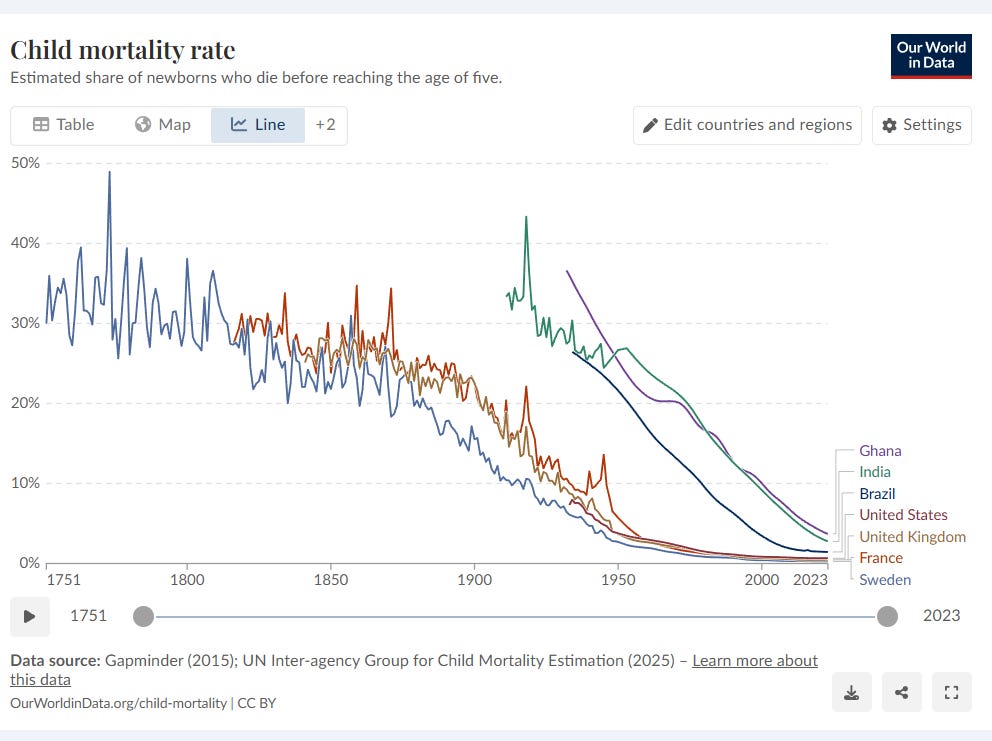
The world has gotten massively better over time. To give one example, though the similar statistics are all like this, here’s a graph of child mortality over time. It used to be that almost half of children died before turning five.
In World War 2, the bombing of Dresden wasn’t very effective, but the bombing of Tokyo was a lot more effective. The more effective bombing hit specific energy targets like the electrical grid and liquid fuel, rather than aiming to cause general destruction. Bombs worked better in Tokyo because Tokyo was largely made out of wood, so bombs lit fires that were more destructive.
If you extrapolate out current AI trends, they imply we’ll get AI that can automate away most human labor pretty soon.
This AI progress is also likely to trigger an explosion in industrial capabilities. Once you have AI that can perform most cognitive tasks, it can oversee labor. This includes robot labor. At that point, it would be possible to build robot factories that build still more robot factories, leading to an exponential explosion in robotic abilities. The main current bottleneck is that we don’t have enough people to oversee the robot factories, but that wouldn’t be present in an intelligence explosion.
A civil war is very unlikely in the U.S. or other developed nations, because basically only poor countries ever fight civil wars.
Shrimp farms crush the eyes of the breeding shrimp, because it speeds up breeding.
Almost all sentient beings on Earth live for a few days or weeks and then die painfully, either from starvation, predation, or something else.
Something’s expected value can be infinite even if it’s actual value is guaranteed to be finite. Relatedly, infinity ruins every plausible ethical principle.
The most detailed estimate of the welfare range of different animals ended up concluding that they don’t differ by more than a few orders of magnitude. This estimate is pretty credible. Neuron counts, which vary by many orders-of-magnitude, are a bad proxy.
Climate change probably will kill millions of people, but it’s very unlikely to cause human extinction.
The global population will probably start declining soon, and could dwindle below a billion people, and perhaps even farther. This seems like a big problem!
GDP per capita doubles about once every 35 years in the U.S.. This is sort of nuts—on average we get about twice as rich every 35 years. Similarly, to quote Tyler Cowen, “considering the years 1870 to 1990, if the United States had grown one percentage point less per year, the country would in 1990 have had the same standard of living as Mexico.”
One can quibble with the exact numbers and methodology, but one study found that U.S. regulations lowered GDP growth rates by about 2% per year between 1949 and 2011. If this is right, then had there not been regulations, the U.S. would have been three times as rich in 2011.
If you give flies spicy food, and genetically engineer them to get spicy food receptors, they get distressed, refuse to eat it, and pull at their mouth. As they get hungrier, they’ll nibble at it occasionally, but each time recoil, and eventually starve themselves to death. However, this effect goes away if you give them painkillers.
On average, those who exercise regularly live almost five years longer, which is about half the impact that smoking has. Failing to exercise regularly is about half as bad for your health as smoking regularly. Exercise also improves mood massively. Probably you should be going on regularish walks! Other things that majorly improve mood and health are meditation and getting adequate sleep. If you don’t exercise regularly, meditate, or sleep enough, you can probably improve your welfare a sizeable amount by doing those things.
Roughly all of those effected by our actions will exist in the far future. For this reason, the rule “maximize expected welfare,” is roughly equivalent to “maximize how well the far future goes.” (And, of course, you don’t need to be a utilitarian to think that future welfare matters a lot).
Our actions have sufficiently enormous second-order effects that even the best actions have only about a 50.0000001% chance of being for the best, and our worst actions have a 50.000001% chance of being for the worst. This doesn’t affect their expected value, however.
I will otherwise mostly refrain from talking about politics, but two important facts are: 1) Trump after the 2020 election tried to illegally seize power, and he almost succeeded, but no one seems to care; 2) USAID saved about 3 million lives a year, and yet recent cuts have probably cost over half a million lives.
A sizeable chunk of people in the world claim to have witnessed a miracle. Often what they describe is remarkably hard to explain away without assuming they’re crazy liars or something very weird is happening.
The EA movement prevents about 17 9/11s worth of death every year. If only the critics saw fit to mention that upon occasion. Seems somewhat important when assessing whether EA has been good, no?
Probably a sizeable chunk of the joy and sadness present humans experience is had while dreaming. Seems pretty important to improve the quality of dreams!
Everyone likes to blame citizens united for the presence of political spending by private actors. But this isn’t accurate. It was the Buckley case that allowed individuals to spend enormous amounts of money on campaign expenditures. Citizens United just held that corporations could too. So Citizens United has nothing to do with whether Elon Musk can spend loads of money helping Trump get elected.
It is very plausible that somewhere in the near future, humanity will take actions that determine the long-run future fate of our species. Despite this, almost no effort is being spent on trying to ensure this goes well.
Africa has relatively few large firms. There’s dispute about exactly why this is, but a plausible answer is low levels of social trust.
Southern Italy is a lot poorer than northern Italy. It’s unclear why this is, but David Oks suggests it’s malaria.
The first gulf war and subsequent sanctions lead to Iraq’s GDP per capita declining by more than 75% (though, as mentioned before, take the exact numbers with 5 quintillion grains of salt).
Immigrants detained by ICE have faced some quite serious welfare abuses, including having their testicles crushed and having ICE agents stick their fingers deep into their ears.
People often argue that Rawls’ veil of ignorance is a good way to make decisions. You imagine you didn’t know who in society you’d be, and act impartially. But if you apply this to animals, you’d pretty much only care about the welfare of wild animals, as you’d be millions of times likelier to be one than a human. You’re also hundreds of thousands or millions of times likelier to be one than a farmed animal.
Some insects have brains about as large as the smallest vertebrate brains.
C. elegans worms are very interesting. They behave in a somewhat agentic way, despite having only 302 neurons. We still can’t simulate how their brains work. And when they get stressed or learn too much, they often go to sleep.
AI being bad for the environment is mostly fake. Compared to other stuff we do, it uses relatively little water and power.
There are different brain regions responsible for different parts of speech. Broca’s region is responsible for our speech being coherent and making sense. Wernicke’s region is responsible for it being fluent. When Broca’s region is damaged, you have Broca’s aphasia, wherein people can speak coherently but without any fluency. With Wernicke’s aphasia, they can speak fluently, but their words make no sense. Pretty weird to watch:
Most farmed animals are insects. The animals killed for food most often are black soldier flies and meal worms, even though the industry is a desperately flailing economically unsustainable disaster. By 2033, about 95% of farmed animals will be invertebrates. Why the hell is this? Who eats invertebrates? The answer is that: 1) a lot of people eat shrimp; 2) insects are very small—you can eat two dozen shrimp in a meal, while it takes many years to eat a cow; 3) smaller insects, like black soldier flies, are REALLY small, so even though they feed relatively few farmed fish (the main group that eats black soldier flies), there are still nearly half a trillion farmed insects each year. Amazingly, more black soldier flies are killed every year than shrimp.
You’ve probably heard the claim made by the book When Prophecy Fails that when cults make big doomsday predictions, and are disproven, the cults double down and believe even harder. Turns out this just isn’t true at all, and that original book makes lots of embarrassing data errors.
It was probably human hunting, not climate change, that caused the extinction of megafauna like woolly mammoths and saber tooth tigers.
Some of these are somewhat controversial.
Number 50 is a basic IQ test. Megafaunal extinction (often of entire ecosystems of weird and glorious fauna) in New Zealand, Australia, and the Americas closely track initial human arrivals. Each of those animals had survived for millions of years, across dozens of individual ice ages, which included sudden climate shocks far beyond anything current climate change offers. The suggestion that climate change is a vital component to those extinctions is often offered with minimal evidence, almost as a ritual repetition, and fails any test of logical reasoning.
Wow, great to know about the failure of *When Prophecy Fails*.
More generally, congrats on the new job!