

Would you give up your life to save 100 people? Probably most wouldn’t, some would (or at least say they would). But now imagine that you could save 100 lives at unclear net cost, so that it isn’t even clear if doing so would make your life worse. It might make it better. Surely you’d do that? I solemnly swear that we are currently living in thought experiment land, and so nothing you say here will have any implications for how you act in the real world.
In fact, I lied (we utilitarians get to do that). The real world is a place where you can save a bunch of lives at unclear personal cost, such that doing so might make your life better. The way to do that is to give a sizeable chunk of your wealth to effective charities. Being charitable makes people happier, in general, so it isn’t even so clear that this would be a cost.
A common complain raised against effective altruists, vegans, and utilitarians is that our moral theory is much too demanding. It demands that you give away all your excess wealth in order to help foreigners or sometimes eat tofu instead of steak. This, it is claimed, is very counterintuitive. Can morality really demand so much of us?
But overlooked in this analysis is the moral theories praised for being non-demanding really are demanding. They simply place demands on other people. It is demanding to require us to give some of our money to effective charities. But it is also demanding if morality requires the beneficiaries of those charities to die at a young age so we don’t have to give away money. It requires they make the ultimate sacrifice, instead of us make a small sacrifice.
This becomes easier to grok if you imagine yourself as the beneficiary of the charities, rather than the person giving to the charities. Imagine that you were going to get tortured unless some distant alien spend a few minutes filling out a form. Would it seem justified for them not to do it, on grounds it was too demanding? No! It’s too demanding for you to have to be tortured, not for them to have to do something about it! Toby Ord put this point extremely well:
Suppose we did take the overdemandingness objection at face value and thereby reject the Principle of Sacrifice. Where would this leave us? I believe that this would actually produce an even more unintuitive position. Our theory would then be open to an underdemandingness objection. Someone who rejects the Principle of Sacrifice is asserting a
Principle of Extreme Liberty: It is at least sometimes permissible to let others suffer great harms in order to secure incomparably small benefits for yourself.
To avoid the conclusion that we must donate much of our income, one would also have to accept a
Principle of Luxury: It is at least sometimes permissible 'to let others die in order to secure additional luxuries for yourself.
These strike me as supremely implausible moral principles. They are far too underdemanding, and yet they follow from the rejection of the Principle of Sacrifice when applied to global poverty.
Singer’s principle of sacrifice, on its face, is really intuitive. It says simply: if you can prevent something very terrible from happening at comparatively minor cost, you should do that. If you just asked people whether they think that principle is true, they mostly would. But because we are among the richest people to ever live, and live in a world where we have the ability to make others’ lives much better at small personal cost, it demands a lot. As Ord notes, this is a classic case of a moral principle being weird because the world is weird, not because the fundamental ethical principle is surprising.
It’s even more intuitive that if deciding between multiple charities, you should pick the best one. If asked to justify giving to a less effective charity, rather than a more effective charity, the explanation is generally that one psychologically prefers the less effective charities. But this, on its face, seems like a totally inadequate response. “I prevented far less death and suffering, because I felt like it?” Does that seem justified to you?
As an analogy, imagine that a plane is going to hit ten people. A train is going to hit two people. You can either pull the people out of the path of the train or the plane. It seems obviously immoral to save the two from the plane because you have a fondness for saving people from planes. It’s wrong to take the action that prevents far less death and suffering, rather than more, because you feel like it.
It’s often said that common-sense morality isn’t demanding. But this isn’t so. It’s often demanding when the stakes are high. As MacAskill, Mogenson, and Ord write:
If the moral stakes are high, morality can be very demanding, without being too demanding. This is represented within commonsense morality. Consider, for example, a slave owner living centuries ago. He would be morally required to free his slaves even if that meant he would lose his family’s livelihood. Or consider an innocent person who, through an unfortunate series of events, has been convicted of murder and is on Death Row in Texas. According to commonsense morality, she would be required to lose her life rather than escape, if the only way to escape involved killing an innocent prison guard.
The better charities are, the more moral libertinism is needed to avoid the conclusion that you have to give your excess wealth to them (or invest it to give to them later). If you buy Longtermism, then it’s plausible that a dollar given to expected charities produces more expected welfare than all the current joy in the world. This might sound outlandish, but when you realize that there could be billions of years of future life, and we could fill space with happy beings, even tiny probabilities of affecting the far future have enormous expected value.
But here is a very plausible principle that implies we should give basically all our wealth to highly effective charities:
Non-extreme libertinism: It is wrong to spend a dollar for personal benefit, when instead, by spending the dollar, you could have produced more expected welfare than all the welfare in human history so far.
This would be totally obvious in other contexts. It only seems unintuitive because it imposes costs on us in the real world. If we imagine in a thought experiment, some distant alien on a beach being able to prevent all the welfare in global history from being lost by spending a dollar, it would seem ridiculously obvious that they should do so. They’d be blameworthy for not doing so!
Similarly, suppose you buy that animal welfare matters, as is totally obvious. Charities helping animals prevent many years of factory farming per dollar. So, to demand we give away nearly all of our wealth, all we need is:
Torture sacrifice: It is wrong to spend a dollar for personal benefit, when instead, by spending that dollar, you could have prevented many years of torture.
Again, if these aren’t intuitive, then I don’t know what is. Certainly if we were the ones being tortured, rather than the ones being asked to give away money, these would seem obvious. But in practice, given our unprecedented influence, these principles imply we should give away nearly all of our wealth.
One other intuition-pump for this not being demanding: suppose we ask whether poor people would be morally permitted to steal from us a few thousand dollars so that they don’t die. Intuitively, it seems the answer is yes. Few blame Jean Valjean for stealing bread for his family. Taking an amount of money that the person taken from won’t miss to save your own life or the life of your family member is permissible. But surely if the global poor would be morally allowed to steal our money, we ought to give it to them. For it to be justified for A to steal X from B, it seems A owes X to B and would be blameworthy for not giving X.
Things get even worse for the prospect that morality doesn’t demand we give away most of our wealth when one considers a further fact: it isn’t at all clear if giving away most of your wealth makes your life worse. Helping others makes people happier. Giving charity makes people happier. So it’s not even clear if having to give away a lot of money is much of a sacrifice—or any sacrifice at all. It might be the opposite. And if you can prevent a bunch of people from dying at uncertain, and possibly non-existent personal cost, then you ought to do so.
Upton Sinclair famously said “It is difficult to get a man to understand something when his salary depends upon his not understanding it.” Similarly, it is difficult to get a man to intuit that some ethical principle is so when, in quite a literal sense, his salary depends on him not understanding it. Humans are notoriously biased by self-interest—it’s thus no surprise that we don’t find morality intuitive.
There can be situations where morality demands more than people are likely to do. If we aggressively did selective breeding for evil people, most people would fall well short of the demands of morality. Similarly, there can be cases where some action is morally required but we understand why people don’t do it. You’re obligated not to kill a stranger to save your child, but I can understand why you’d do it. Similarly, we can psychologically understand why people don’t give away their excess wealth while recognizing that they’re not living up to a moral obligation.
One other curious thing that Ord notes in the paper: why don’t people object to Christianity on grounds that it’s too demanding? Jesus says quite explicitly that we all morally fall short. He even seemed to think that we fall short so much that we deserve hell. That’s way more extreme than Peter Singer! He told someone to give away all their riches—and that wasn’t even the most extreme thing he said. It’s quite puzzling!
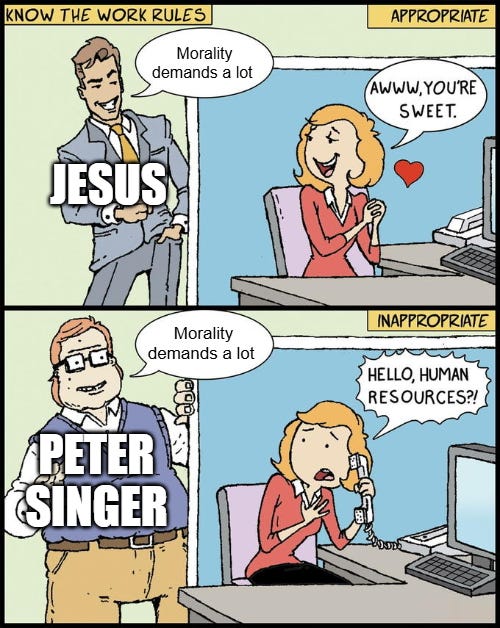
In any case, the intuition that morality can’t be demanding seems like a pretty prime example of the kind of intuition we should give up. It’s highly unintuitive on reflection, seems sort of nuts when you simply rephrase it, and there’s an obvious bias that explains why we believe it. Morality really is demanding. Giving 10% seems like a bare minimum.
There is, however, a problem. Even though this seems demanded by morality, none of us (save maybe Toby Ord) are actually going to do it. Humans don’t have enough moral motivation to do everything that’s morally required. The takeaway, then, should be that our aim should be to do as much good as possible. We should try to save as many lives as we can talk ourselves into saving, rather than trying to locate a precise threshold at which we can declare our obligation met.
We ought to think of moral goodness as a bit like rationality. None of us (save maybe Toby Ord) are totally rational. And yet our aim should be to be as rational as possible. When trying to form beliefs sensibly, people do not ask “at what point am I sufficiently rational that I can’t be said to be rationally blameworthy?” Instead they just try to be as rational as possible. That should be our aim in morality. We should try to do as much good as we can without concern for whether we’ve hit the precise morality threshold at which we count as a Good Person (TM).
If the person whose life would be saved by charity would be justified in stealing money to save themselves, then they aren't required to die, and so morality isn't demanding.
You object that they would only be justified in stealing if we owe them the money, but that does not follow. If you are justified in taking someone's life on grounds of self-defense. it doesn't follow that they owe you their life.
Imagine two sides of a war are using conscripted soldiers, forced to kill the other side in order to survive. Plainly, soldiers on both sides are justified in taking the lives of the other side, but the other side doesn't owe them their lives.
Similarly, I think the person whose life would be saved by charity would be justified in stealing money (even from the innocent) to defend their life. In the same way, they would be justified in stealing a gun to defend themselves from a deadly attack.
So, they are justified in stealing to save themselves, and thus are not required to die. So, my moral views are not too demanding of them. At the same time, we do not owe them whatever they would need to steal, so my moral views are not too demanding of us.
I seem to be able to avoid the charge you lay against me, here. You might try to object that, since defending their lives is more important than whatever I'm usually doing with that money, it should override my right to my money, and so again I would owe them the money.
Yet, look at conscripted soldiers in war once more: even if one side has more to live for, or more people on it who would survive, or a greater claim to a just cause, it still does not follow that the other side owes them their lives. Self-defense does not aggregate in that way.
So, while I agree that many of the principles you cite here are intuitive. I think those intuitions are mostly debunked (as I've argued on other posts), and my alternative view is much less demanding than yours, which strikes most of us as much more intuitive.
P.S.: I think you are trying to debunk the intuition that morality is less demanding by having us ask whether other people owe us things, instead of asking whether we owe other people things. Yet, people are naturally going to be more charitable with other people's money or valuables because they didn't have to work to earn those valuables.
I actually think intuitions asking us whether other people should give us free stuff are pretty unreliable, as a result. It's not like those intuitions are free from our self-interest (we get free stuff!), they are just divorced from the actual steps necessary to produce the free stuff such that the actual costs to the giver of giving away the free stuff (i.e. hours of labor) are not intuitively obvious, and so are not factored well into our intuitions here.
I've been had! You wily utilitarian you!