

Epistemic status: unusually unhinged.
Suppose you say that you love your children. However, you lock them in a dark, cramped, small, filthy, feces-ridden cage where they can’t turn around, slice off their nose with a knife, break their bones multiple times, kill, and eat them. It seems reasonable, in such a case, to say that you don’t really love your children—or at the very least, that you are not living up to what that love demands.
Recently, Billie Eilish, a Singer, declared that you cannot love animals and eat them. As the kids say, this was very based. But the internet has been set ablaze by this shocking claim, with many people disagreeing. These people think that you can eat those you love. Such people are all wrong.
Let me first be clear: I do not think that Eilish was intending to make some precise philosophical claim. Clearly there are possible scenarios where one eats animals and loves them—e.g. if you eat them by accident while sleepwalking. What she was claiming was that you cannot love animals properly and eat them in the normal way people tend to. So I’m not interested in defending the obviously false claim that it is categorically impossible to love and eat animals, but instead that eating animals in the standard way is incompatible with loving them.
Another small qualification: one can have two contradictory attitudes. A parent might feel great love for their children, but also beat them viciously. There’s some sense in which this is compatible with love, even though it can be done while feeling love for their children. So really the claim is that eating animals is inconsistent with the demands of proper love. This isn’t to say you can’t feel warm fuzzy feelings directed at animals while eating them, but that if you feel love for them, and you eat them, then you’re not behaving in the way love demands. As C.S. Lewis says “Love is not affectionate feeling, but a steady wish for the loved person’s ultimate good as far as it can be obtained.”
The argument for this is extremely simple and straightforward: to love someone, you have to care about their interests. You can’t claim to love your children if you don’t care at all about what happens to them. For example, you couldn’t be said to love your children if you loaded them into catapults and fired them across a large stadium because you thought it would be funny to do so. If you care about animals’ interests, then you cannot pay for them to be tortured for trivial pleasure. This is similar to how if you care about people, you can’t pay for them to be tortured for trivial pleasure.
Tortured? Yes. The conditions most animals undergo are torture. They’re kept in small cages where they can’t turn around and are subject to countless horrifying mutilations. Genetically engineering someone to be hideously large and unable to walk, locking them in a cage, breaking their bones multiple times, and mutilating them without anesthetic is obviously torture. And I don’t think you can really love someone and pay for them to be tortured for your pleasure, sorry, I didn’t make the rules.

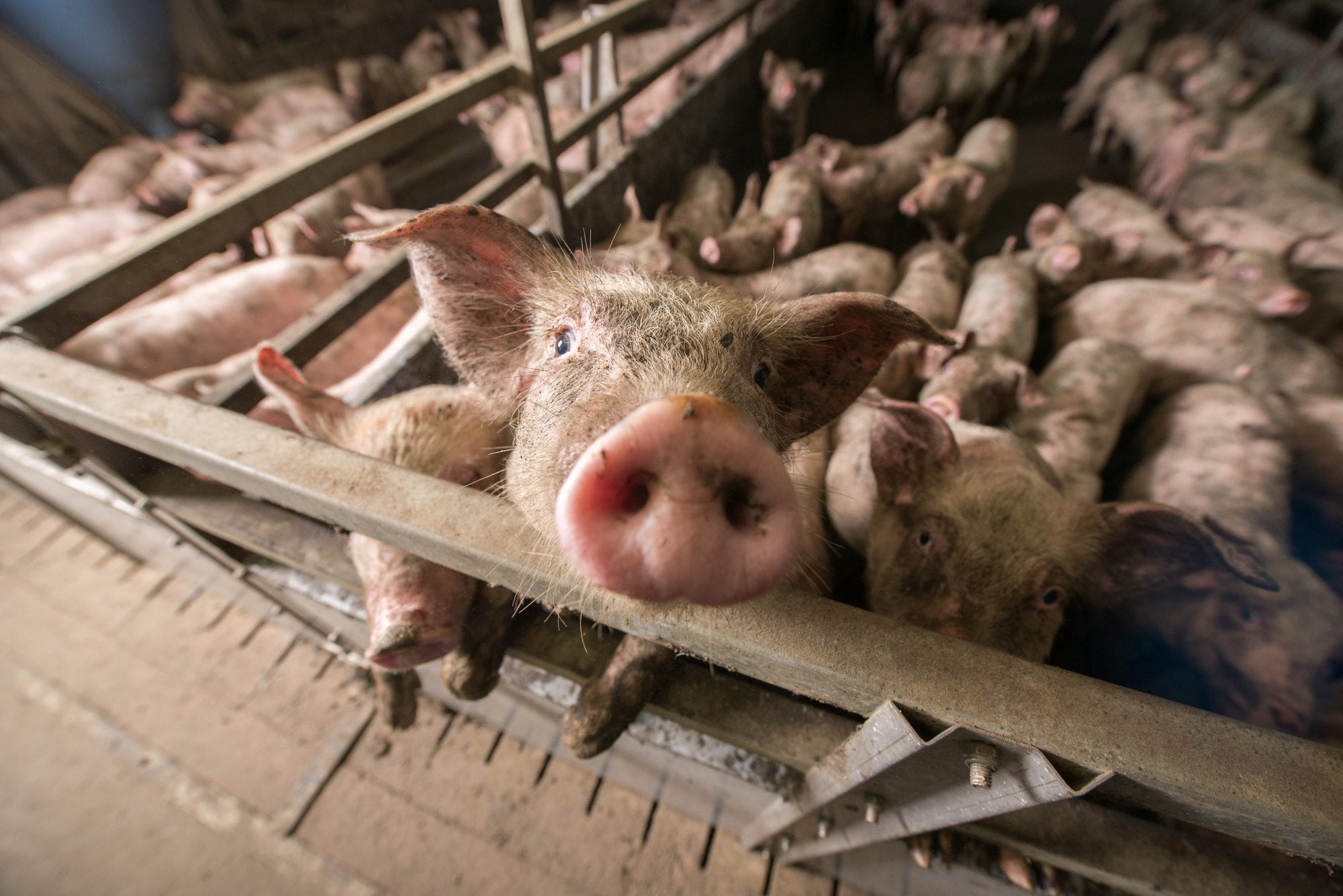
You might object: when a person says they love animals, they don’t mean they love all animals. They’re not saying that they love blobfish or mosquitoes. Really they’re just saying that they love some animals. Fair enough. But the animals that we eat are, in relevant respects, like the ones we love. Pigs and cows are of similar intelligence to dogs. The big difference is that dogs are cuter.
But it doesn’t make sense to unqualifiedly say “I love group X,” if really you only love a tiny and non-representative portion of that group. If you said “I love people,” and really meant “I only love Bob,” that wouldn’t be accurate. Similarly, if you said “I love people,” and really only loved French people—but not people in other countries, who didn’t differ in any morally important respects—then that would obviously be a failure to love people.
So, Billie Eilish’s claim is correct. However, it set off huge numbers of critics on the internet who were very snarky and dismissive in response. Their responses were also massively terrible. Let’s see what they have to say:
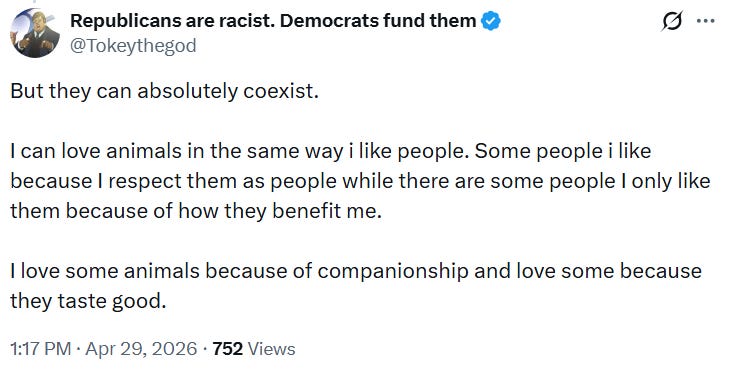
Reply: imagine a person said “I love all my children, some as companions, some to eat.” Would you say they really loved their children? No, obviously not. There is some trivial sense in which people say they love things that they really just enjoy—e.g. “I love Doritos”—but that’s obviously not the right kind of sentiment being expressed. That is the love of a LION: love in only name. Speaking of which:

Do you think lions love gazelles? What are you smoking? And note: you can think it’s okay to eat meat if you need to, but wrong for most people to do it because they don’t need to.

But no one says that they love plants in the same way that people might love animals! That is, you might say “I love plants,” the way that you claim to love Doritos—where love is a shorthand for describing that you enjoy something—but that’s distinctly not the sense in which people claim to love animals.
The principle is: you can’t claim to love someone if pay for them to be mistreated and killed and then you eat them. This doesn’t apply to Earth, because nobody devours all of Earth. If someone did eat Earth, Galactus style, I would say that they didn’t love Earth. If someone eats just little tiny bits of Earth, and the alternative is death, then that is obviously consistent with loving Earth. Additionally, I don’t think you can really love Earth as it’s not an agent.

This Tweet was a nice performative example of itself—raising the question it asks in the first line. The fact that we keep animals for sustenance doesn’t tell anything about whether there is a conflict between loving animals and eating them. Analogy: if you had a child with the plan to eat them later, thus having them for sustenance, eating them would still be inconsistent with proper love. Even if society had been doing that for a long time, it would obviously still be incompatible with love.

This is a better reply, but it doesn’t work. I don’t think that when you say “I love XYZ,” that has to cover weird edge cases, even if they are statistically common. If you say “I like rocks,” even though most rocks are in space, you are not committed to talking about those—you’re just talking about the typical rocks we encounter in normal life. So when one says “I love animals,” they’re supposed to be quantifying over the normal animals we standardly think of. That doesn’t include tape worms. Also, tape worms don’t have any interests, so it can’t be a failure of love to neglect their interests.
If what you mean when you say “I love animals,” is “I love dogs and cats that look cute to me and am totally fine with others that are less cute being tortured in dark nightmare cages,” then say that. But don’t claim to be an animal lover, unqualifiedly.

Nope, try again, not a counterexample, nobody thinks that lions and tigers love animals.

But no one claims to love plants.

Dawg, you can get a yearly supply of supplements for like 7 dollars. And vegans statistically have better health, even controlling for other factors.

The fact that you do something doesn’t tell you if it’s consistent with love. If a society of alien cannibals ate you and your family, then even though their bodies would thrive off it, they couldn’t say they love your family.

It’s not vegans who are performative. It’s the people who routinely virtue signal about how much they love animals and then don’t do anything about it because it would be slightly personally inconvenient. Making personal sacrifices based on one’s moral convictions is the opposite of being performative. It’s absurd for a person who makes no sacrifices for some moral belief to call those who do make regular sacrifices for that belief performative. This would be like Jeffrey Dahmer denouncing the horrors of cannibalism and then calling people with cannibalistic impulses who don’t eat other people performative.


Okay but presumably most meat eaters are not inuit communities hunting whales (nor, in fact, are most vegans white). So then this has nothing to say about normal instances of meat consumption. In addition:


Why does anyone find this a persuasive response? You can’t nullify a charge of hypocrisy by merely repeating you hold both beliefs! Compare: you can’t be opposed to slavery and own slaves. Reply: I AM OPPOSED TO SLAVERY AND OWN SLAVES, GET FUCKED.

Thus, Billie Eilish is obviously right, QED, etc. This was also a funny Twitter brouhaha to witness, because people would start by insulting Eilish’s intelligence, and then demonstrate beyond all semblance of doubt that they have the mental capacity of a potato. Perhaps their concern for the welfare of plants is all the more explicable.
Reminder: though the farm bill passed the house, it is now going to the senate. So call your senators and tell them to vote no on any version of the farm bill that would include the save our bacon act provision, which would destroy most state animal welfare laws.
I want to see someone bite the bullet and argue that you can lovingly cannibalize your friends and family
Bentham's Based Bulldog