

Biblical inerrancy is the doctrine that the Bible is without error. The exact sense in which it’s supposed to be without error is disputed. Here’s my thesis: insofar as there’s any collection of books you can declare non-inerrant by reading it, the Bible is one such collection. The case against inerrancy is overwhelming and decisive. So long as inerrancy is a substantive thesis, rather than a near-tautology, the Bible isn’t inerrant. There’s recently been a lot of debating about Catholicism going on around Substack, and Catholics are committed to some kind of inerrancy, so consider this my latest volley in the perennial religion wars.
Sadly, the pieces cataloguing Biblical errors are often written by twelve-year-old new atheists with titles like “10,000 Biblical Contradictions,” where half are obviously fake. I’ve been disappointed by the paucity of writings making the case against inerrancy seriously. It thus seemed worth doing a comprehensive write-up.
Note that passages can give evidence against inerrancy even if there is some possible reading on which they aren’t in error. Merely coming up with some explanation is inadequate. So long as a passage is more likely to be contained in a book that errs than an inerrant one, it provides evidence against inerrancy. Across many passages like this, the evidential force compounds.
Obviously this list won’t be complete—the Bible is a long book, and I can’t hope to address every single plausibly wrong thing in it. I’ll try to focus on the examples that seem most serious and most representative of broader themes. So, for example, I’ll give some examples of wrong genealogies, some examples of serious moral errors, and some examples of incorrect authorship—while noting there are plenty more.
Here’s the roadmap, where before the colon lists the title and after describes it in more detail:
Warcrimes: slaughter commands in the Hexateuch.
Slavery: repeated Biblical support for slavery.
Leviticus: all the craziness in Leviticus.
Daniel: it contains a lot of historical errors and says it was written by Daniel when it very likely wasn’t.
2 Peter: it claims falsely to have been written by Peter.
Genesis 19: this passage tells a very implausible story of the Israelite’s rival nations both being birthed through incest.
Conflicting genealogies: Matthew and Luke tell conflicting and irreconcilable genealogies.
Imminent return: the Bible repeatedly indicates Jesus’s second coming occurring during the life-time of the Apostles.
Contradictions: lists a bunch of contradictions concerning the time of the crucifixion, who commanded the Davidic census, the person who killed Goliath, whether people can speak to God face to face, and how Judas died.
Violent fulmination: describes immoral depictions of the wholesale destruction of Israel’s enemies, willed by God.
Even Christians shouldn’t affirm inerrancy: explains why there aren’t good theological reasons to affirm inerrancy.
Conclusion: concludes, as you might have guessed.
1. War crimes
The book of Joshua is dedicated almost entirely to discussing the glory of the Israelite conquests—carried out with conspicuous disregard for the lives of the innocent people being slaughtered. If any other ancient source depicted these acts, we wouldn’t hesitate to label the depicted acts serious war crimes. Joshua 6 describes what happened after the Israelites conquered Jericho:
21 They devoted the city to the Lord and destroyed with the sword every living thing in it—men and women, young and old, cattle, sheep and donkeys.
…
24 Then they burned the whole city and everything in it, but they put the silver and gold and the articles of bronze and iron into the treasury of the Lord’s house.
Joshua 8 describes similar brutality after conquering Ai:
24 When Israel had finished killing all the men of Ai in the fields and in the wilderness where they had chased them, and when every one of them had been put to the sword, all the Israelites returned to Ai and killed those who were in it. 25 Twelve thousand men and women fell that day—all the people of Ai. 26 For Joshua did not draw back the hand that held out his javelin until he had destroyed[a] all who lived in Ai. 27 But Israel did carry off for themselves the livestock and plunder of this city, as the Lord had instructed Joshua.
Deuteronomy 20 describes God commanding the Israelites to enslave some nations and slaughter others in their entirety:
10 When you march up to attack a city, make its people an offer of peace. 11 If they accept and open their gates, all the people in it shall be subject to forced labor and shall work for you. 12 If they refuse to make peace and they engage you in battle, lay siege to that city. 13 When the Lord your God delivers it into your hand, put to the sword all the men in it. 14 As for the women, the children, the livestock and everything else in the city, you may take these as plunder for yourselves. And you may use the plunder the Lord your God gives you from your enemies. 15 This is how you are to treat all the cities that are at a distance from you and do not belong to the nations nearby.
16 However, in the cities of the nations the Lord your God is giving you as an inheritance, do not leave alive anything that breathes. 17 Completely destroy[a] them—the Hittites, Amorites, Canaanites, Perizzites, Hivites and Jebusites—as the Lord your God has commanded you. 18 Otherwise, they will teach you to follow all the detestable things they do in worshiping their gods, and you will sin against the Lord your God.
Some people suggest that this is just wartime hyperbole. They cite the fact that other texts in the Ancient Near East would sometimes use hyperbolic language of total destruction that wasn’t meant to be taken literally. But insofar as a text includes language where God allegedly commands the wholesale slaughter of innocent people, that is a clear error. It’s hard to interpret the command to “not leave alive anything that breathes” explicitly contrasted with making people “subject to forced labor” as hyperbole.
Even if the actual destruction of the cities is hyperbolically inflated, the command is not. How can detailed and contrastive instructions to carry out genocide as opposed to some other act—allegedly coming from God—be anything other than a serious moral error? It’s especially hard to see 1 Samuel 15 as hyperbole, when there’s a detailed plot point about Saul being deposed for not completely wiping out the Amalekites. Even if successful, this defense reduces the crime from genocide to ethnic cleansing—still a serious problem.
Similarly, people sometimes suggest that these passages aren’t supposed to be taken literally as depictions of any kind of conquering event. Instead, they are just there to teach us lessons. But it seems like a clear error if you write something whose non-literalism isn’t obvious—and this leads billions of people throughout history to believe in the permissibility of genocide. It is hard to imagine that the optimal vehicle for delivering true and important theological content is a detailed book-length description of mass slaughter of men, women, and children.
Should one just bite the bullet and say that this was justified? After all, we already know that God permits the innocent to die if he exists at all—from malaria, flesh-eating parasites, and earthquakes. God has all sorts of reasons for doing things that we don’t know about. And standard theodicies purport to explain God’s reasons for allowing apparent evil.
Still, there’s a huge difference between directly commanding an evil and simply setting up a world where the evil can happen. God pretty rarely intervenes directly in history in enormous and direct ways. It would be pretty surprising if one of the few times he did, it was to order mass slaughter. The other evils can be chalked up to “bad feature that results from the world being screwed up.” That won’t cut it for God directly commanding mass slaughter. It seems pretty clear that if God is going to intervene in history in a major way, he can work out a better way of achieving whichever ends he aims at than commanding mass slaughter.
Second, the problem isn’t just moral. It’s also that we know that Bronze Age people claimed all the time that their gods supported military victories for their people against their enemies. It would be really surprising if one of God’s major interventions in history corresponded closely to what everyone else throughout the surrounding time period believed wrongly. I like the way Dustin Crummett put it:
One issue here is that it’s not *just* that, e.g., the genocide commands seem like something God wouldn’t command; it’s that they *also* seem like the sort of thing Bronze Age people would falsely make up. This is obvious in the case of, say, Mormonism: “all these women need to have sex with Joseph Smith” seems surprising coming from God, but not surprising coming from Joseph Smith. People have claimed divine sanction for war crimes all throughout history, and presumably we both agree that they were almost always wrong; it’s kind of weird if it turns out God really did order genocide a couple times, and it happened to be in a context where everybody thought genocide was cool and good.
(Some probably was written during the iron age).
If God is going to command things that seem obviously immoral, it would be surprising if he did it right at a time when everyone thought the thing in question was moral. Lastly, it seems the archeological record indicates that this didn’t happen.
I find Dustin’s point to have more force than the purely moral argument. The main problem isn’t that we can be super confident that God wouldn’t command mass slaughter. Theists already think God allows lots of bad things to happen. It’s that once one plays the skepticism card, there is an almost inconceivable range of things that God might do—it would be ridiculously surprising if he just so happened to do the things in the Ancient Near East that resembled what Ancient Near Easterners thought their tribal war gods did. Additional Bayesian machinery in a footnote.1
2. Slavery
The Bible has a number of passages that appear to sanction slavery in a way typical of the beliefs of the surrounding time period, but falling well short of the commands of a perfect God. For example, from Leviticus 25:44-46:
“Your male and female slaves are to come from the nations around you; from them you may buy slaves. You may also buy some of the temporary residents living among you and members of their clans born in your country, and they will become your property. You can bequeath them to your children as inherited property and can make them slaves for life, but you must not rule over your fellow Israelites ruthlessly”.
Note that this explicitly sanctions the practice of slavery. It goes out of its way to permit permanently enslaving foreigners. Exodus 21:20-21 declares:
20 “Anyone who beats their male or female slave with a rod must be punished if the slave dies as a direct result, 21 but they are not to be punished if the slave recovers after a day or two, since the slave is their property.
Ephesians 6:5 says “Slaves, obey your earthly masters with fear and trembling, in singleness of heart, as you obey Christ.” Colossians 3:22 reiterates “Slaves, obey your earthly masters in everything, not only while being watched and in order to please them, but wholeheartedly, fearing the Lord.” Other passages that express similar sentiments include 1 Peter 2:18 and 1 Timothy 6:1.
To reiterate: the concern is not just that these seem immoral (though, of course, they do). It is that they are immoral in precisely the way that human authors making errors in the surrounding context would be expected to be immoral. So this sort of writing is much more expected if inerrancy is false than if it’s true. It would be surprising if, when God makes counterintuitive moral judgments, they line up suspiciously with the widely-shared judgments of the surrounding time period. (Dustin’s “all these women need to have sex with Joseph Smith” analogy is a good one).
Now, maybe God couldn’t have commanded the outright elimination of slavery. Perhaps that would have backfired. But at the very least, he could have described slavery as a lamentable institution and refrained from enshrining in law a kind of slavery that treated foreigners much more cruelly than Israelites. He could also have avoided giving slaves direct instructions to obey their masters. I also find it weird that God apparently was willing to use his limited political capital on prohibiting shellfish and mixed fabrics, but not on banning slavery.
Note one last point: nearly all Christians throughout history, until the last few hundred years, thought these texts permitted slavery. It seems like a crucial oversight to include in sacred scripture passages which are interpreted by billions of people to support the permissibility of slavery.
3. Leviticus
The book of Leviticus seems to contain a number of problematic verses reflecting common errors at the time. In context, Leviticus was the law code, taken seriously by the Jewish people. Ethically objectionable laws in Leviticus are thus a problem. But these abound.
Leviticus 21: “If a priest’s daughter defiles herself by becoming a prostitute, she disgraces her father; she must be burned in the fire.”
Leviticus 15:19: “When a woman has her regular flow of blood, the impurity of her monthly period will last seven days, and anyone who touches her will be unclean till evening.”
Leviticus 20:18: “If a man has sexual relations with a woman during her monthly period, he has exposed the source of her flow, and she has also uncovered it. Both of them are to be cut off from their people.”
Leviticus 20:15: “If a man has sexual relations with an animal, he is to be put to death, and you must kill the animal.” Why should the animal be put to death?
Leviticus 20:9: “Anyone who curses their father or mother is to be put to death. Because they have cursed their father or mother, their blood will be on their own head.” This is pretty insane!
Leviticus 20:13: “‘If a man has sexual relations with a man as one does with a woman, both of them have done what is detestable. They are to be put to death; their blood will be on their own heads.”
These are just a select few of the relevant passages. But surely these are vastly more likely to be the work of a human author making mistakes than a divine author communicating deep wisdom without error! If these don’t count as errors, ask: is there anything that could be found in Leviticus that would count as an error?
If there were just one passage like this, it would be one thing. But Leviticus is suffused with apparent immorality that seems to reflect mistaken prejudices of the surrounding culture. The odds of these sorts of passages appearing in a text produced by humans at the time is quite high—the odds of it being produced in an inerrant text are much, much lower. If a law code is included in scripture as being set up by God himself, and the law code has bad laws, surely that is an error.
Perhaps God was accommodating the existing errors of the culture. After all, Jesus says Moses only permitted divorce because of the hardness of the people’s hearts. But this only explains keeping existing bad laws—not instituting new ones that are both bad and bizarre.
It is very unlikely that the Israelites were so committed that leadership had to impose laws that executed homosexuals, those who curse their father, animals that were raped, and prostitute daughters of priests. Similarly, it’s hard to believe that belief in the impurity of women having their period wasn’t changeable. Remember, this is all after God just did a bunch of totally crazy miracles, freed the Israelites from Egyptian bondage, and spoke from a mountain.
Perhaps God’s ways are mysterious, so we should expect the moral law he implements to look weird to us? Sure, but we shouldn’t expect it to look weird in all these ways that we’d actively expect from law codes of primitive people. It would be very surprising indeed if an infallible law code contained suspicious overlap with the kinds of immoral laws you’d expect from primitive Near-Easterners.
4. Daniel
Daniel claims to have been written by Daniel, repeatedly referring to itself in the first person. For example, Daniel 8:15 says “While I, Daniel, was watching the vision and trying to understand it, there before me stood one who looked like a man.” But there is a pretty overwhelming scholarly consensus against Daniel, who reportedly lived around 600, having written Daniel. And this scholarly consensus is plausible—it looks like the book was compiled around 164 based on older material, often from the 300s:
Ben Sira lists major Israelites and includes Isaiah, Jeremiah, Ezekiel, and the Twelve Minor Prophets. Yet he leaves out Daniel. If, as the book suggests, Daniel was of similar eminence, it is hard to see why he’d be left out.
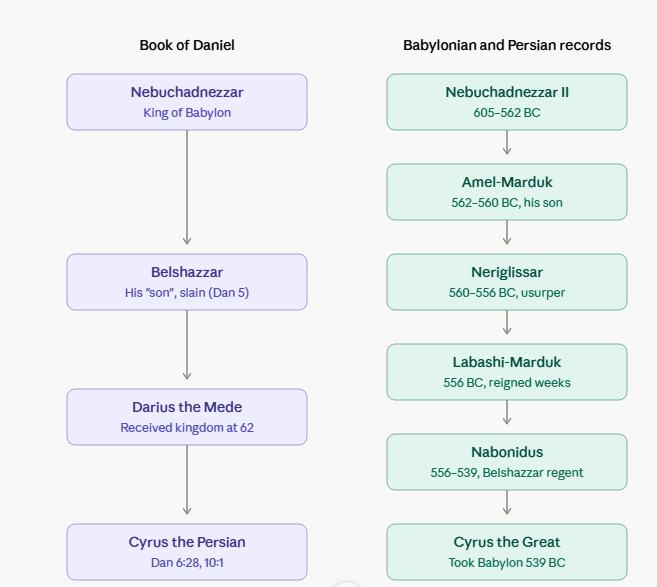
The book jumbles the history that occurred around the time Daniel allegedly lived (between 620 and 530 BCE). It treats Belshazzar as being the son of Nebuchadnezzar when really he was the son of King Nabonidus.2 It also treats Belshazzar as king, when Nabonidus was the last king.3 Now, conservative scholars often reply that Nabonidus entrusted leadership authority to his son. They’ll cite the fact that the verse account of Nabonidus says he “entrusted the kingship to [his son],” but this overlooks a bunch of problems that I’ll put in a footnote.4
Similarly, the book of Daniel claims that Darius the Mede became the king when Belshazzar was killed, while other sources say Cyrus directly took over after Nabonidus was captured and exiled.5 Daniel 9:1 says Darius was the son of Xerxes—in fact, Xerxes was Darius I's son. The description of Darius the Mede also appears to be based on jumbled up history from someone later named Darius Hystaspis, who, like the supposed Darius the Mede, took Babylon, organized the empire into satrapies, and was named Darius (though he lived a lot later, so this definitely couldn’t have been an accurate description). Darius the Mede doesn’t seem to have existed! For this reason, the early dating defenders generally suggest that Darius the Mede was a name for someone else, yet in no case are these people called Darius, and in no case are they both King and a Mede (additional problems for each in a footnote).6 And see here for other errors.
Daniel uses the term “Chaldean” to mean wise man, even though contemporary Neo-Babylonian sources use Chaldean as an ethnic term. The term being used to mean wise man appears only in Persian and Hellenistic-era sources, so Daniel's usage reflects a time period after the fall of Babylon.
The story depicts various things that are very unlikely to have happened:7
Other indications adduced to [show] that the Book of Daniel is not the work of a contemporary, are such as the following :-The improbability that Daniel :i. and his companions, all strict Jews, should have suffered themselves to be initiated into the superstitious arts of the 'wise men', or that he should have been accepted as their president by the 'wise men' themselves 2; the improbability that Nebuchadnezzar should hold all the wise men of Babylon, including Daniel and his three companions, responsible for the failure of some, and condemn them to death even before their skill had been tried; Nebuchadnezzar's seven years' insanity (lycanthropy), with his public proclamation respecting it; the absolute terms in which both he and Darius, while retaining, so far as appears, their idolatry, recognize the eternal and universal sovereignty of the God of Israel.
Probably the strongest evidence is that when depicting events up through the period of the Seleucids in 167, Daniel is very accurate. Right after (starting verse 11:40), his accuracy falls off a cliff. Daniel predicts that Antiochus will launch another major campaign against Egypt, pass through lands including Judea, dominate Egypt/Libya/Cush, then pitch his royal tents “between the sea and the glorious holy mountain,” and die there. That is not how Antiochus died. He died in the east, in Persia/Babylonia-region traditions, not after conquering Egypt and not in Palestine.
His death in Persia is attested to by Polybius, Josephus, and 1 and 2 Maccabees. Daniel also predicts the resurrection of the dead and the coming of Michael occurring immediately after which obviously didn’t happen. And note: the text claiming to be from Daniel occurs in the visions spanning chapters 7-12—so the bit of the text claimed to be first-person is precisely the bit that we have the strongest evidence is not from Daniel.
Daniel depicts the coming end of the world. But every other example of a full blown apocalypse story is from the third century BCE onwards.
The whole book converges on Antiochus. Each of the major prophecies in Daniel terminates at the time of Antiochus’s reign. But it would be pretty weird for a predictive prophecy written in the sixth century BCE to focus excessively on this random second-century ruler.
What do those who favor an early dating say in response?
Much of the contrary evidence is drawn from cases where the Aramaic portions of the text appear older. But the conventional view is that the mostly Aramaic portions in chapters 2-7 are older than the rest. Chapters 1-6 are third-person court tales, while chapters 7-12 are first-person apocalyptic visions. As for language, Daniel 1:1-2:4a are Hebrew, and then it switches to Aramaic through chapter 7, and then back to Hebrew. Chapters 1-6 are generally believed to be older by critical scholars, so citing their extra age isn’t dispositive.
Similarly, those defending an earlier date often cite the absence of Greek words as evidence of earlier composition, but Hebrew and Aramaic texts we know were composed in 2nd–1st century Palestine—the Qumran sectarian corpus—are equally free of Greek loanwords.
Similarly, it’s sometimes claimed that Daniel was correct about the existence of Belshazzar while other sources like Xenophon and Herodotus don’t know him. But demonstrably Babylonian traditions were present in the second century—the Prayer of Nabonidus at Qumran proves this, and Baruch 1:11-12 even illustrates that knowledge of Belshazzar was preserved. Thus, it wouldn’t be surprising for Daniel to know about Belshazzar’s existence while botching some of the details.
Lastly, there are complicated linguistic disputes about what dating the language favors: this is sufficiently complicated and disputed that I don’t give it a ton of weight (though if one gives weight to this, they should note that the Hebrew linguistically more closely resembles Ezra and Esther, written later, than books written in the sixth century. My uninformed outsider sense is that the 600-daters have to cope a bit about the Hebrew and the 160ish daters have to cope a bit about the Aramaic, with the later daters having a slightly stronger linguistic argument; the Aramaic seems consistent with many dates while the Hebrew seems to more strongly favor a later date. But this stuff is way above my pay grade.)
And note: the reason people don’t think Daniel wrote Daniel isn’t that they have a bias against the supernatural. None of the arguments I’ve cited assume that predictive prophecy can’t happen. They just assume that if you butcher the events of some period, you probably weren’t a contemporary—and if your accuracy dives off a cliff around some discrete date, probably that reflects when you stopped retrodicting and started predicting.
Now, some people have suggested that Daniel wasn’t a forgery but instead consistent with a literary genre where one attributes their insights to ancient sources. But all our earliest sources seem to think that Daniel really wrote Daniel. As Bart Ehrman notes, “ancient people really did believe that they were written by the people who claimed to be writing them, as seen repeatedly in the ancient testimonies.” Some sources that attribute the book to Daniel include: Matthew 24:15, Josephus, 4 Ezra 12:11, and Hippolytus.
When Porphyry in the third century AD argues that Daniel wasn’t by Daniel—and this discredits Christianity—Jerome replies by arguing that it was! If attributing books to people who didn’t write them had been an accepted practice, he could have simply granted the point. Everyone in that exchange seemed to agree that attributing books to people who didn’t write them was a big problem. This also illustrates that ancient writers thought that Daniel wrote Daniel.8 In some cases, people were even put to death for forging. Ehrman notes that the Greek descriptions of false authorship condemned it unequivocally:
“In Greek the two most common words to describe literary texts whose authors falsely claim to be a well-known figure are pseudos, which means “a falsehood” or “a lie,” and nothos, which means “an illegitimate child,” with connotations similar to our modern word “bastard.”
In early Christian communities, we have condemnations of forgery from Serapion of Antioch, The Muratorian Fragment, Tertullian, 2 Thessalonians, and more. Ehrman’s conclusion:
In short, there were long, protracted, and often heated debates in the early church over forged documents. Early Christians realized that there were numerous forgeries in circulation, and they wanted to know which books were written by their alleged authors and which were not. As we will see more fully later, practically no one approved of the practice of forgery; on the contrary, it was widely condemned, even in books that were themselves forged (such as 2 Thessalonians and the Apostolic Constitutions).
And note: even if Daniel doesn’t count as a forgery, the many serious errors of fact—with repeated, detailed descriptions of non-existent events and people—still count as errors.
5. 2 Peter
Another Biblical book that wasn’t by the person who is claimed to have written it is 2 Peter. The book claims to be written by “Simon Peter, a servant and apostle of Jesus Christ.” But it very likely wasn’t:
We know that in early Christian communities, people were constantly forging books and attributing them to NT main characters. So the prior on forgery isn’t low.
We have no mention of the book until Origen in the mid-third century.
The book of Acts says that Peter was “unlettered.” 2 Peter, however, is written in elaborate literary Greek (also different in style from 1 Peter).
The book contains various anachronisms like mentioning Paul’s letters as if they’re some organized collection of scripture—though no one else talks like this for at least 100 years. More decisively, it criticizes those who say “Where is the promise of His coming? For ever since the fathers fell asleep, all things continue just as they were from the beginning of creation.” This would be a weird thing to write during the days of Peter, when many of these people (notably: Peter) were still alive.
The book largely borrows from Jude, which would be odd for Peter—the chief Apostle—to do.
And note: there are many books that scholars don’t think are from the person who claims to have written them, not just 2 Peter and Daniel. The full list includes: 1 Timothy, 2 Timothy, Titus, Ephesians, 2 Thessalonians, Colossians (though this is a closer split), 1 Peter (also a closer split), James, Jude, Ecclesiastes, and various others. Though I admit to not having looked into these carefully.
6. Genesis 19
Genesis 19 tells the story of how the Moabites and the Ammonites—two of the main rival nations—came to be. Here is the story: Lot’s daughters got him drunk and slept with him on two consecutive nights while he was unconscious (it says “he was not aware of it when she lay down or when she got up,” which is, at the very least, physiologically improbable). They both gave birth: one to someone named Moab, who fathered the Moabites, and the other to Ben-Ammi, who became the father of the Ammonites.
Note: this occurs alongside other stories that are standardly thought to be literal history by inerrantists—e.g. about Abraham. So it’s hard to see why those who think that Christians should believe in a literal Abraham would be skeptical of this story.
Tell me: which seems more probable?
Two daughters got their father drunk, were able to successfully sleep with him in a cave while he was unconscious, and bore two sons. These sons went on to found the Israelites’ main enemy nations which suspiciously continued to bear their name, despite this not being how nations typically work. Oh, and the names also happened to be Hebrew puns on incest! A five-fold coincidence!
The Israelites had a fictitious mean story about the enemy nations’ disreputable origins, according to which they were the products of incest, just as lots of other nations have made up mean stories about enemy nations.
If you believe 1, I have a bridge to sell you.
What could inerrancy mean if it’s compatible with the transmission of stories—presented alongside ones taken to be historical—that are both false and bad in effect? By this standard, almost any book could be found in sacred scripture and not taken to be in error!
And note: while this is the most direct instance of this kind of thing, it’s far from the only one. We similarly have three different stories—two of Abraham, one of Isaac—passing off their wives as their sisters to avoid being killed. The second story of Abraham and the one of Isaac have them being passed off to the same person. Isn’t it clear that these stories are not accurate—but instead are garbled versions of a common motif?
7. Conflicting genealogies
The most serious conflict between genealogies in the Bible is between Matthew and Luke. Their differences are myriad:
Matthew runs through Solomon, Luke through Nathan.
Matthew gives Joseph's father as Jacob, Luke gives Heli.
The lists have different lengths (Matthew says there are 27 generations between David and Jesus, while Luke says there are 42).
They only share two names in the middle (Shealtiel and Zerubbabel).
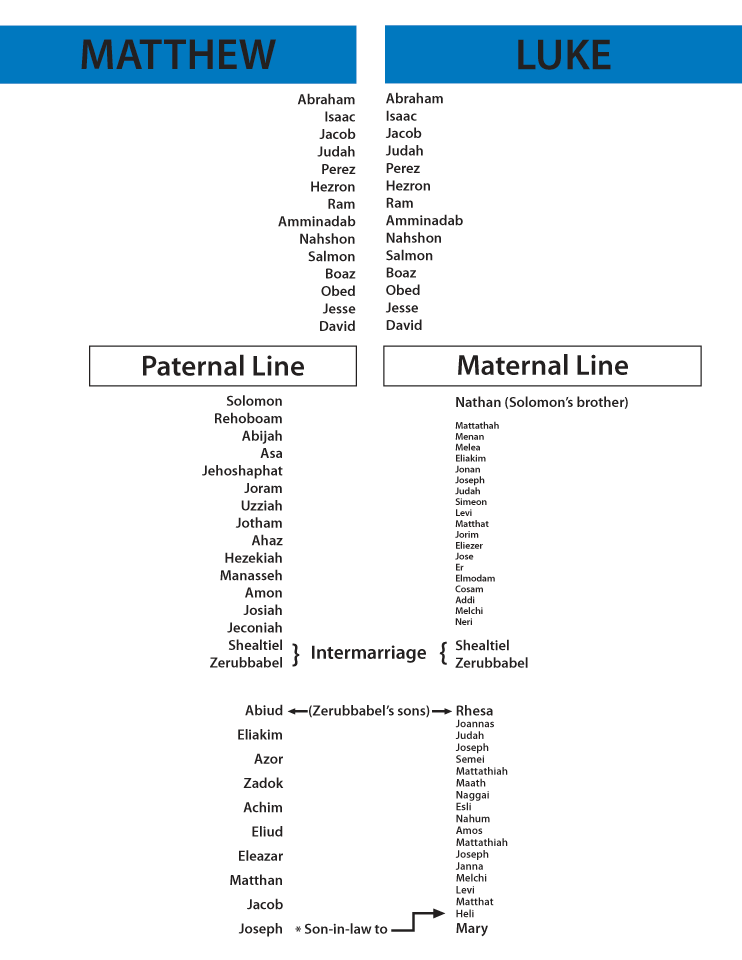
Now, some say that Luke was giving Mary’s genealogy while Matthew was giving Joseph’s. This would be odd, though, because it describes Jesus as the son of Joseph, and then lists Joseph’s lineage. This is obviously not the plain reading of the text—which plainly appears to list Joseph’s father—and wasn’t dreamt up by anyone till 1490. In addition, the texts differ as to who Shealtiel’s father was.
Jimmy Akin proposes the following theory. Joseph was the adopted son of Heli but the biological son of Jacob. So the lists diverge regarding who to count as the grandfather: Matthew counts the biological grandfather, Luke counts the adopted grandfather. The two continue up the line until converging at Zerubbabel. They differ as to Shealtiel’s father because of adoption. Akin writes, “Though biologically the son of Neri, Shealtiel was reckoned as Jechoniah’s son for purposes of the kingly line.” Thus, Matthew counts Jechoniah as the father (taking into account his status as the adopted father), while Luke counts Neri as the father looking biologically. The two trace parallel paths through David. But this account has a number of problems:
At Shealtiel, Akin says Matthew (Jeconiah) gives the legal father and Luke (Neri) the biological one—he needs to say this since 1 Chronicles 3:17 explicitly makes Shealtiel Jeconiah's son, so Luke's Neri is otherwise a contradiction with Chronicles. Then, Luke gives the legal succession (Heli) while Matthew gives the biological succession (Jacob). But this means that they’re not consistent between using legal and biological frameworks.
It requires that two separate adoptions happened at the only two places the lines touch: one at Shealtiel and one at Joseph. This would be pretty surprising. Note: it’s not just that there would be two separate adoptions, but that they’d occur at precisely the points the lines overlap. It would be extremely surprising if both times the lists overlap after David, there was an adoptive marriage, and then the two counted them differently. The evidence for the Shealtiel crossover is nonexistent, and the evidence for the Joseph crossover comes from a source 190 years after Jesus, probably five or six generations removed from the family, that suggests Melchi is the father of Heli, while Luke suggests the father is Matthat. So the supporting source directly contradicts Luke!
The texts have wildly different numbers of generations. Between David and Jesus, Matthew has 27, Luke has 42. In addition, the length of the generations doesn’t hold up. David was born around 1040 BC; Jeconiah was born around 615. That's ~425 years across 18 links (based on the records according to Kings/Chronicles)—about 24 years per generation. Then, the remaining period, from Jeconiah to Jesus is roughly 610 years. At the dynasty’s own documented rate, you’d expect 25–26 generations. Matthew's list has only 13 links over the same ~610 years—~47 years per paternal generation, sustained for six centuries.
Now, maybe Matthew is skipping generations (he appears to leave out some kings attested in Kings and Chronicles), but that seems to call into question an inerrant genealogy dictating who came from whom! (Worth noting that Luke’s number is pretty plausible). More problematically, Matthew declares “Thus there were fourteen generations in all from Abraham to David, fourteen from David to the exile to Babylon, and fourteen from the exile to the Messiah.” This seems to indicate he at least purports to be providing the number of generations, meaning he is in error.
8. Imminent return
The plain reading of the New Testament text implies that Jesus will return within the lifetime of the disciples.
Mark 8:38-9:1 depicts Jesus saying “If anyone is ashamed of me and my words in this adulterous and sinful generation, the Son of Man will be ashamed of them when he comes in his Father’s glory with the holy angels. Truly I tell you, some who are standing here will not taste death before they see that the kingdom of God has come with power.” Matthew 16 similarly states:
27 For the Son of Man is going to come in his Father’s glory with his angels, and then he will reward each person according to what they have done.
28 “Truly I tell you, some who are standing here will not taste death before they see the Son of Man coming in his kingdom.”
The same theme is found in Luke 9. Other passages from the Gospels that suggest this reading include Mark 13 which declares:
26 “At that time people will see the Son of Man coming in clouds with great power and glory. 27 And he will send his angels and gather his elect from the four winds, from the ends of the earth to the ends of the heavens.
28 “Now learn this lesson from the fig tree: As soon as its twigs get tender and its leaves come out, you know that summer is near. 29 Even so, when you see these things happening, you know that it[d] is near, right at the door. 30 Truly I tell you, this generation will certainly not pass away until all these things have happened. 31 Heaven and earth will pass away, but my words will never pass away.
Similarly, Matthew 10:23 declares, “Truly I tell you, you will not finish going through the towns of Israel before the Son of Man comes.” And many other passages in the Gospels seem to indicate that the second coming is near: Mark 14:62, Mark 1:15, Matthew 24:33, Mark 13:29, and Luke 18:8.
In Paul’s letters, we have similar claims that Jesus’s coming was imminent. Examples:
1 Thessalonians 4:15–17: “we who are alive, who are left until the coming of the Lord.”
1 Corinthians 7:29–31: “What I mean, brothers and sisters, is that the time is short. From now on those who have wives should live as if they do not; those who mourn, as if they did not; those who are happy, as if they were not; those who buy something, as if it were not theirs to keep; those who use the things of the world, as if not engrossed in them. For this world in its present form is passing away.”
Romans 13:11–12: “salvation is nearer to us now than when we became believers; the night is far gone, the day is near.”
In the rest of the New Testament, we have similar attestation:
Hebrews 10:37: “in a very little while, the one who is coming will come and will not delay.”
James 5:8–9: “the coming of the Lord is near... the Judge is standing at the doors.”
1 Peter 4:7: “The end of all things is near.”
1 John 2:18 “Dear children, this is the last hour; and as you have heard that the antichrist is coming, even now many antichrists have come. This is how we know it is the last hour.”
Revelation 22:20 He who testifies to these things says, “Yes, I am coming soon.”
Amen. Come, Lord Jesus.
Then there are passages coming from the later books of the New Testament indicating an expectation of imminent return. 2 Peter 3:3 quotes scoffers asking "Where is this ‘coming’ he promised? Ever since our ancestors died, everything goes on as it has since the beginning of creation,” before answering (v8) “With the Lord a day is like a thousand years, and a thousand years are like a day.” John 21 purports to correct the widespread belief that the beloved disciple wouldn’t die until the second coming. Thus, it seems belief in an imminent return was very much in the air, and represented the standard belief of the Gospel authors.
C.S. Lewis calls one of the verses of Jesus predicting an imminent return “certainly the most embarrassing verse in the Bible.” He resolves this by suggesting that Jesus is capable, in his human form, of making errors. After all, the Bible depicts him saying he doesn’t know things and that he grew in wisdom, which requires previous ignorance. But this would not rescue Biblical inerrancy.9
My friend Aron Wall has an interesting post about this. His post is primarily concerned with Matthew 24:34, which says “Truly I tell you, this generation will certainly not pass away until all these things have happened.” Mark 13 and Luke 21 say basically the same thing.
Aron starts by noting that there are a bunch of passages that caution against trying to guess when the second coming will happen. Matthew 24:42 says:
Therefore keep watch, because you do not know on what day your Lord will come. But understand this: If the owner of the house had known at what time of night the thief was coming, he would have kept watch and would not have let his house be broken into. So you also must be ready, because the Son of Man will come at an hour when you do not expect him.
And Mark 13:32 describes Jesus saying that not even he or the angels know when it will happen:
But about that day or hour no one knows, not even the angels in heaven, nor the Son, but only the Father.
But here I think there’s a pretty easy response: Jesus was cautioning against trying to predict exactly when it would happen. He did, however, think it would come soon. For a point of comparison, you might say to a small child “we don’t know exactly when Mom is coming home,” while also saying “she’ll be home soon.”
Aron notes that the passage in Matthew begins:
24 Jesus left the temple and was walking away when his disciples came up to him to call his attention to its buildings. 2 “Do you see all these things?” he asked. “Truly I tell you, not one stone here will be left on another; every one will be thrown down.”
3 As Jesus was sitting on the Mount of Olives, the disciples came to him privately. “Tell us,” they said, “when will this happen, and what will be the sign of your coming and of the end of the age?”
He proposes that the disciples were asking two separate questions. One: when will this happen, where “this” refers to the destruction of the temple? Two: what will be the sign of Jesus’s coming? The destruction of the temple occurred in 70 AD, so Jesus was right that “this generation will certainly not pass away until all these things have happened,” where “these things” refers to the destruction of the second temple.
Here’s the big problem: verses after 36 seem clearly to be about the second coming. In verse 37 it says “As it was in the days of Noah, so it will be at the coming of the Son of Man.” So it seems like Aron needs the answer about the destruction of the temple to last about one sentence and be sandwiched between two passages about the second coming. To see this, I’ll highlight all the passages in yellow that really seem like they’re about the second coming and the passages in blue that Aron needs to be about the second temple:
30 “Then will appear the sign of the Son of Man in heaven. And then all the peoples of the earth[c] will mourn when they see the Son of Man coming on the clouds of heaven, with power and great glory.[d] 31 And he will send his angels with a loud trumpet call, and they will gather his elect from the four winds, from one end of the heavens to the other.
32 “Now learn this lesson from the fig tree: As soon as its twigs get tender and its leaves come out, you know that summer is near. 33 Even so, when you see all these things, you know that it[e] is near, right at the door. 34 Truly I tell you, this generation will certainly not pass away until all these things have happened. 35 Heaven and earth will pass away, but my words will never pass away.
36 “But about that day or hour no one knows, not even the angels in heaven, nor the Son,[f] but only the Father. 37 As it was in the days of Noah, so it will be at the coming of the Son of Man. 38 For in the days before the flood, people were eating and drinking, marrying and giving in marriage, up to the day Noah entered the ark; 39 and they knew nothing about what would happen until the flood came and took them all away. That is how it will be at the coming of the Son of Man. 40 Two men will be in the field; one will be taken and the other left. 41 Two women will be grinding with a hand mill; one will be taken and the other left.
Now, here’s one way you can try to get around this: you can suggest that everything until 36 is about the destruction of the temple. My friend Gavin Ortlund suggests that the early bit of the passage is about the destruction of the second temple but uses weighty theological imagery to indicate that this was a typological foreshadowing of the second coming—just as similar language is used in the Old Testament to describe judgment on nations.10
But then you’d need to have verses 29-31 all be about the destruction of the temple, when they plainly appear to be about the second coming. I’ll illustrate what this reading looks like just to show how implausible it is (blue=second temple, yellow=second coming):
15 “So when you see standing in the holy place ‘the abomination that causes desolation,’[a] spoken of through the prophet Daniel—let the reader understand— 16 then let those who are in Judea flee to the mountains. 17 Let no one on the housetop go down to take anything out of the house. 18 Let no one in the field go back to get their cloak. 19 How dreadful it will be in those days for pregnant women and nursing mothers! 20 Pray that your flight will not take place in winter or on the Sabbath. 21 For then there will be great distress, unequaled from the beginning of the world until now—and never to be equaled again.
22 “If those days had not been cut short, no one would survive, but for the sake of the elect those days will be shortened. 23 At that time if anyone says to you, ‘Look, here is the Messiah!’ or, ‘There he is!’ do not believe it. 24 For false messiahs and false prophets will appear and perform great signs and wonders to deceive, if possible, even the elect. 25 See, I have told you ahead of time.
26 “So if anyone tells you, ‘There he is, out in the wilderness,’ do not go out; or, ‘Here he is, in the inner rooms,’ do not believe it. 27 For as lightning that comes from the east is visible even in the west, so will be the coming of the Son of Man. 28 Wherever there is a carcass, there the vultures will gather.
29 “Immediately after the distress of those days
“‘the sun will be darkened,
and the moon will not give its light;
the stars will fall from the sky,
and the heavenly bodies will be shaken.’30 “Then will appear the sign of the Son of Man in heaven. And then all the peoples of the earth[c] will mourn when they see the Son of Man coming on the clouds of heaven, with power and great glory.[d] 31 And he will send his angels with a loud trumpet call, and they will gather his elect from the four winds, from one end of the heavens to the other.
32 “Now learn this lesson from the fig tree: As soon as its twigs get tender and its leaves come out, you know that summer is near. 33 Even so, when you see all these things, you know that it[e] is near, right at the door. 34 Truly I tell you, this generation will certainly not pass away until all these things have happened. 35 Heaven and earth will pass away, but my words will never pass away.
36 “But about that day or hour no one knows, not even the angels in heaven, nor the Son,[f] but only the Father. 37 As it was in the days of Noah, so it will be at the coming of the Son of Man. 38 For in the days before the flood, people were eating and drinking, marrying and giving in marriage, up to the day Noah entered the ark; 39 and they knew nothing about what would happen until the flood came and took them all away. That is how it will be at the coming of the Son of Man. 40 Two men will be in the field; one will be taken and the other left. 41 Two women will be grinding with a hand mill; one will be taken and the other left.
In Mark, the disciples only ask “Tell us, when will these things happen? And what will be the sign that they are all about to be fulfilled?” after Jesus describes that “Not one stone here will be left on another; every one will be thrown down.” Jesus gives a similar answer, with similar descriptions according to which “about that day or hour no one knows.” Thus, it seems the event that would overturn the stones is treated as the same as the second coming. Further supporting that interpretation is verse 29, which is naturally read as saying the crazy cosmic stuff happens “Immediately after the distress of those days.”
The Son of Man coming in his glory is elsewhere used in Matthew to refer to the final judgment. So it would be weird if he uncharacteristically—just in this passage—used it to refer to the destruction of the temple, using a wealth of cosmic imagery that is otherwise reserved for descriptions of the second coming.
And the parallel passage in Luke goes so far as to use the phrase “At that time they will see the Son of Man coming in a cloud with power and great glory,” sandwiched between “Truly I tell you, this generation will certainly not pass away until all these things have happened,” and “When you see Jerusalem being surrounded by armies, you will know that its desolation is near.” Thus, the Lukan account seems to require that Jesus goes from talking about the destruction of the temple to talking about the eschaton, back to talking about the destruction of the temple without any warning.
Verse 36 looks pretty weird on any such account. On this picture, Jesus randomly switched from talking about the date of the destruction of the temple to talking about the date of the second coming, with no warning. Also, this account seems to involve Jesus answering the question in an intentionally confusing way, where he uses vivid theological language to describe different events without detailing when he’s going from one to the other.
This account runs into similar awkwardness with the parallel passages in Luke and Mark—I’ll put the awkward highlighting in a footnote.11
Aron also gives a response to Mark 9:1, where it says “Truly I tell you, some who are standing here will not taste death before they see that the kingdom of God has come with power.” He proposes this refers to the resurrection, not the second coming. But this fits awkwardly with the version of this story from Matthew 16:
27 For the Son of Man is going to come in his Father’s glory with his angels, and then he will reward each person according to what they have done.
28 Truly I tell you, some who are standing here will not taste death before they see the Son of Man coming in his kingdom.
Any other account will have similar problems with Matthew 16. Insofar as it’s about the resurrection, it requires verse 27 to be about the second coming, but verse 28 to randomly switch to talking about the resurrection. So then the theory will require multiple independent cases where the text switches between the second coming and some other topic—in one case the resurrection, in the other the destruction of the temple—with no warning.
Lastly, none of these are any help for explaining away the apparent imminent eschaton described outside of Matthew, Mark, and Luke. Taking into account the fact that this was demonstrably a widespread belief at the time, the default assumption should be that it made its way into the synoptics. It would be super surprising if the synoptics accurately record Jesus giving a teaching that just so happens to sound on plain reading like he’s asserting another extremely common belief at the time.
9. Contradictions
The Bible contains a number of pretty clear contradictions. I won’t go through all of them, and we’re already ten thousand words in, so I won’t go into too much detail about many of the seeming contradictions, but here are a few:
Mark 15:25 says “It was the third hour when they crucified Him,” (the third hour is 9 am) while John 19:14 says it was “about the sixth hour,” (noon). People often try to resolve this by claiming that John was using Roman civil time, rather than traditional time-keeping, but we have no evidence that anyone ever used “Roman civil time” to count hours rather than days. Rome counted when a new day started at midnight, but there’s no evidence that this was how anyone counted the hours and there is strong contrary evidence. Note additionally that a crucifixion at 12 had theological significance, putting things near when the Passover lambs were slaughtered, so if the Gospels were distorting details, this is exactly the kind we’d expect them to distort.
2 Samuel 24:1 says that God commanded David to take a census (saying “Go and take a census of Israel and Judah”) while 1 Chronicles 21:1 says “Satan rose up against Israel and incited David to take a census of Israel.” (Satan here might also mean an adversary). Surely whether something was commanded by God or the devil is not some minor, irrelevant detail. Now, generally people suggest God was the ultimate cause but Satan the immediate cause—this seems like quite a stretch, and also contradicts where the text suggests it was a direct command, delivered verbally, from God.
2 Samuel 21:19 says “Elhanan son of Jaare-oregim the Bethlehemite struck down Goliath the Gittite,” while 1 Samuel 17 says that David killed Goliath. 1 Chronicles 20:5 even tries to patch this by suggesting that Elhanan killed the brother of Goliath.
Exodus 33:11 says “The Lord would speak to Moses face to face, as one speaks to a friend,” while Exodus 33:20 says to Moses “you cannot see my face, for no one may see me and live.” Exodus 24:9-11 says “9 Moses and Aaron, Nadab and Abihu, and the seventy elders of Israel went up 10 and saw the God of Israel. Under his feet was something like a pavement made of lapis lazuli, as bright blue as the sky. 11 But God did not raise his hand against these leaders of the Israelites; they saw God, and they ate and drank.” Numbers 12:8 says that Moses “beholds the form of The Lord.” The most natural resolution of this is also the dominant scholarly view: the Torah is compiled from a number of different sources, and they often contradict each other. See also Jacob’s declaration in Genesis 32:30 “It is because I saw God face to face, and yet my life was spared,” which conflicts with the declaration in John 1:18 “No one has ever seen God, but the one and only Son.”
Matthew 27:5 says Judas “went and hanged himself,” while Acts 1:18 says, “Judas bought a field; there he fell headlong, his body burst open and all his intestines spilled out.” Each has theological reasons for their suggestion. The standard harmonization is that Judas was hanged and then fell from where he was being hung, leading to his insides bursting out. This would be quite a bizarre event—seems much less probable than the stories simply being in conflict.
10. Violent fulmination
A common theme in the Old Testament is brutal and violent depictions of what will happen to Israel’s enemies. Talking about the Babylonians, for instance, Isaiah 13 says:
9 Behold, the day of the Lord cometh, cruel both with wrath and fierce anger, to lay the land desolate: and he shall destroy the sinners thereof out of it.
…
15 Every one that is found shall be thrust through; and every one that is joined unto them shall fall by the sword.
16 Their children also shall be dashed to pieces before their eyes; their houses shall be spoiled, and their wives ravished.
17 Behold, I will stir up the Medes against them, which shall not regard silver; and as for gold, they shall not delight in it.
18 Their bows also shall dash the young men to pieces; and they shall have no pity on the fruit of the womb; their eyes shall not spare children.
19 And Babylon, the glory of kingdoms, the beauty of the Chaldees’ excellency, shall be as when God overthrew Sodom and Gomorrah.
Isaiah 49:26 adds:
I will make your oppressors eat their own flesh; they will be drunk on their own blood, as with wine. Then all mankind will know that I, the Lord, am your Savior, your Redeemer, the Mighty One of Jacob.
Psalm 137:9 proclaims, “How blessed will be the one who seizes and dashes your little ones Against the rock.” Now, I know that the standard explanation is that this is reflecting rather than endorsing existing anti-Babylonian sentiment popular in Israelite society. But I mean come on—if a passage depicts God saying that he will make the Babylonians eat their flesh and praises dashing babies against rocks, without any indication of it being a profoundly immoral sentiment, this is obviously an error. Especially if this is supposedly relayed from an inerrant prophet of God, as in the case of Isaiah.
11. Even Christians shouldn’t affirm inerrancy
Are there strong theological reasons to affirm inerrancy? I think the answer is no.
Here’s a very common throughline running all throughout scripture: God gives people lots of freedom to make mistakes. The Adam and Eve story, taken literally, implies that God gave people freedom to completely ruin the world. In light of this, we shouldn’t be that surprised that he gave the Biblical authors the freedom to make errors. It’s a bit hard to imagine being confident that God command mass slaughter and gives us the freedom to lie, murder, cheat, rape, steal, but he’d surely never ever allow something to be in Scripture that has errors.
There are proof texts cited for inerrancy. Once you reject inerrancy, as a Christian, you can think they’re wrong. They also come well short of proving inerrancy—saying things like “All Scripture is God-breathed and is useful for teaching, rebuking, correcting and training in righteousness.” That doesn’t entail inerrancy. And besides, the inerrantist will already be used to explaining away problematic passages—far better to do that with the few passages favoring inerrancy than the 50 bajillion passages that seem to be in error.
Lastly, Matthew 5:18 says “For truly I tell you, until heaven and earth disappear, not the smallest letter, not the least stroke of a pen, will by any means disappear from the Law until everything is accomplished.” But saying the law will not disappear, and he didn’t come to abolish it, isn’t the same as saying that it’s strictly inerrant.
12. Conclusion
Insofar as inerrancy is a non-trivial thesis, it is false. The Bible contains a great many different errors: concerning history, morality, authorship, and more. And I’ve only mentioned a small fraction of the ones on offer. Some I haven’t listed yet from just the first two books:
Historical problems with the Exodus.
Moral problems with the ten plagues in the Exodus.
Contradictions between the Exodus and Psalms concerning the plagues.
Problems with Genesis.
In fact, I claim that pretty much every book of the Bible gives some evidence against inerrancy. Certainly generating evidence against inerrancy from each book is relatively smooth sailing from Genesis at least until Ruth. Just a few of the examples could be explicable on their own (though I think some of the examples are decisive by themselves). But together, they comprise an overwhelming cumulative case: the Bible contains errors.
Here’s the basic problem: in order to rescue God from the charge of immorality, one needs to think that there’s a vast range of things God might do. So if the text were inerrantly recording what he in fact did, the probability that he’d command genocide or ethnic cleansing would be ridiculously low. In contrast, basically every civilization has thought that their gods granted them brutal military victories over their enemies. So if the text wasn’t inerrant, and was the byproduct of the warlike minds of those in the Ancient Near East, the odds it would contain the genocide and ethnic cleansing passages are very high. Some fact is evidence for the theory on which it’s least surprising; these passages are thus strong evidence against inerrancy.
See Daniel 5 for the claim that Belshazzar is the son of Nebuchadnezzar and see the Nabonidus cylinder and various administrative tablets for proof this isn’t the case. Some say this is just indicating that he was the descendant of Nebuchadnezzar, but Daniel 5 directly says that Nebuchadnezzar was Belshazzar’s father repeatedly, and says “you, Belshazzar, his son.” Additionally, the whole story seems to presuppose Nebuchadnezzar was Belshazzar’s father.
Babylonian scribes dated every contract, receipt, and legal document by the year of the reigning king, and tens of thousands of these tablets survive from the archives. The sequence runs continuously through Nabonidus's seventeenth year (539) and then switches to Cyrus—"accession year of Cyrus, king of Babylon, king of lands.” Not a single tablet anywhere is dated by a regnal year of Belshazzar.
As mentioned, Belshazzar wasn’t the son of Nebuchadnezzar.
Daniel 5 presupposes Belshazzar directly succeeding Nebuchadnezzar as his son, ignoring Nabonidus and three intervening kings (Amel-Marduk, Neriglissar, Labashi-Marduk).
Baruch, dated to the second century, also claims that Nebuchadnezzar and Belshazzar were father and son. Thus, we have evidence that this was a belief around the time.
Again, the administrative records run directly from Nabonidus to Cyrus. Now, some have suggested that perhaps Cyrus delegated authority to Darius, but we have no record of a Darius to whom authority was delegated—this would have had to be a strange way of referring to someone else. Daniel 5 says “That very night Belshazzar, king of the Babylonians,[h] was slain, 31 and Darius the Mede took over the kingdom, at the age of sixty-two,” which is an odd way to describe delegation—something that probably wouldn’t occur the very day Cyrus took over—to someone who wasn’t king.
Some candidates for being Darius the Mede. First, Gubaru. Problem:
He wasn’t named Darius.
There’s no evidence he was a Mede.
He wasn’t King.
Cyrus. Problems:
The text elsewhere refers to Cyrus as someone different from Darius.
Probably wasn’t a Mede.
Wasn’t named Darius.
Cambyses II. Problems:
Wasn’t named Darius.
Wasn’t a Mede.
Was the son of Cyrus and ruled after Cyrus, rather than the son of Xerxes.
Astyages. Problem:
Wasn’t named Darius.
Was deposed by Cyrus eleven years before the fall of Babylon. He never ruled Babylon.
Cyaxarxes II:
Wasn’t named Darius.
His existence is contradicted by all the administrative records, Herodotus, the Cyrus Cylinder, and the Nabonidus chronicle.
He never ruled Babylon.
Xenophon says that Cyaxarxes is the son of Astyages, while Daniel says he’s the son of Xerxes.
Edited slightly for readability—mostly to fix weird formatting glitches.
Our first contrary source is Bava Batra 15a, written maybe around 100 CE. It suggests “members of the Great Assembly wrote the following…Ezekiel, and the Twelve Prophets , Daniel, and the Scroll of Esther.” But no one thinks that the twelve prophets didn’t write their books and the passage is written weirdly, so the common thought is that it’s talking about who compiled the books rather than their original author. In any case, the passage is weird enough and late enough that I don’t place much weight on it in indicating the acceptability of pseudepigraphy.
This is for two reasons. First, those committed to the inerrancy of the Bible are also probably committed to the inerrancy of Jesus’s theological claims. After all, theological and moral claims are generally those that inerrantists are most likely to say are without error. Second, if Jesus said that the second coming was imminent, then you should interpret the other passages in scripture as predicting an imminent coming. This would then falsify inerrancy.
Though see here for a book that argues that this weighty theological language couldn’t plausibly, during the time of Jesus, have depicted mere historical events.
Blue=second temple, Yellow=second coming. Here’s Luke 21, highlighted in the way the account needs:
7 “Teacher,” they asked, “when will these things happen? And what will be the sign that they are about to take place?”
8 He replied: “Watch out that you are not deceived. For many will come in my name, claiming, ‘I am he,’ and, ‘The time is near.’ Do not follow them. 9 When you hear of wars and uprisings, do not be frightened. These things must happen first, but the end will not come right away.”
10 Then he said to them: “Nation will rise against nation, and kingdom against kingdom. 11 There will be great earthquakes, famines and pestilences in various places, and fearful events and great signs from heaven.
12 “But before all this, they will seize you and persecute you. They will hand you over to synagogues and put you in prison, and you will be brought before kings and governors, and all on account of my name. 13 And so you will bear testimony to me. 14 But make up your mind not to worry beforehand how you will defend yourselves. 15 For I will give you words and wisdom that none of your adversaries will be able to resist or contradict. 16 You will be betrayed even by parents, brothers and sisters, relatives and friends, and they will put some of you to death. 17 Everyone will hate you because of me. 18 But not a hair of your head will perish. 19 Stand firm, and you will win life.
20 “When you see Jerusalem being surrounded by armies, you will know that its desolation is near. 21 Then let those who are in Judea flee to the mountains, let those in the city get out, and let those in the country not enter the city. 22 For this is the time of punishment in fulfillment of all that has been written. 23 How dreadful it will be in those days for pregnant women and nursing mothers! There will be great distress in the land and wrath against this people. 24 They will fall by the sword and will be taken as prisoners to all the nations. Jerusalem will be trampled on by the Gentiles until the times of the Gentiles are fulfilled.
25 “There will be signs in the sun, moon and stars. On the earth, nations will be in anguish and perplexity at the roaring and tossing of the sea. 26 People will faint from terror, apprehensive of what is coming on the world, for the heavenly bodies will be shaken. 27 At that time they will see the Son of Man coming in a cloud with power and great glory. 28 When these things begin to take place, stand up and lift up your heads, because your redemption is drawing near.”
29 He told them this parable: “Look at the fig tree and all the trees. 30 When they sprout leaves, you can see for yourselves and know that summer is near. 31 Even so, when you see these things happening, you know that the kingdom of God is near.
32 “Truly I tell you, this generation will certainly not pass away until all these things have happened. 33 Heaven and earth will pass away, but my words will never pass away.
As for Mark 13 (blue=second temple, yellow=second coming):
14 “When you see ‘the abomination that causes desolation’[a] standing where it[b] does not belong—let the reader understand—then let those who are in Judea flee to the mountains. 15 Let no one on the housetop go down or enter the house to take anything out. 16 Let no one in the field go back to get their cloak. 17 How dreadful it will be in those days for pregnant women and nursing mothers! 18 Pray that this will not take place in winter, 19 because those will be days of distress unequaled from the beginning, when God created the world, until now—and never to be equaled again.
20 “If the Lord had not cut short those days, no one would survive. But for the sake of the elect, whom he has chosen, he has shortened them. 21 At that time if anyone says to you, ‘Look, here is the Messiah!’ or, ‘Look, there he is!’ do not believe it. 22 For false messiahs and false prophets will appear and perform signs and wonders to deceive, if possible, even the elect. 23 So be on your guard; I have told you everything ahead of time.
24 “But in those days, following that distress,
“‘the sun will be darkened,
and the moon will not give its light;
25 the stars will fall from the sky,
and the heavenly bodies will be shaken.’[c]26 “At that time people will see the Son of Man coming in clouds with great power and glory. 27 And he will send his angels and gather his elect from the four winds, from the ends of the earth to the ends of the heavens.
28 “Now learn this lesson from the fig tree: As soon as its twigs get tender and its leaves come out, you know that summer is near. 29 Even so, when you see these things happening, you know that it[d] is near, right at the door. 30 Truly I tell you, this generation will certainly not pass away until all these things have happened. 31 Heaven and earth will pass away, but my words will never pass away.
The Day and Hour Unknown
32 “But about that day or hour no one knows, not even the angels in heaven, nor the Son, but only the Father. 33 Be on guard! Be alert[e]! You do not know when that time will come. 34 It’s like a man going away: He leaves his house and puts his servants in charge, each with their assigned task, and tells the one at the door to keep watch.
35 “Therefore keep watch because you do not know when the owner of the house will come back—whether in the evening, or at midnight, or when the rooster crows, or at dawn. 36 If he comes suddenly, do not let him find you sleeping. 37 What I say to you, I say to everyone: ‘Watch!’”
The relevant question is the delta between Pr(apparent errors this credible | inerrancy) and Pr(apparent errors this credible | ~inerrancy).
There are many ways that a text could be preserved from error that I would expect to generate lots of apparent errors if we searched for them using the procedure that you have. It would take an insanely strong view of inspiration to generate the expectation that there wouldn't be the false appearance of errors when you adversarially select examples from a corpus written by dozens of authors across 1,500+ years that spans lots of genres/literary conventions we have to speculate about, history we only have fragmentary records of, moral issues that are hotly contested, etc...
To make a strong case, you'd need to argue that either you wouldn't expect there to be apparent errors as credible as X or that you wouldn't expect there to be so many apparent errors that are so credible or something along those lines.
Book of Florb: “Bob’s favorite color is blue.”
Book of Jlorb: “Bob’s favorite color is red.”
Apologist: “You see, when Bob was a child, his favorite color was blue. But later in life his favorite color was red...”