

There are moderate deontologists and absolutist deontologists. Moderate deontologists say that you are sometimes permitted to perform seriously wrong actions if the benefits are great enough. Absolutist deontologists deny that. Moderate deontologists think you can kill an innocent person to save a trillion people, but not to save five people. Absolutist deontologists think you can never kill an innocent person (at least, in a prohibited way).
I think both views are wrong and I’ve given a number of reasons for this here. But absolutist deontology has significantly bigger problems than moderate deontology. The objections to it are, in my view, decisive. Unfortunately, closing the door on every option available to the absolutist deontologist is a lengthy endeavor—this piece will be quite long, around 5,000 words, but in most cases the long sections are responding to fairly in the weeds objections that you can easily skip. As Scott Alexander says, “the cost of thoroughness is length.”
Why should you read 5,000 words about absolutist deontology? To see how there really are proofs in philosophy, that it really is possible to establish non-obvious things by subtle argument. Philosophical progress is possible. To see, in addition, that no acts are absolutely impermissible—wrong to perform no matter how good their consequences are. The arguments in this piece, especially those in section 3, are some of the coolest arguments in all of philosophy!
1 Counterintuitive
Here’s a first problem with absolutist deontology: it is counterintuitive! It seems obvious that you should kill one person to prevent an infinite number of babies from being slowly tortured to death. If the only way to save the world was to kill one person, then you should kill that one person. This becomes clearer when you vividly imagine a world full of endless suffering, inflicted on babies, for all of eternity—all because of one omitted act that wouldn’t be very different from what people do daily. If the only way to save everyone on Earth from torture was to kill one person, then you should kill that one person.
My sense is this is the intuition that most people have, especially professional philosophers who have thought carefully about these things. Still, I don’t expect it to move the absolutist deontologist who probably does not find their view counterintuitive. Fortunately, we have other, better arguments.
2 Risk
The biggest problem for absolutist deontology: it struggles massively with risk. Absolutist deontologists think that it’s impermissible to kill an innocent person, no matter how large the benefits are. Even if shooting an innocent person would save the world, you shouldn’t do it.
But now ask: is it impermissible to risk killing someone? How much risk are you allowed to impose on someone to save the world? To see this, imagine a series of cases where you shoot someone with projectiles of progressively diminished lethality. At one end, the projectiles have a 99.9999% chance of killing them. At the other end, they have a 0.000000001% chance of killing them.
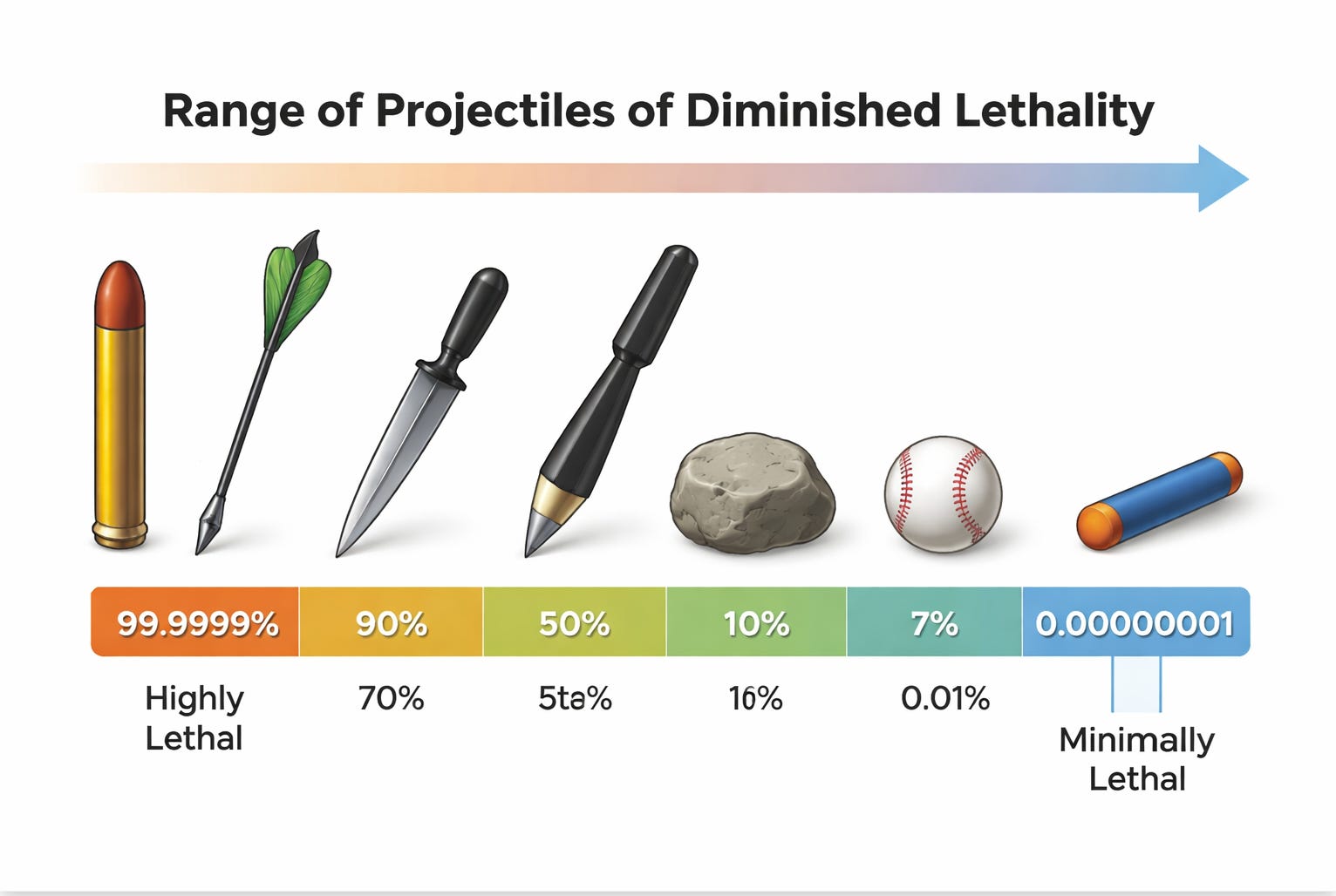
At what point does it become absolutely deontologically prohibited to fire the projectile to save many lives? There are three answers that the absolutist deontologist could give:
Any risk is impermissible.
Risks above some threshold (say, 40%) are impermissible. Perhaps the threshold is vague.
Only certainty of death is impermissible.
Note: absolutist deontologists generally make fine distinctions between different kinds of actions that lead to death. They often think, for example, that you can kill innocent people in a just war or redirect a threat to save more lives. In all of the cases I am imagining, stipulate that the imposition of risk is not done in one of these ways that would make it permissible to take an action that leads to a death for a greater good.
It’s easy to see why 1 can’t be right. All actions impose some risk on people. If you shot a nerf gun at someone, there is some chance that it would trigger a fatal allergic reaction and kill them. Nonetheless, obviously it is permissible to shoot a nerf gun at someone to save the world. Some people maybe don’t find this obvious if they adopt the non-aggression principle—but even they will hold that it’s permissible to shoot a nerf gun vaguely in someone’s direction to save the world. But the problem arises: at what point does risking aggressing upon someone become impermissible? How high does the risk of the nerf gun hitting them have to be to be impermissible?
3 can’t be right either. No action ever imposes a 100% risk of death on a person—if you shoot someone ten times in the head, there is always some risk that a miracle will happen, or the gun will jam, or they survive by huge improbability, or that they have some weird genetic defect where their head is ridiculously hard. So this would mean that absolutist deontology never absolutely rules out any acts in the real world. Additionally, the problem I’ll raise for the next view involving sequences of acts also applies to this view.
The only remaining option is 2—that you can impose some risk of death on people, but it can’t pass some threshold. E.g. maybe you can impose risks up to 40% on someone, but never more than 40%. But this has a number of big problems.
First, it is objectionably arbitrary. Why 40% rather than 39.9% or 27%? Where did this threshold come from? You could say that it’s vague, but wherever the threshold vaguely kicks in will seem equally arbitrary (e.g. you may say that it’s absolutely impermissible to impose a substantial risk of death on someone no matter how great the benefit is, but why substantial rather than enormous or near-certain or some other vague predicate?)
It also doesn’t seem like the fundamental normative facts can be vague. It can’t be that there’s no fact of the matter about whether an act is absolutely prohibited. Either it’s absolutely prohibited, so that you’re morally not permitted to do it, or it’s not. It can’t be vague! It can’t be that there’s no fact of the matter about whether an action is categorically morally banned. Vagueness is (on my preferred view) a matter of the imprecision of language and/or mental representation, not of reality.
Second, and more concerningly, this has the counterintuitive implication that sometimes you are permitted to do A, permitted to do B, but not permitted to do A and B together as one act. Suppose that there are two actions which both impose a 30% risk of death on someone (both involve firing a projectile at some person which has a 30% chance of killing them). Each one saves a million people when performed. Assume that they each impose a risk of death on a different person. For instance, the first one might fire a projectile that leads to a 30% risk of death at John and the next would fire a projectile that leads to a 30% risk of death at Steve.
Each action would individually be permissible. But if you bundled them together as one act, then they’d be impermissible, because they’d have a 51% chance of killing someone. However, surely whether an action is wrong doesn’t depend on whether it’s counted as one act or two.
We can illustrate this in another way: imagine that there are two buttons which each impose a 30% chance of death on someone and save a million lives. Surely it wouldn’t matter whether you press the buttons as one act or as two. Yet if you press them as one act, with one hand motion, they’d exceed the risk threshold. And note: saying the threshold is vague doesn’t help at all, because a sequence of acts can still exceed a vague threshold, without any individual act surpassing the vague threshold.
I can see four ways out of this dilemma, each lousy.
2.1 Lifetime tally
First, you can think that you are never permitted, over the course of your life, to take actions which impose a risk of death on someone above some threshold (at least, in the way that’s morally culpable). So, for instance, over the course of your life you’d never be allowed to impose a more than 40% chance of death on anyone no matter how great the benefits are from doing so. That way, you could say that the first action is permissible but the second one is impermissible. The first act doesn’t exceed the threshold, while the second one does in combination with the first. If you take both acts together, then you’ll have exceeded the threshold.
On this picture, you have a running tally of “risk of death imposed on the innocent.” That tally can’t exceed some threshold, barring specific circumstances, like deaths in a just war or from the redirection of a threat, no matter how great the benefits of exceeding the threshold are. The threshold could also be vague.
The big problem with this view is that it makes the permissibility of acts bizarrely sensitive to other unrelated acts. Suppose that I’m deciding whether to fire a projectile at an innocent person which has a 40% chance of killing them but will save a billion lives. On this view, it matters whether a million years in the past, I imposed risk of death on some other innocent person for the greater good. But that is bizarre—why would such a thing be? Whether an act is wrong depends on the people it affects, not on whether it runs up some risk tally! Ironically, this seems, in a deep way, to violate the separateness of persons.
And what if you’re already above the permissibility threshold? Is every act that imposes any risk on someone impermissible? Nuts!
The view has another strange result. Suppose two people are deciding whether to perform an act that would have the exact same effects. It seems either both should do it or neither should. On this view, however, it might be that one person is permitted to do it and the other isn’t, so as the act raises one person above the risk threshold. That is bizarre—it shouldn’t be that Bob gets to fire the projectile that imposes a 40% risk of death, but Steve doesn’t because he did something similar a million years in the past. The view has even more problems—I’ll explain one more in a footnote—but I think this is sufficient to rule it out.1
2.2 Person-relative thresholds
The second way out: you can think that it’s impermissible to impose a risk above some threshold on any particular person. So, on this picture, you’re not allowed to perform an action if it imposes odds of death on someone in an impermissible way above some threshold, no matter how great the benefits are. For the actions A and B, because they impose risks on different people, they don’t contribute to the same threshold. Thus, A and B together would be impermissible only if either A or B was impermissible.
This view still has a number of problems.
First of all, the dilemma arises again in cases where the actions impose risks on the same person. Suppose that there are two projectiles that you can fire at John, each of which will have a 30% chance of killing him but each save a million lives. Suppose additionally that it’s impermissible to impose more than a 40% chance of killing John. On this view, each projectile would be individually permissible to fire, but firing them together is impermissible.
To get around this, you can hold that there’s a running tally of the risk you imposed on John. Because the second one would elevate John’s total odds of death as a result of you to above 40%, it’s impermissible. However, this is a very odd feature—why would whether I’m permitted to impose a 30% chance of death on John, who is very much alive, depend on whether a previous action imposed a risk on him, yet didn’t end up harming him? We can even imagine that the act imposed risk on John several billion years in the past—surely that shouldn’t be determinative of the permissibility of acts that impose a risk on John today.
Then, the second big problem for this proposal is that it fundamentally violates the spirit of absolutist deontology. Absolutist deontologists hold that it’s absolutely impermissible to do wicked acts, not just to do things which ensure any particular person is victim of a wicked act. To see this, imagine that you can throw a razor boomerang through a festival full of babies. It will kill a baby, but the risk of death imposed on any particular baby is low. Doing so will save a million lives. Absolutist deontologists should hold that doing so would be impermissible. And yet on this proposal, it would be permissible, so long as the risk imposed on any particular baby is low.
Note: any view that implies that throwing the boomerang through the baby festival is impermissible to save a trillion lives will have a problem with risk. Throwing a boomerang that imposes a tiny risk on a single baby to save a million lives is clearly permissible, if the risk is low enough—but if you multiply that, then you get the boomerang festival case. So any view that holds that throwing the boomerang through the festival will have problems with implying that taking sequences of permissible acts as one act is impermissible.
A third problem: the view requires bizarre individuation of people. Suppose I perform two acts, each of which have a 30% chance of killing someone (a different person each time). Each act saves a million people. Suppose the relevant risk threshold is 40%. Now, on the one hand, it might be thought that my sequence of acts is permissible. But now suppose that if my act harms one of the two people, it harms whoever is taller (so, for instance, each act might impose a 60% risk of death on the person if they’re the taller of the group). Additionally, let Tallee refer to whichever person is taller. Well, now my act has a 51% chance of harming Tallee.
Now, maybe you object that Tallee is not a person but instead just whoever has some property. What matters is whether there’s some specific person that you can point to who an action imposes a more than 40% risk of death upon. But this has more problems:
This “pointing to” notion is vague. Does it require that you can see the person? What if you can only see them partially? What if, to borrow a memorable example from Caspar Hare, you can only see their fleshy ear? What if you additionally know that the taller person was called Tallee as a young child? Any time you know a person, what you really have learned is a number of properties about them—so knowing Tallee as the possessor of the property of being the taller of the two is only different from ordinary knowledge of people in degree, not of kind. And any threshold will be arbitrary.
This makes actions counterintuitively sensitive to states of knowledge. Suppose that you will, in the above scenario, later learn which of the people is the taller one. Surely that shouldn’t change whether the act is permissible. But on this view, now that there’s some identifiable victim, it will have exceeded the risk threshold that you can impose on a known person. This has the strange result that there is moral reason to prevent yourself from learning anything about the potential victims of your acts, so that they don’t thereby become impermissible. It also violates Pareto.2
This violates the spirit of absolutist deontology. Absolutist deontologists should hold it’s impermissible to kill, even if you don’t know anything about the people you’re killing. Imagine a blind person can shoot into an unknown crowd to save a million people. Absolutist deontologists should hold that that action would be wrong. But in this case, the blind person can’t identify any of the victims, so they don’t know who they’ll be harming.
Similarly, you get the same problem I highlighted in the previous footnote—where the proposal fails whether you use subjective or objective risk, plus the other problem in cases where you’ve already exceeded the probability threshold.
2.3 Knowledge
A third way out is to say that it’s impermissible to take acts that you know will kill someone. Knowledge, on this view, isn’t a matter of exceeding some quantitative threshold. Even if the odds I’ll win the lottery are lower than the odds that there’s no oat milk in my fridge, I might know that I have oat milk in my fridge without knowing that I won’t win the lottery. But this doesn’t help much.
First of all, there can be cases where you don’t know A, you don’t know B, but you know A or B. So, suppose that there are two acts. The first has a 50% chance of killing someone. The second one kills someone if the first one didn’t. You don’t know either kills someone, but you know they together kill someone. So problem with combining acts arises once more. This is also why the agglomeration problem arises for views that say there is only a categorical prohibition on imposing certain death on someone.
We can see this more vividly. Imagine that every day, you throw a razor boomerang with a 30% chance of killing someone, that saves a million lives. You don’t know, on any particular day, that you’ve killed someone. Nevertheless, you know that you will kill someone at some point over the course of your life.
Second, if this divorces knowledge from probability, then it delivers the result that actions that impose lower risks can be harder to justify than ones that impose higher risks. Suppose there is a 99% chance that there’s oat milk in my fridge (I just saw it) and a 99.99% chance that I won’t win the lottery. Suppose that nonetheless I know there’s oat milk in my fridge, but don’t know I won’t win the lottery. On this view, I am permitted to take an action that will kill someone if I don’t win the lottery to save many lives, but not permitted to take an action that will kill someone if I don’t have oat milk in my fridge to save many lives. But the first is strictly worse than the second, imposing a higher risk of death! If the view doesn’t divorce knowledge from probability, then it doesn’t help with the core challenge.
2.4 Individuation matters
A fourth way out is to bite the bullet and say that individuation of acts matters intrinsically. So, if acts A and B each impose a 30% risk of death on someone, they are impermissible if bundled as one act, while permissible if counted as two. Serious problems remain.
First, it’s not at all obvious that there are facts of the matter about whether acts count as one act or two. Is two button presses done in one continuous motion one act or is it two acts? It doesn’t seem like the moral law should make these fine-grained distinctions.
Second, even if there are facts about this sort of thing, it doesn’t seem like they’re morally relevant. It doesn’t seem to matter whether two acts are performed as one or done as two. If there are two buttons which each impose a risk of death on someone, it shouldn’t matter whether you press it in one continuous motion or two separate motions. It shouldn’t matter whether you fire two projectiles with one finger motion or with two.
Third, assigning some moral importance to whether two acts are counted as one produces weird Pareto violations. Suppose that it’s impermissible to impose risks of death on people above 40%. Now suppose that there are two ways to save a million people:
Press one button that saves 500,000 of them while imposing a 30% risk of death on someone, and then press another button that saves 500,000 of them while imposing a 30% risk of death on someone.
Press a single button that imposes a 40% risk of death on the person, and it saves all million people, plus an extra billion.
A view that cares about how acts are individuated—whether two are counted as one—counts the first as permissible but the second as impermissible. But this is bizarre—the second is better for many people, including the potential victim, and worse for no one.3
2.5 Conclusion
Note: any solution for the absolutist to the problem of risk will inevitably look like one of the proposals I gave. To see this, the paradox arises for the absolutist from the following contradictory affirmations (where A and B are risky acts that collectively but not individually exceed the risk threshold):
It is permissible to take some action A which imposes a risk of death below the threshold on a person to save many lives.
It is permissible to take another action B which imposes a risk of death below the threshold on a person to save many lives.
Taking two permissible acts together as one act is permissible.
Taken together as one act, actions A and B are above the threshold at which one can impose risks, and thus impermissible.
1-2 establish that A and B are each permissible, by 3, then, A&B together as one act would be permissible, but by 4 it’s not. Non-absolutists avoid this puzzle because they reject 4. If you reject 1, then you’ll get the result that it’s never okay to impose risks on people.4 If you reject 2, then you’ll think that B’s permissibility depends on whether A was done before. If you reject 3, then you think that how acts are divided up determines their permissibility. And if you reject 4, then you must either hold something like the view discussed in section 2.2 or reject absolutism.
3 Spectrum
Imagine the only way to save a million people is to fire a projectile at someone that has a one in a billion chance of killing them. This seems permissible—even required. You should shoot a nerf gun at someone to save the world, even though there’s some chance it will kill them.
But now imagine another action which has odds of two in a billion of killing them, which would save the million original people plus an extra million. Surely that is better. And a third action that would save a million extra people, while elevating risk of death to three in a billion (a slightly more dangerous projectile than a nerf gun) is even better. But if one continues down this process, one ends up with the result that shooting a gun at someone to save a very large population of people is permissible.
To avoid this, one must think there’s some threshold at which it stops being permissible to perform the act, even though the immediately prior point was permissible. But this would be bizarre! If you can impose a 19.9999% chance of death on someone by firing a slightly dangerous projectile, in order to save a billion people, then surely you can impose a 20% chance of death by firing a projectile that will save googolplex people. The second action is an improvement on the first—just a tiny bit of extra risk for a massive improvement.
And note: the spectrum doesn’t just arise with risk. Similar points arise with amount of time lost. It is permissible to shorten a person’s life by a single second to save a million people. But then surely it is permissible to shorten a person’s life by two seconds to save a billion people, and by three seconds to save a trillion, and so on. But at the end of this process, you’ve shortened their life by so many seconds that it’s brought about instant death in order to save a large number of people.
Now you might wonder: isn’t this just a Sorites argument (I’ll explain what this means in a footnote if you don’t know)?5 After all, aren’t we trying to identify the precise point where things shade from permissible to impermissible? Isn’t this like trying to identify when taking away a grain of sand makes something go from a heap to not a heap? No!
The Sorites paradox arises from the vagaries of language. The fundamental normative facts aren’t about language. Impermissibility, as already described, doesn’t seem to be vague. While things can intuitively be vaguely a heap, or sort of a heap, things can’t be vaguely permissible.
With the Sorites paradox, each time you take away a grain, it seems like the thing is getting less heap-like. Of the properties that make something a heap, it has fewer of those properties each time you take away a grain of sand. The puzzle concerns when it becoming less heap-like causes it to stop being a heap. This isn’t similar: at each step of the way, it seems the action is getting better! Each time it saves a million extra people. Formulated more precisely, the argument claims 1) the initial action which imposes slight risk of death to save a million people is permissible; and 2) each action in the sequence is better than the one before it, so the end action is permissible too. That’s not like the Sorites paradox, where the piles of sand are getting less heapy each time.
If you go through all the solutions to the Sorites paradox—epistemicism, supervaluationism, nihilism—none of them provide a natural solution to this worry that doesn’t require biting bullets.
4 An intuition pump
I don’t consider this argument as forceful as the others, but it’s helpful for drawing out the core intuition:
The fact that an action would save someone’s life gives you a reason to perform it.
If 1. then you have infinitely strong reason to perform an act that would save infinite lives.
The strength of your reason not to kill someone is only finite.
If you have infinitely strong reasons to perform an act and finitely strong reasons not to perform it, you ought to perform it.
Therefore, you should kill someone to save infinite lives.
You might try to reject 2 on grounds that there can be infinite sums of positive reasons that are only finitely weighty. For example, you have reason to extend a person’s life by a year, and other reason to extend a life by half a year, and by a quarter, and so on, but you don’t have infinitely strong reason to take this full infinite sequence of acts—that only adds two years collectively. But in that case, each action is less valuable than the rest, and the value of the acts asymptotically approach zero. Not so for saving lives.
The other premise to reject is 3. But a few things can be said in favor of 3:
I think 3 is pretty intuitive. Naturally it seems that killing someone is very bad, but it doesn’t give you infinitely weighty reasons not to do it!
If some action might be one you have infinitely strong reasons to avoid, then you should never risk it. But any time you step out of the house, there is some tiny chance that you will have some bizarre motivational shift and go on a killing spree. Notice that if there were a day during which if you killed anyone, this would cause infinite babies to be tortured, then it really would make sense to never interact with people on that day. On the absolutist picture, your reasons not to kill are similar.
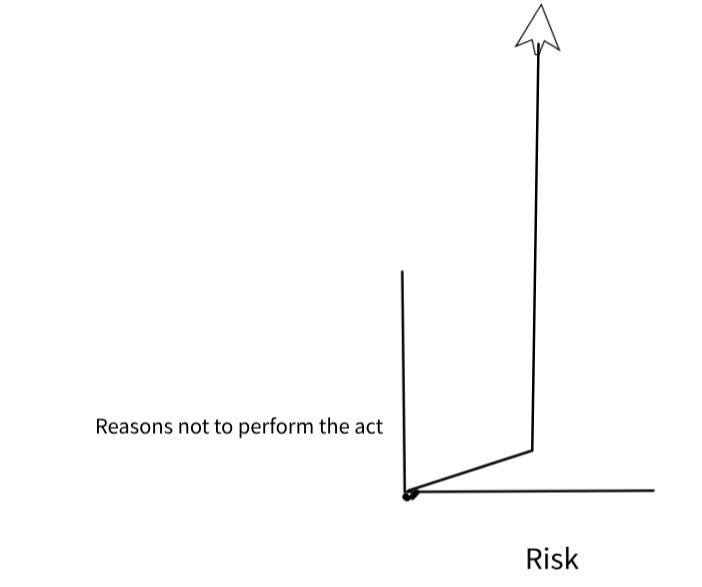
Suppose we’re looking at the strength of your reasons not to impose risk on someone. On this view, the graph will unnaturally spike to infinity.
5 Conclusion
Deontology writ large has a number of serious problems. I think it is very likely to be false. But moderate deontology, at least, has some hope. Absolutist deontology, in contrast, is, in my view, a complete non-starter. The objections—especially the second and third objections I raised—strike me as decisive. If you’re going to be a deontologist, be a moderate, enlightened centrist deontologist!
Another problem is construing what kind of risk the threshold is in terms of. Presumably it will either be subjective risk or objective risk. Subjective risk refers to how likely the decision-maker thought it was that an action would harm someone, while objective risk refers to how likely it actually is that the action would harm someone. Both have huge problems.
Suppose it’s subjective risk. Well, then that implies that if the decision-maker thought they were imposing a risk on someone in the deep past, that contributes to the threshold. But this is bizarre. If someone gave you a drug so that you reasonably thought turning on your lightswitch had a 30% chance of killing someone, that would not affect whether you should fire a projectile that risked someone’s death to save a million lives!
Suppose it’s objective risk. The problem is you don’t generally know objective risks. So this would imply that whether it’s permissible to risk harming someone depends on causally-isolated facts that you don’t know. But how can what you’re supposed to do, in light of your evidence, depend on things that aren’t part of your evidence? This also might imply, if the objective risks really are low, but you don’t know that, that you are permitted to take an action that for all you know has a 99.9999% chance of killing an innocent person.
What if it’s subjective risk that gets overridden if you learn objective risks? So, for instance, suppose you thought that an action had a 10% chance of killing someone but later learn that it really had a 40% chance of killing them, then you’d replace the amount contributing to the threshold from 10% to 40%? But on this view, you would treat wildly differently the contribution risk of the following two cases:
An action leads to a coin being flipped, and if it comes up heads, someone dies.
An action kills someone if the millionth digit of pi is even.
Because, assuming the millionth digit of pi isn’t even, the second one had a zero percent objective probability of killing someone, it would be treated differently in the calculus. It also isn’t clear that actions do have precise objective probabilities of killing people, as that depends on the reference class from which you’re counting objective probabilities. So, for instance, if you throw a sharp boomerang in someone’s direction and miss, is the relevant reference class total boomerang throws or missed boomerang throws?
Imagine that you currently, in the above scenario, know nothing about who the taller person is. However, in one hour, you will learn many things about them. Right now, you have the option to kill them painfully to save a million lives. In an hour, you’ll have the option to kill them painlessly to save a million lives. On this view, killing them in an hour will be impermissible (once you know who they are). That means you must kill them now, even though it would be strictly better for them if you killed them later. Now, there are many ways to try to wriggle out of this result, but Kacper Kowalczyk persuasively argues that none of them work.
Now, in theory, you could think that option 2 becomes permissible only if option 1 is present because it’s an upgrade over option 1. But this is an odd situation. Impermissible acts shouldn’t be improvements over permissible act sequences. Similarly, this runs afoul of the following principle: if there are two acts and one is individually impermissible, then if choosing between them, you should pick the permissible one. Additionally, this will still have the result that the first sequence considered on its own is permissible while the second is impermissible, even though the second seems obviously better than the first.
If it is okay to impose risks on people, then can cobble together a number of acts at the acceptable risk level until they exceed the threshold.
The Sorites paradox arises from the conflict between the following obvious-seeming principles:
A single grain of sand is not a heap.
A pile of a billion grains of sand is a heap.
Taking away a single grain of sand never causes something to go from a heap to a non-heap.
Do you think utilitarianism has any problems with vagueness or arbitrariness?
I agree it feels arbitrary to say the absolute prohibitions kick in at (eg) 40%, and I agree it feels weird to say that the threshold is vague. But I feel the same about saying that precisely n shrimp lives outweigh mine (or that the threshold is vague).
Really enjoyed the post btw.
Should've used this in debate class.