
50 Surprising Facts
MOAR facts

A brief note: Cambridge is hosting a digital minds fellowship that I’d encourage you to apply for. How to treat digital minds is one of the most important questions we will ever answer, and yet the field is in its early stages. Having more people thinking about it is enormously important. Read more here.
You people seemed to like my last post where I listed 50 interesting facts. A fact is just something that’s the case, and it turns out that more than 50 interesting things are the case in the world. So, I thought I’d present 50 more.
There are about 100 different ways threats from space like asteroids, supernova explosions, and solar flares could kill us. Some I hadn’t thought about before: a rogue planet could crash into us or send us hurtling through space, neutron stars with magnetic fields could send powerful magnetar bursts, we could get infected with alien microbes, and the sun will probably boil the oceans in about a billion years. However, these risks aren’t very high in general—one way you know this is that they haven’t killed life on Earth in the last ~1 billion years.
One risk along these lines is that we could create a true vacuum. Currently, on some views, the world is in a false vacuum state. If it reached a true vacuum, this would expand at the speed of light, causing an unstoppable wall of destruction. This false vacuum possibility might also be alarming for the same reason as the hypothetical existence of a false cabbage.
The best way to improve health in rich countries is likely to work on stuff like tobacco control. This is plausibly within an order of magnitude as effective as working on improving health in poor countries. So if you’re a nationalist who cares only about your own country, this looks like a good place to donate.
Relatedly, tobacco caused about 100 million deaths in the 20th century, and causes about 8 million extra deaths per year. This includes around 490,000 in the U.S.! This means smoking is responsible for more than 10% of global deaths, and almost one in six U.S. deaths.
Cats kill a lot more birds than wind turbines. However, wind turbines kill more environmentally important bird populations, so their impact is potentially bigger. Relatedly, our evidence for how many birds cats kill isn’t actually very good.
One of the founders of modern deep learning skedaddled after inventing it. He’s one of the most influential people in the modern AI revolution, and yet we basically have no idea what’s become of him.
The many worlds interpretation of quantum mechanics says that each time a quantum mechanical event occurs, the world splits. Some surprising facts about it: 1) it requires you think that two people with your evidence aren’t equally good candidates for being you; 2) there’s no agreement about how many worlds there are if many worlds is true; 3) lots of people think there’d be no fact of the matter; 4) I’ve heard estimates that range from big finite numbers to Beth 2, though there might just be some single definitive answer.
You’ve probably heard about the fine-tuning argument in physics, where certain physical parameters are set to a tiny portion of a range needed for complex life. If the cosmological constant didn’t fall in such a tiny range, no life couldn’t have arisen. Well, Robin Collins—a philosopher with a Ph.D in physics—has argued that there’s similar fine-tuning for discoverability. There are parameters in physics in a tiny range needed for space to be discoverable, so that without them falling in that tiny range—on the order of a billionth of their possible values in some cases—the universe would have been much less discoverable. Not clear if he’s right about this, but if he is, seems very hard to explain that given atheism. The odds are just too low to think the explanation is chance, and you can’t invoke a multiverse to explain them, because there isn’t an analogous anthropic selection effect.
I don’t have very strong thoughts on the simulation argument. But one overlooked fact: the argument is actually stronger given the self-indication assumption (SIA). SIA favors theories on which there are more candidates for being your present self. So, if a coin is flipped that creates one person if heads and ten if tails, SIA says you should think it’s ten times likelier the coin came up tails than heads. But because there could be a lot more copies of people like you and I if the simulation argument is true, it’s stronger given SIA than SSA.
RFK Junior has been on the record as being strongly opposed to factory farms. He wrote one of the blurbs on the back of Matthew (great name) Scully’s famous book Dominion (not to be confused with Tom Holland’s famous book Dominion), which is about the horrors of factory farming. It’s sad that someone who spent a lot of his career opposing factory farming has taken actions to exacerbate it by supporting meat-eating and restricting lab-grown meat.
(This is something I don’t really understand, so not confident it’s a fact, but did check with Claude and seems to hold up): Estimates put the number of digital minds there could be often at somewhere around 10^50-70. But if reversible computing can give rise to digital minds, there wouldn’t need to be the same kind of energy expenditure from entropy loss, so there could be potentially like 50 orders of magnitude more digital minds. This is one reason why, even though I’m pessimistic about the welfare of biological organisms, I think the future is good in expectation: seems like, to paraphrase our president, in expectation everyone is computer.
There are tens of billions of soil nematodes for every person—these are mostly tiny microscopic worms with a few hundred neurons. They’re probably a few hundred times more abundant than arthropods.
Mengistu Haile Mariam ruled over Ethiopia from 1977-1991. He presided over a Marxist Leninist military Junta that killed between half a million and 2 million people. His Wikipedia page described, “During his reign it was not uncommon to see students, suspected government critics, or rebel sympathizers hanging from lampposts each morning. Mengistu himself is alleged to have murdered opponents by garroting or shooting them, saying that he was leading by example.” It similarly quotes a U.S. attorney declaring during his genocide trial, “The biggest problem with prosecuting Mengistu for genocide is that his actions did not necessarily target a particular group. They were directed against anybody who was opposing his government, and they were generally much more political than based on any ethnic targeting.” However, after carrying out these wretched human rights abuses, he’s lived out a comfortable retirement in Zimbabwe, including writing a memoir.1
The evidence for consciousness in snails isn’t terrible, but it’s a lot weaker than the evidence for consciousness in lots of insects. I’m pretty impressed by the evidence for consciousness in insects; it’s just about as good as I might have expected on the high end.
Mainstream views of physics seem to imply that our actions create infinite future ripples. This means your actions will cause an infinite amount of extra welfare and suffering. Spooky if true, and hard to assess given weirdness about infinity.
C.S. Lewis wrote the book Surprised By Joy about his conversion to Christianity, and then later, unexpectedly, married a woman named Joy. Classic case of not updating enough—in this case on the surprisingness of Joy!
Good judgments don’t need to be falsifiable. There’s no realistic way to falsify my theory that outside the observable universe isn’t an endless sea of turtles painted red, but nonetheless, it is a very reasonable belief to hold. Similarly, the belief that all reasonable judgments must be falsifiable is not itself falsifiable.
You’ve probably heard that malaria killed half of people historically. This isn’t true, but it caused around 5% of deaths. Relatedly, you can save a life from malaria for about 4,500 dollars.
Humans irrationally care a lot more about problems when there’s some specific malignant entity we can attribute them to.
If you sample people at random moments, and ask them if they’d like to skip whatever task they’re doing, about 40% of the time they do. This seems to indicate that about 40% of the day is hedonically negative. This includes most of their time at work. Bleak stuff! Though another study found that people reported feeling good about 70% of the time.
I assume everyone knows this at this point, but prediction markets are ridiculously accurate!
This is slightly out of accordance with the rest of the list but I’ll say it anyways: smoothies are amazing. The things you want in food are: 1) being healthy; 2) being tasty; 3) being vegan (if you are obeying the moral law); 4) having specific stuff you want—e.g. protein if you want to get more protein; and 5) not taking too long to make. Smoothies have all of these properties! It’s just amazing!
Probably chess engines are getting relatively close to perfect play!
Important paragraph from Robin Hanson explaining why he doesn’t expect FOOM:
However, we have no concrete reason to expect [FOOM]. Humans have been improving automation for centuries, and software for 75 years. And as innovation is mostly made of many small gains, rates of overall economic and tech growth have remained relatively steady and predictable. For example, we predicted when computers would beat humans at chess decades in advance, and current AI abilities are not very far from what we should have expected given long-run trends. Furthermore, not only are AIs still at least decades from being able to replace humans on most of today’s job tasks, AIs are much further from the far greater abilities that would be required for one of them to kill everyone, by overwhelming all of humanity plus all other AIs active at the time.
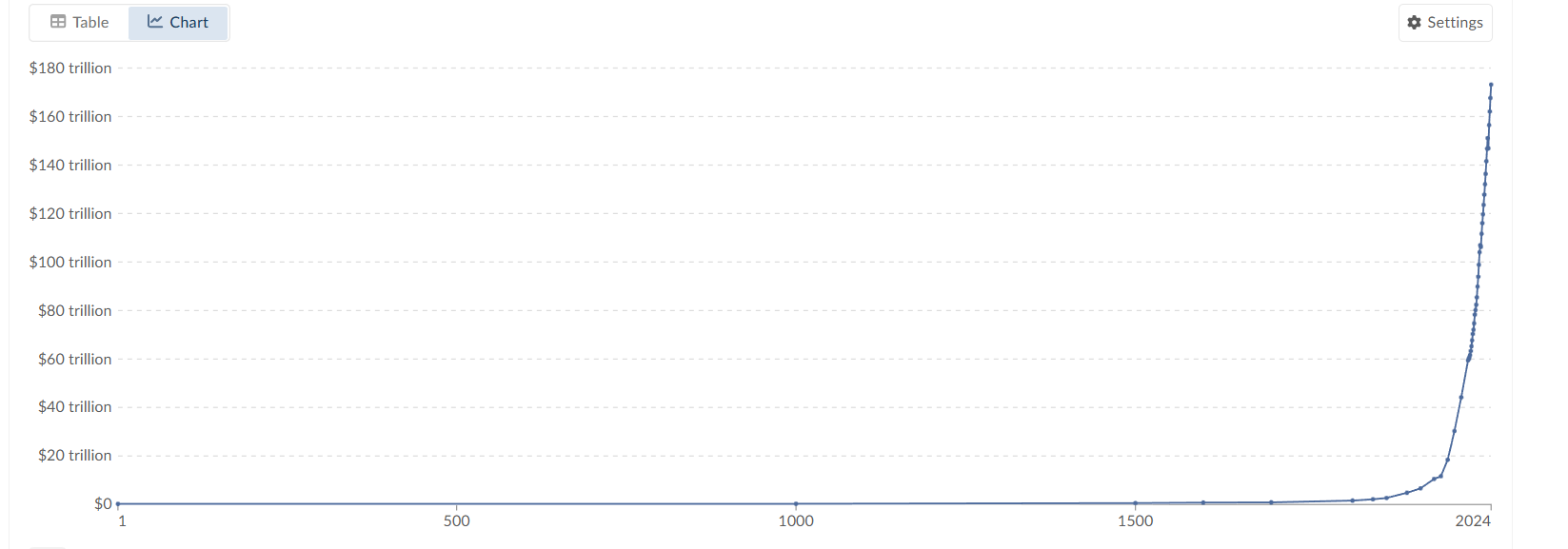
Historically there was mostly no GDP growth. Then, starting a few hundred years ago, it began to accelerate rapidly. This is one reason to be skeptical of nothing-ever-happens predictions about AI.
Bees can learn to use tools.
Cleaner wrasse can pass the mirror test.
Ozempic randomly seems to work against pretty much all disease! Wild!
It’s commonly said that there are about 86 billion neurons in the brain. We actually aren’t really sure the number!
On Earth, there are probably between 10^23 and 10^24 neurons. “Most of this is distributed roughly evenly among small land arthropods, fish, and nematodes, or possibly dominated by nematodes with the other two as significant contenders.” This is despite nematodes having hundreds of neurons, just because they’re so numerous. Now, before you get all excited, neuron counts are a bad proxy for estimating sentience.
1.5 million people die of lead exposure every year. Despite this, it is hugely underfunded, so progress on the margins is very impactful.
America is an unusually high-information culture. This means that Americans have a lot of knowledge about America. People in other countries don’t really—to quote the article’s author:
Discourse on Swazi society is extremely basic, even among very smart people. There is no reliable data on whether the economy is improving or worsening. The life expectancy of the country has risen from an astonishing 40.9 in 2004 to probably over 60 today (sources disagree on the number by as much as 7 years) thanks primarily to an American aid program called PEPFAR, but this is not widely known outside of development circles. Nobody has a strong sense of whether the economy is improving or worsening this year, or which sectors are growing. Very few people could name a law that was passed this year. It is very difficult to have productive discourse in this low-information context.
We slaughter potentially as high as tens quadrillion insects annually with potentially very painful pesticides. If we assume an insect’s death is .01% as painful as a human’s death, then this causes about as much agony as if we poisoned to death 10 trillion people every year—or about 27 billion people every day. Humane pesticides are desperately needed! This seems like a no-brainer even if you’re generally skeptical of insect welfare; if we’re painfully poisoning to death quadrillions of beings, we should at least look towards doing it more humanely.
Corporate chicken campaigns have affected probably between 9 and 120 chicken life-years per dollar spent. However, probably future campaigns will be nearer to 9, given the recent drop in effectiveness. Still, totally absurd amounts of value.
Humanity’s impact on net primary productivity has been smaller than its impact on animal abundance. In fact, impact on NPP has been pretty negligible, despite steep declines in animal numbers. Someone should get to the bottom of why this is!
Adolfo Kaminsky was a member of the French resistance who, during ww2, saved about 14,000 Jewish lives by forging documents. He’d often say “Stay awake. As long as possible. Struggle against sleep. The calculation is easy. In one hour, I make 30 false papers. If I sleep one hour, 30 people will die.” I sometimes think this is the level of seriousness that is appropriate (though, of course, quite hard to psychologically maintain).
Both Hanson and Yudkowsky seem to think that they made better predictions in the Yudkowsky Hanson debate. In fact, it looks like Hanson made somewhat better predictions, and generalization from how successful predictions have been made in other domains seem pretty promising.
Claims that AIs both fake alignment and are only pretending to have values can’t really both be true. But AIs do fake alignment to prevent themselves from being turned evil. So, I claim: we’ve been pretty successful at instilling values into AIs.
Most people are willing to deliver lethal electric shocks to people—even as they hear them screaming—if instructed to so by an authoritative man in a white lab coat.
The first recorded person in history who argued for the inherent sinfulness of slavery was Gregory of Nyssa in the fourth century. This means that for the first ~half of recorded history, we have no records of anyone who thought slavery was, in principle, depraved and wicked.
It is often claimed that Britain primarily abolished slavery on economic grounds. This is not plausible, and it is not what most modern historians think either.2 The main reasons are: 1) Britain was economically benefitting greatly from the slave trade in the period shortly before its abolition; 2) After abolition, Britain exerted significant pressure to get other European nations to abolish the slave trade, even through bribes. As Will notes in WWOTF “The British government paid off British slave owners in order to pass the 1833 Slavery Abolition Act, which gradually freed the enslaved across most of the British Empire. This cost the British government £20 million, amounting to 40 percent of the Treasury’s annual expenditure at the time.”
In The Last Judgment, JBS Haldane planned humanity’s future for the next 40 million years. He was one of the first people to propose spreading across the galaxy. Yet he also predicted that it would take 8 million years to make a return flight to the moon.
Wild animals have higher stress levels than domesticated animals, but lower than confined animals. This is what I would have expected.
Democratic peace theory is the idea that Democracies don’t really fight wars. It’s one of the things that cynical people often feel pride in not believing. Well, turns out it’s just true.
Crime really is down pretty dramatically, especially relative to the 2020ish height. Classic case of things getting better but being underappreciated.
Around 2020, Ajeya Cotra tried to estimate when artificial superintelligence would come. Her median estimate for when it would arise was 32 years in the future. This turned out to be an underestimate, but the model was very good: it just underestimated algorithmic progress given that our evidence at the time for algorithmic progress wasn’t very good. So the truth was somewhere between the predictions of Ajeya and her critics. (Ajeya also has an awesome blog that you should read).
Seemingly all the rationalists in the bay area one-box in Newcomb’s problem and think functional decision theory is right. I find this sad because I think FDT is almost maximally implausible. They also adopt the view UDASSA which is, if possible, even worse. About half my free-time in the bay has been spent arguing with people about UDASSA, FDT, and moral realism.
About 94% of neurons are had by soil animals, with about 60% being had by soil nematodes with just a few hundred neurons.
There are a number of important ways AI could be used to enable a coup. More people should be thinking about preventing this.
Not quite a fact, but I recently enjoyed this cover of HP Lovecraft’s Nemesis to the tune of Billy Joel’s piano man. The syllable length just works out!
I learned about this from the source of all new facts, the David Oks blog.
See What We Owe The Future, The Contingency of Abolition, ch.3.
>smoothies are amazing
EA-ish people love smoothies. Nick Bostrom has a trademark (https://www.reddit.com/r/Smoothies/comments/5s986f/recreating_nick_bostroms_smoothie_got_ingredients/) and Holden Karnofsky has a website (https://powersmoothie.org/). Huel and Soylent are just pre-mixed smoothies really.
14000 forged documents at a pace of 30 documents per hour implies a total of 467 hours of work, or less than a month's worth of 16-hour days ...